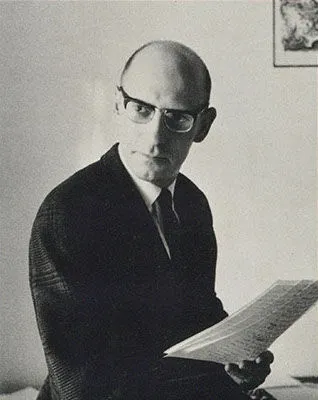
Michel Foucault
Human Design Chart
Biography
Born in Poitiers, France, into an upper-middle-class family, Foucault was educated at the Lycée Henri-IV, at the École Normale Supérieure, where he developed an interest in philosophy and came under the influence of his tutors Jean Hyppolite and Louis Althusser, and at the University of Paris (Sorbonne), where he earned degrees in philosophy and psychology.
What does Generator 1/3 mean for Michel Foucault?
Generator 1/3 — Design at a Glance
Michel Foucault's Human Design suggests a tendency towards extreme endurance and inner drive when pursuing tasks that truly matter to him. As a Generator, he had a lot of sacral energy, making him seem like a strong workhorse – powerful and steady when burning for his goals. However, this configuration also described two specific pitfalls: First, the risk of burnout through activities without internal enthusiasm, where energy was wasted. Second, the frustrating feeling of being held back from his heart project despite still having full power.
The mechanics of his design required a clear strategy: Not initiating but responding. His energy became free primarily when he answered impulses from life. The motto was to act „from the gut“ – waiting until the sacral center gave a clear „Yes!“, and then reacting with action. If Michel Foucault lived in harmony with this response, he was rewarded with deep satisfaction and a sense of fulfillment. However, if he constantly tried to initiate himself or ignored his design signals, sooner or later he faced persistent frustration as well as a noticeable lack of energy. His path lay in waiting for life signals and then reacting with full force.
Sacral Authority
Michel Foucault's Human Design suggests an inclination towards intuitive, body-based decision-making. As a Generator, his strategy – waiting for the right answer – was identical to his inner authority: sacral authority. This configuration simplified his process as he did not have to switch between strategic action and internal guidance. His inner voice showed itself as a direct reaction to external stimuli, often felt as a surge of energy or an involuntary sound like a grunt or hmm.
This mechanism presupposed an open emotional center, meaning that he had no immediate emotional security but had to learn to trust these physical signals. When his sacral motor kicked in, Michel Foucault felt vital and alive; he seemed to have inexhaustible energy and tackled tasks with great enthusiasm. He was born to perform activities without aimlessness and immerse himself in them, which brought him joy and satisfaction.
Furthermore, his activated spleen center acted as a supportive instance for sacral authority. This gave him the ability to react especially quickly and spontaneously. He had immediate access to his physical well-being and instinctive perception. This combination allowed Michel Foucault to make decisions not only based on inner drive but also based on a reliable, quick instinct check that considered his physical welfare and intuitive security.
The 1/3 Profile — Investigator / Martyr
Michel Foucault's Human Design suggests a basic stance as a researcher and experimenter. His Profile 1/3 combined the need for thorough knowledge with the necessity of practical testing. Line 1 ensured intense engagement with details, continuity, and process preservation. In this way, a sharp instinct developed to handle changes carefully. At the same time, Line 3 drove him towards experimentation. It stood for trial and error as well as the readiness to accept mistakes as an integral part of the learning process. Through this combination, Michel Foucault tested topics both theoretically and practically down to their core. Only through this double approach – first careful information gathering, then bold testing and triggering unusual discoveries – did self-earned insights emerge for him. When his judgment fell, it was based on this rigorous examination. The tension between the fear of insufficient knowledge (Line 1) and the urge to simply act and learn from mistakes (Line 3) shaped his work significantly. He learned through doing and analyzing what happened rather than just passive observation.
Split Definition — Defined & Open Centers
Michel Foucault revealed himself as someone with a fixed, reliable self-identity and a clear sense of direction in life. His defined G Center gave him this inner orientation that allowed him to show others new perspectives without needing their approval. This firm identity was strengthened by his defined Heart Center, which gave him willpower and the ability to use his resources autonomously. He enjoyed working according to his own internal mechanisms, which helped him find a balance between effort and rest.
As a Generator with a defined Sacral Center, Michel Foucault had an enormous source of vital energy. His strategy was not to initiate but to wait for life and then react correctly to experience satisfaction. This sacral power was complemented by his defined Spleen Center, which gave him strong body awareness and intuition for the "now." He could make spontaneous judgments and relied on trusting these instinctive warning signals to stay healthy and protected. His defined Root Center provided the necessary pressure to move forward in the world and master existential challenges.
At the same time, Michel Foucault was marked by several open centers. His open Head Center meant that he did not have a consistent way of processing mental information; he tended to engage with questions that were not his own and sought inspiration from outside. The open Ajna Center allowed him a flexible mind that was open to intellectual stimulation but also vulnerable to interpreting the concepts of others as his own truth. His open Throat Center led to inconsistent communication; he had to wait for invitations to speak effectively rather than actively seeking attention. Finally, his open Solar Plexus absorbed the emotions of his environment, making him vulnerable to emotional conditioning and difficult to distinguish between his own feelings and those of others.
Channels for pioneering spirit, ambition and natural maturation.
Michel Foucault's design laid a tendency towards competitive forward movement, coupled with the drive to improve social positions through constant effort. This dynamic was concretely expressed in the Initiation Channel 51-25: Here, the egoistic energy of shock (Gate 51) combined with universal love and higher self (Gate 25). This created a mutative force that pushed individuals towards individualization through initiation shocks – a process that had to be lived authentically rather than controlled.
Parallel to this, the Transformation Channel 54-32 was at work: Ambition (Gate 54) drove constant effort, motivated by the Spleen perception of talent and continuity (Gate 32). This promoted rising out of the birth layer, always dependent on tribal support and exchange of loyalty for recognition.
Additionally, the Maturation Channel 53-42 shaped his experience: New cycles were begun (Gate 53) and went through a process to completion (Gate 42), from which wisdom was gained. Each experience had to be fully run through and reflected upon before starting a new cycle; expectations were avoided as a source of frustration in favor of pure dedication to the process.
Individual Gates complemented this picture: Gate 62 provided logical pattern recognition and fact clarification, while Gate 61 sought inner truth and silence. Gate 38 set boundaries for defending integrity, Gate 60 accepted limitations as prerequisites for transcendence. Awareness (Gate 44) and deep pattern recognition (Gate 48) supported the analysis of complex interconnections. Openness to new directions (Gate 2), collective memory (Gate 13), and persistent saying yes (Gate 29) rounded out the profile, complemented by corrective instincts (Gate 18), leadership impulses (Gate 7), and provocative mutative pressure (Gate 39).
Individual Circuitry — Circuit Signature
Michel Foucault revealed himself through his design as someone who possessed a deep inner firmness and individuality that was not primarily communicated outwardly. The Centering Circuit in him connected the Identity Center with the Heart Center via the Initiation Channel. This created a pulsating energy of self-worth and personal convictions, which strongly appeared individualistic. Since there was no connection to the Throat Center, these firm inner stances often remained unspoken; they strengthened the individual in their uniqueness without loudly proclaiming it.
Parallel to this, two more separate circuits were at work. The Meaning Circuit connected the Sacral with the Root Center via the Maturation Channel. Here, emotional waves and experiences from the past were processed to draw collectively meaningful insights. This cyclical energy stood in contrast to the third component: the Ego Circuit. This connected Spleen and Root Centers through the Transformation Channel. As part of tribal energy, this focused on cooperation, giving and taking, and the joint creation of resources. Since there was no direct connection to the Sacral Center here either, pauses were necessary to regenerate these supportive forces.
Michel Foucault's design was marked by a split definition. The groups – on one hand G- and Heart Centers, on the other Spleen, Root, and Sacral – did not form a cohesive unit but existed as parallel, independent fields of power alongside each other. This resulted in a personality that was strongly anchored individually while carrying different aspects of social interaction and past experience separately, yet not integrated.
Right Angle Cross of Maya 3
Michel Foucault's design featured the right Maya Cross configuration in Human Design. This was not just a sum of traits but a specific architectural pressure within his chart. The right Maya Cross is characterized by an intense, often passionate commitment to life coupled with deep skepticism towards established structures and doctrines. It was a design that did not seek freedom as an abstract ideal but anchored it in concrete, sensual experience.
This configuration created an internal tension between the desire for absolute autonomy and the necessity of moving through relationships. Michel Foucault was marked by this mechanism: his focus lay on exploring the boundaries of what is accepted as normal or true. The right Maya Cross conveyed not a calm serenity but a dynamic, sometimes turbulent energy that questioned the status quo. It was about the right of an individual to walk their own path, even if it contradicted conventions. This energetic alignment shaped how he viewed the world – not as a fixed order but as a field of possibilities that could be redefined through personal will and experience. The mechanics of this cross emphasized the importance of personal integrity over collective expectations. Michel Foucault lived out this tension from his design: an ongoing movement between engagement and distance, connection and disengagement. It was a pattern that did not allow for simple adaptation but demanded continuous active shaping of one's existence.
Saturn Return · Uranus Opposition · Chiron Return · 2nd Saturn Return — Life Cycles
Michel Foucault's design inclined towards profound structural changes often accompanied by public recognition or critical life transitions. This dynamic was evident in 1954 at the age of 28 during his first Saturn Return. That year, he published the preface to the French translation of Binswanger’s work – a moment when years of intellectual groundwork condensed into a tangible, visible result that solidified his professional position.
The tension between inner development and outer expression peaked in 1966 with the Uranus Opposition. With the publication of “The Order of Things,” Michel Foucault gained significant international attention. This cycle marked a break from previous structures and a breakthrough to a broader reach of his thinking.
His Chiron Return around 1975 at age 49 ushered in a phase of fulfillment. Here, his incarnation purpose unfolded increasingly in life; the publication of “Discipline and Punish” stood for this flourishing period when the meaning and purpose of his work became experiential – not as healing but as the completion of his specific contribution.
The second Saturn Return around 1984 concluded this arc. Michel Foucault died at age 57 from complications due to AIDS. This cycle often brings final consolidation or the end of physical existence, which for him coincided with death and marked the conclusion of his lifespan.
Generator · Sacral Authority — Synthesis
A central red thread in Michel Foucault's life was a deep connection to his own, sacral authority (Authority, Design) and the resulting drive to learn through experience and validate insights (Profile). As a Generator with defined inner centers (Centers), he lived a life powered by strong energy as long as he engaged in activities that truly fulfilled him. This energy allowed him to dive deeply into topics and chart new paths – a researcher's spirit (Profile) who found self-actualization through active experimentation (Line 3). The Initiation Channel (Channels/Gates) points to a natural ability to advance innovations and inspire others, while the Centering Circuit (Circuit) amplified his individuality and adherence to personal convictions.
A defining paradox in his design lay in the interplay of competitive spirit and universal love (Channels/Gates). The Initiation Channel suggests an inner drive to be first, while the Heart Center signals a deep connection with all life. This tension was evident in his work by questioning existing orders and inspiring new ways of thinking (as evidenced by career events such as the publication of 'The Order of Things' and 'Discipline and Punish'), but always aimed at developing a deeper understanding of human existence. The recurring cycles, especially Saturn Returns, underscored this dynamic between personal progress and social responsibility.
3 Defined Channels
Incarnation Cross - Right Angle Cross of Maya 3
Solar Return
The Solar Return shows the moment when the sun returns to its exact birth position - your personal solar year.
Life Cycles
Discover the life cycles with a detailed triple view (birth chart, cycle chart, composite).
Human Design Profile
- Type
- Generator
- Strategy
- To respond - wait for something to respond to
- Authority
- Sacral Authority
- Profile
- 1/3 - Investigator / Martyr
- Definition
- Split Definition
- Incarnation Cross
- Right Angle Cross of Maya 3
- Date of Birth
- 15.10.1926 07:30
- Place of Birth
- Poitiers, France
Frequently Asked Questions
What was Michel Foucault's Human Design type?
What Profile did Michel Foucault have in Human Design?
What Authority did Michel Foucault have?
What incarnation cross did Michel Foucault have?
When was Michel Foucault born?
Discover your own Human Design
Are you also a Generator? Find out in a personal reading how to use your sacral energy correctly and discover deep satisfaction.
More Personalities
Back to overviewAaliyah

Alexia

Angèle

Anne-Marie

Arcángel

Arno