
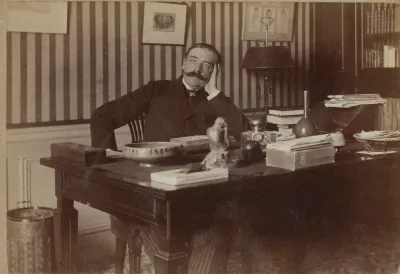
Octave Mirbeau
Human Design Chart
Biography
Mirbeau died on 16 February 1917, Paris, France.
Octave Mirbeau as a Generator 3/5 in Human Design
Generator 3/5 — Design at a Glance
Octave Mirbeau's Human Design profile indicates a tendency towards great endurance, which is activated not by personal initiative but solely through reactions to internal impulses. As a Generator, he possesses abundant sacral energy, comparable to that of a workhorse: extremely strong and durable as long as he has the energy for his task. This foundation determines his fundamental mechanism for satisfaction and energy flow.
His central dilemma lies in two pitfalls. The first is burnout from forced, non-resonant external activities; the second is frustration when prevented from working on his heart project despite wanting to continue with full power. His "manifesting" works differently than it does for other types: the energy of the sacral center becomes free primarily when reacting to impulses. Not initiating but responding was his motto.
The most successful strategy for Octave Mirbeau is to react to a signal from life and then, when the sacral center says “Yes! Let’s get started!”, to act accordingly. Living in alignment with this design makes him unstoppable; he is rewarded with deep satisfaction. If he continually initiates himself, however, sooner or later he encounters persistent frustration and a lack of energy. His path to fulfillment therefore always lies in reacting from the gut.
Sacral Authority
Octave Mirbeau oriented his decisions based on an inner resonance that responded to external stimuli as a physical impulse. His inner authority was the Sacral Authority, unique to the Generator type, simplifying his decision-making process because strategy and authority were identical. This mechanism manifested through a kind of gut feeling or sudden surge of energy. Mirbeau had to learn to listen to specific body language signals such as grunting, humming, groaning, or an affirming "Mhm." When his sacral motor engaged with something, he felt vital and alive. Then, he was endowed with seemingly inexhaustible energy that enabled him to tackle his work with great enthusiasm. He was born to walk through life with joy and satisfaction, fully immersed in his activities without any sense of purposefulness. This configuration promoted immediate well-being and instinctive perception, guiding him reliably.
The 3/5 Profile — Martyr / Heretic
Octave Mirbeau revealed himself as someone who shaped his identity through constant, often public experimentation. His Profile 3/5, that of the "Experimenting Hero," suggested that he initially took nothing at face value. Line 3, the line of the Adventurer, drove him to experience everything firsthand and learn from his own mistakes. This process was inevitably accompanied by setbacks visible to others. Yet it was precisely these accumulated practical experiences that formed the core of his attractiveness.
Line 5, the line of the Hero or Saviour, used this knowledge to solve other people's problems. Mirbeau’s design described a person who presented a rich treasure trove of life experience, which magnetically attracted others. This role as a competent problem solver flattered his self-image but also created an inner conflict: the need for recognition clashed with the reality of failure during the experimental phase.
To protect this vulnerability, his design developed mechanisms such as arrogance or a strong emphasis on innate dignity. These attitudes served to maintain the projection of his competence when the experimental Line 3 failed. Thus, he appeared as someone who radiated power – often misunderstood as arrogance – in order to secure the respect required by his role as a saviour. This dynamic between painful failure and the resulting need for dignity shaped his essence profoundly.
Split Definition — Defined & Open Centers
Octave Mirbeau's Human Design configuration tended towards continuous, active expression: He had defined centers for mental conceptualization (Ajna), communication (Throat), identity and direction (G Center), willpower (Heart), vital energy (Sacral) as well as stress management (Root). This setup created a person whose inner mechanisms were always 'switched on'. He thought constantly, spoke what he thought or wanted, and acted with his own reliable source of energy. His mental function was specific and not easily influenced by others; he could create concepts and manifest them directly.
These defined centers formed the foundation of his ability to act consistently. In contrast, his Head Center (Inspiration/Doubt), Solar Plexus Center (Emotions) and Spleen Center (Health/Intuition) were open. These open areas reacted situationally to their environment and were susceptible to conditioning. Mirbeau tended to be distracted by external questions or doubts when he did not trust his inner authority. He absorbed emotions from his surroundings, making him vulnerable to others' moods, and possibly sought security through others due to a lack of his own constant well-being frequency.
While his defined centers allowed him to work consistently and fulfill promises (Heart), as well as persistently invest energy (Sacral), he had to learn not to interpret impulses from his open centers as his own truth. The danger lay in making spontaneous decisions out of fear or uncertainty (open Spleen) or emotionally identifying with the environment (open Solar Plexus). His strength was in maintaining his own direction and willpower despite these external influences, without being overwhelmed by the transient doubts of his open Head Center.
Channels for pioneering spirit, persistence, logic and maturation.
Octave Mirbeau exhibited a complex dynamic of logical analysis, competitive impulse towards individualization, and deep cyclical experience formation. His design enabled him to logically organize and express complex details while simultaneously discovering new levels of consciousness through competition and shock.
Channel Accepting 17-62 connected the Ajna Center with the Throat Center. Gate 17 visualized patterns, while Gate 62 translated these into language and named details. This created a permanent internal process to mentally organize information based on substantial details. Everything he could fit into this mental image he understood; what didn't fit remained incomprehensible. In the Throat Center there was pressure to express opinions and understandings in detail, which made him enjoy explaining precisely what he comprehended or did not.
Channel Initiation 51-25 connected the Heart Center through Gate 51 of Shock with Gate 25 of Higher Self. The competing ego energy from Gate 51 was here linked to universal love. This gave him the ability to initiate individualization through 'shock' and encourage others to expand their boundaries. It was a natural competitiveness aimed at recognizing potential for individualization and, if invited, providing an impetus for consciousness shift.
Channel Discovery 29-46 connected Sacral with G Center. Gate 29 stood for persistent saying yes, Gate 46 for the determination of self. This led him to immerse himself in experiences without preconceived expectations to ultimately gain a new insight. Success did not come from control but through letting go of expectations about the cycle.
Channel Maturation 53-42 connected Root with Sacral Center. Gate 53 marked beginnings, Gate 42 growth. He went through cyclical experiences from start to finish. Only after completion would he reflect on the wisdom gained and share it before a new cycle began. This process was not goal-oriented but served the collection of collective history.
Collective Circuitry — Circuit Signature
Octave Mirbeau's design tended towards solid, courageous individuality. The Centering Circuit connected his Identity with Heart Center (Channel 25-51). This created strong inner convictions and self-worth ('I am who I am'), without directly carrying this outwardly. As the Throat Center was missing in this circuit, clear expression of these firm internal stances was difficult; the energy worked more individualistically than communicatively.
Parallel to this, there was a separate group consisting of Ajna and Throat Centers (Channel 17-62). Here showed the ability to focus on logical insights and articulate them in words – free from emotional coloring. This connection allowed sharing rational strategies for a better future but did not energetically exchange directly with the inner conviction of the Centering Circuit.
Another independent stream connected Identity, Sacral and Root Centers (Channels 46-29 and 42-53). This generated a cyclical emotional processing of past experiences. The resulting insights should be shared with the collective to learn from history. These three circuits did not form a cohesive unit in Octave Mirbeau but rather parallel existing forces: inner firmness without direct verbal connection, rational future planning and emotional reflection on the past. The Shared Definition emphasized this separation of energetic systems, making his personality consist of these distinct, non-directly merging aspects.
Right Angle Cross of Contagion 1
Octave Mirbeau's Human Design chart revealed a profound, often unconscious sensitivity to the emotional and energetic states of others. He was someone who passively absorbed and reflected the moods, beliefs, or conflicts of others rather than actively influencing them. This configuration, known as the right infection cross, described a life dynamic where there was a constant risk of being 'infected' by the feelings of others.
The mechanics of this pattern highlighted that Octave Mirbeau did not primarily act through his own initiative but worked as a mirror for external dynamics. This required a conscious maintenance of personal boundaries; without these protective barriers, he faced the danger of being drawn into the vortex of foreign energies and losing inner clarity. His chart indicated that his challenge lay in distinguishing between his true self and the absorbed otherness. The energy of this cross marked him by a high sensitivity to the invisible aspects of interpersonal relationships, making him vulnerable to the whims of his environment unless he learned to separate these influences from his own identity.
Saturn Return · Uranus Opposition · Chiron Return · 2nd Saturn Return — Life Cycles
During this phase of his life, Octave Mirbeau showed a clear tendency towards solidifying his position and public perception of his work. This development corresponded with the second Saturn return cycle, typically occurring between the ages of 58 and 60 – here however, it became active earlier or served as a preparatory phase due to specific chart configurations. During this time, years of internal work condensed into a stable external structure that sought and found recognition.
In 1903, at age 55, his most famous drama, 'Business is Business,' was published. This event marked a crucial point in consolidation: the life task he may have pursued intuitively or privately before now entered the public sphere and took on a concrete form. The success of this work underscored the mechanics of the Saturn return as a phase of maturity and confirmation. It was not an abrupt stroke of luck but the result of long-term development where his individual expression met the demands of his environment. Octave Mirbeau used this moment to strengthen his voice and anchor his message sustainably. The structure of his design promoted a stance of constancy; he did not let himself be swayed by fleeting trends, but built upon the foundation he had laid earlier. This phase thus served as a bridge between an earlier experimental spirit and later established authority.
Generator · Sacral Authority — Synthesis
Octave Mirbeau was a Generator whose life was marked by deep sacral energy and a drive to channel this into concrete results. The connection between Sacral Center and Identity and Heart Centers (Centering Circuit) points to a strong inner motivation that did not primarily stem from external constraints but from the need to act authentically and express personal values. His profile as an Explorer/Hero and Rescuer reinforced this tendency: he gathered life experiences through experimentation and shared his knowledge generously – a cycle of personal exploration and the desire to effect positive change.
A central paradox in his design lay in the interplay between defined mental function (Ajna Center) and sacral authority. While the mind developed concepts and recognized patterns (Channel Accept), actual decision-making was based on gut instinct, an immediate surge of power as a reaction to external stimuli. This likely led to internal tension between rational thinking and intuitive action – a dynamic that manifested in the success of his work (event 1903) but also required constant weighing of different perspectives.
4 Defined Channels
Incarnation Cross - Right Angle Cross of Contagion 1
Solar Return
The Solar Return shows the moment when the sun returns to its exact birth position - your personal solar year.
Life Cycles
Discover the life cycles with a detailed triple view (birth chart, cycle chart, composite).
Human Design Profile
- Type
- Generator
- Strategy
- To respond - wait for something to respond to
- Authority
- Sacral Authority
- Profile
- 3/5 - Martyr / Heretic
- Definition
- Split Definition
- Incarnation Cross
- Right Angle Cross of Contagion 1
- Date of Birth
- 16.02.1848 09:00
- Place of Birth
- Tréviéres, France
Frequently Asked Questions
What was Octave Mirbeau's Human Design type?
Which Profile did Octave Mirbeau have?
What Authority guided Octave Mirbeau?
What incarnation cross did Octave Mirbeau have?
When was Octave Mirbeau born?
Discover your own Human Design
Are you also a Generator? Find out in a personal reading how to use your sacral energy correctly and discover deep satisfaction.
More Personalities
Back to overviewAaliyah

Alain-Fournier

Alexia

Angèle

Angeli

Anne-Marie
