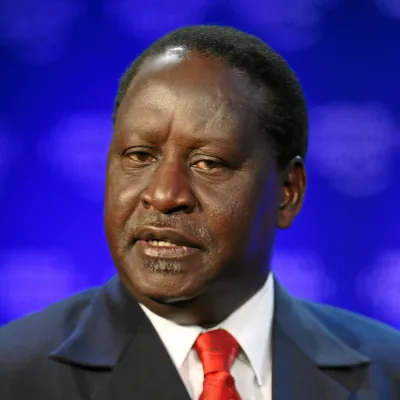
Raila Odinga
Human Design Chart
Biography
He was the Member of Parliament (MP) for Langata from 1992 to 2007. Raila Odinga served in the Cabinet of Kenya as Minister for Energy from 2001 to 2002, and as the Minister for Roads, Public Works and Housing from 2003 to 2005. Odinga was appointed High Representative for Infrastructure Development at the African Union Commission in 2018.
The son of the first Vice President of Kenya, Jaramogi Oginga Odinga, Raila Odinga is commonly known as "Baba", coincidentally, he was an MP at the same time as his father between 1992 and 1994. Other nicknames that have been associated with the premier include "Nyundo" which is hammer in Kiswahili, "Tinga" which means tractor in Kiswahili a symbol of his National Development Party (NDP) and "Agwambo" meaning a man who is unpredictable (enigma or mysterious) and 'Baba' which means a political father.
Odinga is married to Ida Odinga (Ida Anyango Oyoo). They live in Karen, Nairobi and have a second home at central Farm, in Siaya County. The couple had four adult children: Fidel (1973–2015), Rosemary (born 1977), Raila Jr. (born 1979) and Winnie (born 1990).
Human Design Analysis: Raila Odinga as Manifestor 2/4
Manifestor 2/4 — Design at a Glance
Raila Odingas Human Design lays the foundation for that of a Pioneer and Visionary. As a Manifestor, he is destined to lead the world into a new future, much like an Emperor in ancient Rome who carried the vision of a great empire but did not wage wars himself but sent others to do so. This role came with a specific pain point: He was often misunderstood and polarizing. Because he thought ahead more than many around him, some loved and followed him for his grand visions while others hated or rejected him precisely because of them.
To ensure the right followers found him, it was crucial for his design to inform others about his plans in a timely and precise manner. This formed his ideal strategy. If he adhered to this guideline and held onto his inner authority, he would be rewarded with an internal sense of peace. Living against this design likely resulted in a persistent, deep-seated anger within him. His leadership trait was thus inseparable from the necessity to communicate clearly to avoid misunderstandings and gain support from those who shared his vision.
Emotional Authority
Raila Odingas Human Design sets a tendency towards emotional wave movements that significantly shaped his perception and decision-making process. As a carrier of Emotional Authority, he was subject to constant ups and downs in his feelings; the world appeared colored by his current mood. In one moment, he could be totally enthusiastic about something, only to see it completely negatively in the next. His immediate feeling was merely a snapshot, an initial impression that did not necessarily represent his truth yet. Quick, spontaneous decisions based on such emotions often had negative consequences.
The mechanics of his inner authority demanded patience: The more time he took for a decision to mature, the deeper and more comprehensive could he see. This required sleeping over decisions and hesitating before acting. Over time, intense feelings subsided, emotional distance set in, followed by clarity and calmness. Only then had he gone through the process. This rule applied regardless of what else was defined in his chart; the defined Emotions center always carried the authority. For long-term decisions influencing his life course, this process of waiting and maturing was central to not being swayed by fleeting moods.
The 2/4 Profile — Hermit / Opportunist
Raila Odingas Human Design sets a tendency towards constant oscillation between withdrawal and social engagement. As someone with Profile 2/4, the 'Natural Talent', he constantly fluctuated between two basic needs: Line 2, which seeks solitude and aloneness, and Line 4, which demands time with favorite people in community. This configuration created an internal tension that required him to create a safe environment where he could clearly communicate when he needed company and when he wanted to be left alone. In his 'Me-Time', he immersed himself in internal processes to find calmness and clarity. Once the need for withdrawal was satisfied, he emerged from his 'cave' to reconnect with his network again. This structure allowed him to reflect on knowledge gained from social relationships during solitary times, evaluate it, and develop brilliant ideas. The second line of Gate 54 promoted discretion and restraint; Saturn amplified this energy, meaning wisdom in handling past interactions. At the same time, it strengthened ambition but could weaken loyalty if immature. The fourth line of Gate 57 showed a fixation on relationships as means for survival. Venus here enhanced masterful network management towards productivity and harmony, while Mars could lead to authoritative decisions when personal survival was threatened. Odinga used this mechanism to navigate between private reflection and public networking.
Single Definition — Defined & Open Centers
Raila Odinga's Human Design profile is characterized by a reliable internal direction and profound emotional intelligence. His defined G Center provided him with a stable self-image and a clear sense of his life mission, while the also defined Solar Plexus Center acted as an inner authority: He learned to make decisions not impulsively but waited for the emotional wave to subside before clarity emerged. This combination allowed him to communicate easily and honestly – supported by his defined Throat Center – without denying his own identity. Additionally, the defined Spleen Center provided spontaneous intuition in the present moment, while the defined Root Center supplied the necessary pressure to move forward in the world and master existential challenges.
At the same time, Raila Odinga was marked by several open centers that made him susceptible to external conditioning. His open Head and Ajna Centers meant he did not have a consistent mental inspiration; instead, he tended to absorb questions and doubts from others or get lost in mental monologues when he did not trust his inner authority. The open Heart Center led to feeling often under pressure to prove his worth through willpower and promises – a cycle that could lead him into failure if he tried to meet expectations for which he was not designed. Finally, the undefined Sacral Center revealed a missing consistent energy source: He had to learn not to misinterpret borrowed energies from others as his own and protect himself from overexertion by taking breaks and setting boundaries.
Channels for ambition, intuition, expression and emotion.
Raila Odinga's Human Design profile inclined him towards intuitive, self-determined action that relied less on external recognition than on inner fulfillment. This attitude stemmed from Channel of Perfect Form 57-10, which connected the Spleen and G Centers. Through Gate 57 (intuitive insight) and Gate 10 (self behavior), there was a capacity to make spontaneous decisions that perfected his own survival. This behavior was guided by a deep love for oneself and allowed him to move through life unburdened by unfounded future anxieties.
Parallel to this, there was a drive towards social transformation and advancement. Channel of Transformation 32-54 connected the Root and Spleen Centers, driven by the ambition of Gate 54 and the desire for continuity in Gate 32. Here it was about improving one's position in life through consistent effort and supporting the foundation. The awareness of the Spleen Center instinctively recognized when support was available to increase prosperity. This created a dynamic interaction: While Perfect Form secured the individual in the here and now, Transformation propelled progress in the material world, always dependent on feedback from the environment.
Additionally, Channel of Wavelength 16-48 connected the Spleen with the Throat Center. Gate 48 sought life-critical information and depth, while Gate 16 perfected dexterity. This promoted the development of specific talents through repeated experimentation and precision. The combination of intuitive depth and technical mastery allowed him to refine skills so they were communicated as talent.
In the background, further Gates shaped his nature: Gate 53 (freedom, pioneer) initiated new cycles, while Gate 51 (willpower, shocks) reacted to challenges. Gate 62 (logic, details) provided patient pattern recognition and fact-finding. Gate 1 (uniqueness) emphasized creative expression at the right time, and Gate 35 (change) sought satisfaction through new experiences. Gate 50 (protective reflex, traditions) preserved values, while Gate 52 (concentration, pause) urged reflection. Gate 18 (correction, politics) discriminated between necessary and unnecessary corrections in the collective process, and Gate 33 (reflection) enabled withdrawal to remember before the next step.
Individual Circuitry — Circuit Signature
Raila Odinga's Human Design profile displayed a clear, coherent energetic structure. As a person with simple definition, his Identity, Spleen, Throat, Root, and Solar Plexus Centers formed a single flow. This created an integrated experiential world where intuition, emotional waves, and expression were directly interwoven.
The Knowledge Circuit acted through the channel 'Emotion Release'. It connected the Solar Plexus with the Root Center. This allowed Raila Odinga to translate emotional impulses into concrete action impulses and initiate changes impulsively.
In the Understanding Circuit, he activated the channel 'Wavelength' between Throat and Spleen Centers. Here a connection of intuitive selection to verbal communication occurred. Raila Odinga could thus articulate insights marked by his intuition as clear and focused.
The Ego Circuit carried the channel 'Transformation' between Spleen and Root Centers. This connected intuitive wisdom with the energy for transforming situations. Raila Odinga used this connection to unlock resources through profound changes, always guided by inner perception.
Finally, Integration worked through the channel 'Perfect Form' between Identity and Spleen Centers. This linked his self-understanding with intuitive knowledge in the here and now. Raila Odinga acted from a stance that expressed his unique individuality through spontaneous, intuitive decisions, always in harmony with his inner compass.
Right Angle Cross of Penetration 4
Raila Odinga's Human Design profile indicated a tendency towards strategic and profound action. He was someone who did not just superficially assess complex situations but sought to penetrate their underlying structures and connections. This attitude stemmed from the right cross of Permeation 4 in his chart. This specific configuration linked the need for clear, defined identity with the ability to process information on a very deep, almost intuitive level. For Raila Odinga, this meant that he often made decisions based on an extensive, internally understood picture rather than being swayed by external opinions. The energy of this cross promoted a kind of leadership based on clarity and the assertion of necessary truths, even if they were uncomfortable. It was not vague intuition but a structured, almost analytical form of understanding that allowed him to find a solid point in chaotic or unclear phases and build upon it. This inner confidence in his own understanding of the situation shaped how he dealt with challenges: he did not seek simple solutions but rather aimed to grasp the core of the problem and act from there.
Saturn Return · Uranus Opposition · Chiron Return · 2nd Saturn Return — Life Cycles
Raila Odinga's design was characterized by periods where structural responsibility and internal alignment met. His first Saturn Return around age 30 marked a time of consolidation: in 1975, he was appointed Deputy Director of the Kenya Bureau of Standards. This step reflected the typical effect of this cycle, where years of groundwork condensed into a stable position, creating a solid foundation for future actions.
Later, his design showed a deeper turn during the Chiron Return (around ages 49-51). This period is not a healing process but an actualization cycle in which one's personal life purpose unfolds – provided that one follows their own strategy. In 1994, his father Oginga Odinga passed away and Raila joined the National Development Party (NDP). This crisis served as a catalyst to test his inner authority and define his path into public politics.
His second Saturn Return around age 57 brought further structural clarity. In 2002, he was elected General Secretary of KANU but failed in his bid to succeed Moi for the presidential candidate status. Again, this showed the mechanics of the Saturn Return: despite external setbacks, his role within existing structures strengthened over time, leading to a clearer definition of his own authority.
Manifestor · Emotional Authority — Synthesis
He was a Manifestor whose life was marked by a constant oscillation between the urge to lead and the necessity of withdrawal. The definition through emotional authority required careful consideration before decisions, yet his profile as a natural talent and networker inevitably drew him back into the community to share his visions (Channel 57-10). This natural rhythm was reinforced by the energetic connection between Spleen and G Center – an intuitive recognition of one's behavior in service of self-realization. He seemed always eager to explore new paths and initiate changes (Knowledge Circuit), relying on his inner truth even when it contradicted conventions.
A central paradox lay in the tension between his manifesting impulse towards initiation and the emotional process that was indispensable for him. He acted as a pioneer (Manifestor type), yet decisions matured only through experiencing an emotional wave, leading to an internal conflict between quick action and reflective patience. This dynamic was evident during key career shifts in 1975 and crisis phases (1994, 2002) where he oscillated between the desire for influence and the need for inner reflection.
4 Defined Channels
Incarnation Cross - Right Angle Cross of Penetration 4
Solar Return
The Solar Return shows the moment when the sun returns to its exact birth position - your personal solar year.
Life Cycles
Discover the life cycles with a detailed triple view (birth chart, cycle chart, composite).
Human Design Profile
- Type
- Manifestor
- Strategy
- To inform others before acting
- Authority
- Emotional Authority
- Profile
- 2/4 - Hermit / Opportunist
- Definition
- Single Definition
- Incarnation Cross
- Right Angle Cross of Penetration 4
- Date of Birth
- 07.01.1945 11:47
- Place of Birth
- Maseno, Kenya
Frequently Asked Questions
What is Raila Odinga's Human Design type?
What profile did Raila Odinga have?
What authority did Raila Odinga have?
Which incarnation cross did Raila Odinga carry?
When was Raila Odinga born?
Discover your own Human Design
Are you also a Manifestor? Find out in a personal reading how to use your initiation power peacefully and dissolve resistance.
More Personalities
Back to overviewChristian-Jaque
Kesha

Laurent-Eynac
Lucebert
Masaccio
Papus