
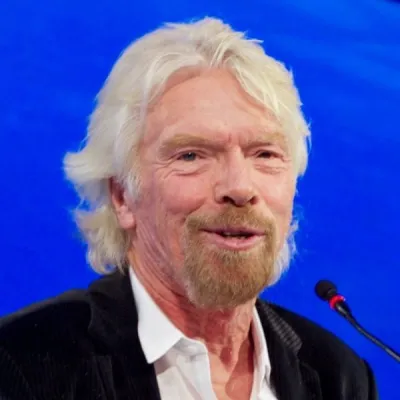
Richard Branson
Human Design Chart
Biography
Branson expressed his desire to become an entrepreneur at a young age. His first business venture, at the age of 16, was a magazine called Student. In 1970, he set up a mail-order record business. He opened a chain of record stores, Virgin Records—later known as Virgin Megastores—in 1972. His Virgin brand grew rapidly during the 1980s, as he started the Virgin Atlantic airline and expanded the Virgin Records music label. In 1997 he founded the Virgin Rail Group to bid for passenger rail franchises during the privatisation of British Rail. The Virgin Trains brand operated the InterCity West Coast franchise from 1997 to 2019, the InterCity CrossCountry franchise from 1997 to 2007 and the InterCity East Coast franchise from 2015 to 2018. In 2004, he founded the space tourism company Virgin Galactic, based at Mojave Air and Space Port in California, United States, noted for the SpaceShipTwo suborbital spaceplane.
In March 2000, Branson was knighted for "services to entrepreneurship". Due to his work in retail, music and transport, his taste for adventure and for his humanitarian work, he has become a prominent global figure. In 2007 he was named one of the 100 Most Influential People in the World by Time magazine. In June 2023, Forbes magazine listed Branson's estimated net worth at US$3 billion.
The Human Design of Richard Branson: Generator 5/1
Generator 5/1 — Design at a Glance
Richard Branson revealed himself as someone who purposefully utilized his immense stamina and work ethic once he felt an inner impulse. His Generator design tends towards high energy production, comparable to a strong workhorse that only runs effectively when fueled for its task. This energy was not released through mere initiation but through responding to environmental signals.
The core mechanics of his type lie in not taking the first step himself but in responding to an invitation or a stimulus. When his sacral center – the motor of his life force – signaled a clear “yes,” he could act with full power, leading to deep satisfaction and a sense of fulfillment. Conversely, frustration or energy loss threatened if he acted against this inner compass or did things that found no resonance.
Two main risks shaped his profile: First, the danger of wasting energy on tasks that did not find inner approval, which could lead to exhaustion. Second, the risk of being held back from his heart project despite the energy still being present. His strength thus lay in reacting from the gut and then consistently acting, thereby unleashing his materialization power without overburdening himself.
Emotional Authority
Richard Branson revealed himself as someone who never made decisions immediately but consciously let them mature. His design carries Emotional Authority, meaning his defined Emotional Center held the inner guidance – regardless of which other centers were also defined. This configuration subjects the person to a natural wave of emotional highs and lows. The perception of the world is always colored by the current mood; a topic can appear enthusiastic in one moment and negative in the next.
Since the immediate feeling is only a snapshot and not a final judgment, spontaneous decisions based on these first impressions carry significant risks. Richard Branson therefore used the strategy of taking his time. By letting decisions rest overnight multiple times, he gained emotional distance. The initial intensity of the feelings subsided, leading to clarity and calmness. This process of delay was not a sign of hesitation but a necessary mechanism to reach the deeper, more comprehensive truth. Only when the emotional wave had subsided could he act with a clear, stable foundation. This patience shaped his approach to long-term, life-defining questions, where a quick, impulsive decision would have had negative consequences. Through waiting, the necessary calmness set in to recognize the right direction.
The 5/1 Profile — Heretic / Investigator
Richard Branson revealed himself as someone who gathered deep, specific knowledge to offer others for problem-solving. His Human Design Profile 5/1, the “Hero/Researcher” design, establishes a structure in which Line 1 stands for intensive, often solitary research, while Line 5 transports this knowledge outward. Other people instinctively sought him out for solutions, drawn to the authority that arises from thorough expertise. This created a tension field: The need to answer questions conflicted with the necessity of setting clear boundaries to avoid being drained by inquiries.
The mechanics of his design require that details be worked through to absolute clarity before they are shared. Only when the “research” inside is complete does the “Hero” side take the stage. Without this inner order, confusion and overload threaten, as the example of the scientist shows, who is left drained after intensive consultation. Richard Branson had to learn to also say no to maintain the balance between the private research process and public availability. Only so could he optimally utilize his gifts without overburdening himself. The mutation hidden in his design required this synthesis of analysis and order to achieve sustainable impact.
Split Definition — Defined & Open Centers
Richard Branson was revealed through a design that linked constant mental activity with a deep, physical energy source. His defined Ajna Center ensured a steady, trustworthy form of conceptual thinking; he was not easily influenced from the outside in his concepts and used his mind as an external authority to process data and mentally condition others. This mental structure flowed directly into his defined Throat Center, allowing him to reliably and clearly express what he thought. His voice was the fulcrum that transmuted mental information into concrete communication and action.
At the same time, he had a defined Sacral Center, which gave him enormous, daily generated vitality. This energy was only available upon a consenting reaction to external initiatives. If he waited for questions or offers to react, he could bring his full power to bear; initiating from the mind, however, risked frustration and exhaustion, as the sacral energy was then not available. His defined G Center also gave him a firm sense of self-identity and direction, allowing him to inspire others without being dependent on their approval.
This stable inner life stood in contrast to his open centers. His open Head Center made him vulnerable to mental pressure and the urge to answer questions that were not his own. He tended to get entangled in the doubts of others rather than trusting his inner authority. The open Heart Center lacked consistent willpower; he was not designed to give and keep promises to prove his worth, but had to learn not to fall into spirals of self-proving. Additionally, his open Root Center absorbed external stress from the environment, leading to a sense of urgency that did not spring from his own nature. His open Spleen Center made him vulnerable to fears and often sought safety in the proximity of others rather than making spontaneous decisions that could be harmful in the long term.
Channels for intimacy, logical leadership and mental acceptance.
Richard Branson was revealed as someone who entered relationships and cooperation through a powerful, emotional wave. This tendency was rooted in the Channel of Union 59-6, linking sacral sexuality with emotional friction. Intimacy here was not a superficial phenomenon but a process requiring patience to allow fertility in creative endeavors. Simultaneously, he exercised logical, collective leadership as described by the Channel of the Alpha Animal 7-31. This is not about authoritarian rule but about gaining trust and being invited by the community to lead. His voice had influence because it was based on patterns that society recognized as safe.
Parallel to this, he mentally organized information into details, a characteristic of the Channel of Accepting 17-62. This channel translates visual patterns into language, making complex matters understandable and acceptable. It was an ongoing inner process where only what could be logically integrated into one's worldview was understood.
Additionally, specific gates influenced him. Gate 61 sought inner truth and silence, while Gate 3 demanded mutation and adaptation to global changes. Gate 50 fostered traditional values and protective reflexes, and Gate 25 brought a mystical stance of innocence. Gate 46 emphasized full presence and commitment in the here and now, while Gate 12 promoted creative restraint and poetic expression. In his design, Gate 2 acted as a receiver of new directions, Gate 55 with its emotional mood swings, Gate 15 with its focus on collective rhythm, and Gate 37, which connected friendship and organic community structures. This constellation shaped a person navigating between intense emotionality, logical structuring, and mystical commitment.
Collective Circuitry — Circuit Signature
Richard Branson was revealed through his design as someone who combined logical strategies with deep, instinctive care – yet as two separate, parallel forces. His Mind Circuit linked the Ajna Center with the Throat and Identity Centers. This created a direct flow from visual strategy through communication to personal identity. He used this connection to clearly formulate and share rational insights, free from emotional conditioning. The Channels of Accepting and The Alpha Animal allowed him to structure complex connections and communicate them with a certain wildness or unconventionality.
Completely independently, his Archer Circuit was at work. Here, the Channel of Union linked the Sacral Center with the Solar Plexus Center. This generated timeless, primordial energy based on the protection of one's genetics and care for the family. This connection linked the life force of the Sacral Center with the emotional waves of the Solar Plexus, driven by the sense of touch and smell.
As Richard Branson had a Shared Definition, these two circuits did not exist as a cohesive whole. The strategic, future-oriented ratio of the Mind Circuit stood alongside the instinctive, protective energy of the Archer Circuit. Both systems were defined and active, but not directly connected. This shaped a personality that, on one hand, clearly thought and communicated strategically, while on the other hand, was driven by a strong, emotional loyalty to one's core and family, without these two aspects always seamlessly blending.
Left Angle Cross of Obscuration 1
Richard Branson revealed himself as someone who often hid his true nature behind a facade to follow his own path. This aligns with the structure of the left Veiling Cross 1, which describes a tendency towards self-concealment or wearing a social mask. The mechanics of this cross suggest that the person does not always stand openly with themselves but hides from the outside world to remain internally free. Richard Branson used this ability to find himself in various roles without revealing his true identity. The Veiling served as a protective mechanism that allowed him to pursue his goals undisturbed. Through this stance, he could adapt flexibly and take on new challenges without being bound by external expectations. The left Veiling Cross 1 thus shaped his way of moving in the world – always with a hint of mystery that preserved his authenticity. Richard Branson understood how to use this duality between visibility and concealment to realize his visions. His ability to veil himself was not a lack of transparency but a strategic choice that helped him thrive in a complex world.
Saturn Return · Uranus Opposition · Chiron Return · 2nd Saturn Return — Life Cycles
Richard Branson showed himself to be someone who, in the middle of his life, went through a phase of intense realignment and expansion, driven by an inner urge to transcend established boundaries. This dynamic was reflected in his Uranus opposition, an aspect often associated with sudden insights and a desire for freedom from conventional structures. In 1991, at the age of 41, this energy peaked with the first hot air balloon crossing of the Pacific with the 'Virgin Pacific Flyer'. This event was not just an adventure act but the concrete manifestation of a mechanical configuration that drove him to attempt the impossible and explore new horizons.
Later, during his Chiron Return around 1997, another layer of development emerged. In Human Design mechanics, this cycle does not mark a healing of wounds but a bloom period in which the individual life purpose increasingly unfolds and becomes experiential. Richard Branson founded the Virgin Rail Group in this year. This founding can be seen as an expression of this fulfillment phase, in which his strategic alignment and sense of entrepreneurship came to fruition in a new, stable form.
The second Saturn Return, which occurred around 2007, brought a phase of consolidation and recognition. Saturn stands for structure, responsibility, and long-term stability. That Richard Branson, at 57 years old, was named one of the 100 most influential people in the world by Time magazine in this year underscores how his years of work and influence condensed into broader societal recognition. This recognition was the result of a continuous alignment with his inner authority and strategy, which over the years led to a sustainable presence.
Generator · Emotional Authority — Synthesis
A central red thread runs through the design: the dynamic connection between deep, sacral energy (Generator Type, Pairing Channel) and the need to transform this energy into profound insights (defined Ajna Center, 5/1 Profile). This combination leads to a natural ability to grasp complex problems and offer solutions, with the learning process itself being a crucial part of the experience. The recurring cycles associated with professional departure and recognition suggest that this energy continually realigns and manifests in new enterprises.
The design reveals a central paradox between the need to deeply immerse oneself in the emotional wave (emotional authority, Gate 6) and the urge to share and convey knowledge (Hero/Researcher Profile, Understanding Circuit). While the emotional center requires time for clarity, the line 5 urges to make the acquired knowledge accessible to others. This creates a tension between the internal maturation process and external expectations, leading to a constant struggle with one's inner truth and the needs of others.
3 Defined Channels
Incarnation Cross - Left Angle Cross of Obscuration 1
Solar Return
The Solar Return shows the moment when the sun returns to its exact birth position - your personal solar year.
Life Cycles
Discover the life cycles with a detailed triple view (birth chart, cycle chart, composite).
Human Design Profile
- Type
- Generator
- Strategy
- To respond - wait for something to respond to
- Authority
- Emotional Authority
- Profile
- 5/1 - Heretic / Investigator
- Definition
- Split Definition
- Incarnation Cross
- Left Angle Cross of Obscuration 1
- Date of Birth
- 18.07.1950 07:00
- Place of Birth
- Blackheath, United Kingdom
Frequently Asked Questions
What is Richard Branson's Human Design type?
What profile does Richard Branson have in Human Design?
What authority guides Richard Branson?
What incarnation cross is Richard Branson associated with?
When was Richard Branson born?
Discover your own Human Design
Are you also a Generator? Find out in a personal reading how to use your sacral energy correctly and discover deep satisfaction.
More Personalities
Back to overviewAaliyah

Alexia

Angèle

Anne-Marie

Arcángel

Arno
