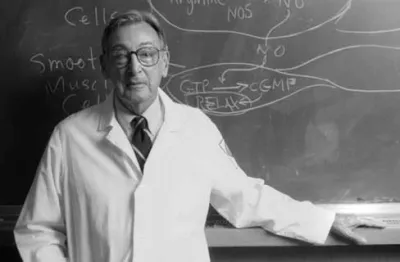
Robert F. Furchgott
Human Design Chart
Biography
The son of a department store owner, he graduated with a degree in chemistry from the University of North Carolina at Chapel Hill (1937) and went on to earn a PhD in biochemistry at Northwestern University (1940), immediately joining a medical faculty thereafter.
Furchgott was faculty member of Cornell University Medical College from 1940 to 1949, of Washington University School of Medicine from 1949 to 1956, and State University of New York Downstate Medical Center from 1956 to 2009, as professor of pharmacology.
In 1978, Furchgott discovered a substance in endothelial cells that relaxes blood vessels, calling it endothelium-derived relaxing factor (EDRF). By 1986, he had worked out EDRF's nature and mechanism of action, and determined that EDRF was in fact nitric oxide (NO), an important compound in many aspects of cardiovascular physiology. This research is important in explaining a wide variety of neuronal, cardiovascular, and general physiologic processes of central importance in human health and disease.
In addition to receiving the Nobel Prize, Furchgott's discovery, that NO gas causes blood vessels to dilate, provided a long sought-after explanation for the therapeutic effects of Nitroglycerin used to treat Angina pectoris and was later instrumental in the development of the erectile dysfunction treatment drug Viagra.
Furchgott was married to Lenore Mandelbaum (February 1915 – April 1983) from 1941 until she died aged 68. They had three daughters: Jane, Terry and Susan. His daughter, Susan, was a prolific artist in the San Francisco counter culture and a co-founder of the Kerista Commune (she was also known as "Even Eve" and "Eve Furchgott").
The Human Design of Robert F. Furchgott: Manifesting Generator 3/5
Manifesting Generator 3/5 — Design at a Glance
Robert F. Furchgotts design exhibited a tendency towards hybrid dynamics: As an Manifesting Generator, he possessed the constant energy source of the sacral center combined with the ability to skip steps and draw rapid results into his life. This configuration did not describe a pure reactor like the classical generator but rather a type that also had manifestor characteristics due to direct connections between motor centers and the throat center.
This speed significantly shaped his work style. He could advance multiple projects in parallel and react simultaneously to various impulses. However, this efficiency carried two specific risks: By skipping stages, he occasionally needed to backtrack to complete missing steps, which could cause frustration – the classic challenge for this type. Additionally, he tended to spread himself thin across numerous tasks.
His strategy was not to initiate things himself but to react to inner impulses. Only when his sacral center signaled a clear
Sacral Authority
Robert F. Furchgott was a Generator whose decision-making process was marked by sacral authority. This internal guidance did not manifest in intellectual deliberation but as a direct physical reaction to external stimuli. His design allowed him to listen to his gut feeling – often acoustically perceived as grunting or humming, emotionally felt as an immediate surge of energy. When his Sacral Center engaged with a topic, he had vital energy and inexhaustible enthusiasm that enabled him to immerse himself in activities without the need for external purposefulness.
Central to his mechanics was the condition of an open emotional center. This protected him from impulsive decisions based on emotions and guided him back to the physical truth of the Sacral Center. Additionally, his activated Spleen Center served as a supportive instance. Through this connection, he had direct access to instinctive perception and could react particularly quickly and spontaneously to his environment. This configuration greatly simplified his process: He did not need to think but only needed to trust the first impulse of his body to find areas that brought him satisfaction and joy.
The 3/5 Profile — Martyr / Heretic
Robert F. Furchgotts design inclined towards experimental action validated through personal experience. As a person of Profile 3/5 – Explorer and Hero – he initially believed little in preordained truths. Instead, he learned through trial and error, with Line 3 functioning as a purely personal development line. This meant that crises and chaos during his youth often served as catalysts for progress. He needed other people within these processes to enable forward-looking changes.
His role as a Hero (Line 5) developed from this: Practical knowledge gained through his own mistakes became a resource for others. In times of crisis, he asked the right questions to dispel doubts and find precise solutions. This ability to emerge from immaturity or empty rituals made him attractive to his surroundings, which wanted to partake in his insights. Yet, this heroic role carried risks: Failing before others could be painful since a 3/5er defined himself through the success of his experiments. His path was marked by the necessity to experience things firsthand before he could offer advice – a process that generated authenticity through lived practice rather than theory.
Single Definition — Defined & Open Centers
Robert F. Furchgott's Human Design profile indicated a tendency towards consequent and powerful expression capabilities. He had a defined Ajna Center (conceptual thinking), which gave him a consistent mental function; he processed data and creativity in the same way, unaffected by external opinions. These concepts flowed directly into his defined Throat Center (communication). The throat acted as a pivot point that transformed these mental contents into clear speech and action. He did not speak impulsively but articulated what he had conceptually understood—a reliable source for honesty and clarity.
This intellectual stability contrasted with his open Head Center (mental pressure). Here, he lacked consistent inspiration; instead, he tended to engage with others' questions or be overwhelmed by doubts that were not his own problem. His open Heart Center (willpower) showed another vulnerability: He was not designed to prove his worth through willpower or promises. Attempting to appear competitive or take on commitments from the mind often led him into a cycle of self-criticism, as he could not consistently muster the necessary energy for such efforts.
His drive came instead from his defined Sacral Center (vital energy). As a Generator, he possessed an enormous power source that was only available through reaction. He had to wait and be asked by life before responding with a "yes" or "no." Only then did full energy become available to him for persistence. His defined Root Center (stress) provided the necessary pressure to move forward and master existential challenges.
At the same time, his open Solar Plexus Center (emotions) made him vulnerable to picking up on others' moods. He could amplify emotional waves of others and misinterpret them as his own, which could unsettle him in confrontations. His open Spleen Center (body consciousness) also made him sensitive to well-being; spontaneous decisions were risky, often driven by conditioned fears rather than healthy intuition.
Channels for rhythm, reflection, logic and maturation.
Robert F. Furchgott revealed himself as someone driven by the inner flow of life, connected to a deep ability for reflection and logical structuring. His design set a tendency in stone: He moved in a natural rhythm that kept him vital and magnetically attracted others.
The Rhythm Channel 5-15 connected his Sacral Center with the G Center. Gate 5 held onto fixed habits while Gate 15 integrated the diversity of society into the flow of life. This mechanism ensured he was perpetually propelled by life and possessed intuitive timing. When he listened to this inner flow, everything felt effortless; away from it, his surroundings seemed chaotic.
At the same time, he intensely reflected on collected experiences. The Lost Son Channel 13-33 connected the G Center with the Throat Center. Gate 13 listened and stored secrets while Gate 33 withdrew to recognize deeper truths. This gave him the patience to categorize life stories before sharing them – a wisdom that became fully apparent in hindsight.
Furthermore, he organized information mentally precisely. The Accepting Channel 17-62 connected the Ajna Center with the Throat Center. Gate 17 visualized patterns which Gate 62 translated into detailed language. This allowed him to logically structure complex connections and communicate them clearly if he waited for his audience's receptiveness.
Finally, he experienced things through to completion. The Maturity Channel 42-53 connected the Root Center with the Sacral Center. Gate 53 initiated new cycles while Gate 42 ensured growth and reflection. This process challenged him to let go of expectations and carry every experience to its end to gain collective wisdom.
Individual Gates like 35 (Change through Interaction), 63 (Doubt as Motivation) and 64 (Clarity from the Past) underscored his drive for progress and understanding. Gate 60 (Acceptance of Limitations) and 59 (Genetic Binding Strategy) complemented his Profile with a focused, almost mechanical approach to relationships and transformations.
Collective Circuitry — Circuit Signature
Robert F. Furchgott's Human Design shows a clear, coherent structure: As a Single Defined individual, he had an uninterrupted energetic flow between the Sacral, Identity, Throat, and Ajna Centers as well as the Root Center. This connection allowed him to translate inner impulses directly into outer action and expression.
Two circuits shaped this dynamic. The Understanding Circuit connected his Ajna with his Throat Center (Channel "Accept") and his Identity with his Sacral Center (Channel "Rhythm"). This promoted a rational, future-oriented logic that was free from emotional conditioning. He used this channel to clearly formulate and systematically communicate strategic insights. Parallel to this, the Meaning Circuit was active: Here he connected his Throat with his Identity Center (Channel "The Lost Son") and his Sacral with his Root Center (Channel "Maturity"). This configuration focused on processing past experiences. Emotional waves from the past were reflected and transformed into shared insights for collective learning.
The combination of these circuits created a pattern: Rational future visions and emotional reflections on the past flowed together. Through the direct connection of all five centers, Robert F. Furchgott could seamlessly integrate these different energies – cool strategy and felt experience – as a coherent whole. He did not act from separate, isolated impulses but rather incorporated both logical structures and deeper emotional questions into his expression and actions.
Right Angle Cross of Consciousness 2
Robert F. Furchgotts Human-Design profile was characterized by the configuration of the right cross of consciousness. This structure established a specific energetic alignment that shaped his inner experience and reaction to the world. In Human Design, this cross describes a particular arrangement of defined centers and channels in the upper body, often associated with information processing, autonomy or certain emotional patterns. For Robert F. Furchgott, it meant he did not move through life neutrally but had a wired-in energy that filtered his perception and brought certain themes to the forefront. The mechanics of this cross are seen in how consciousness energy flows and where it is blocked or free to circulate. Without further specific data about his life events, the description remains limited to this fundamental architectural fact. His design provided him with a stable foundation for certain types of interactions and inner processes while other areas may have remained open and flexible. This configuration was an integral part of his biological identity and influenced how he received and processed impulses.
Saturn Return · Uranus Opposition · Chiron Return · 2nd Saturn Return — Life Cycles
Robert F. Furchgotts life journey followed the classical, cyclical rhythms of Human Design that marked structure and maturity. His first Saturn return around age 29 served as a pivotal turning point: here early experiments coalesced into a stable identity and clear direction. This cycle established the foundation for his later work by linking inner values with outer commitments.
The Uranus opposition in mid-life then brought necessary dynamism. It broke entrenched patterns and challenged Robert F. Furchgott to break free from outdated structures. This push allowed him to integrate new perspectives without entirely abandoning his gained stability. It was a phase of essential renewal that prepared him for the following years.
The Chiron return around age 50 ushered in his bloom period. In this fulfillment cycle, his incarnation purpose became tangible; he could live out his deepest nature and meaning in life if he followed his strategy. This was not healing from wounds but the unfolding of his full potential. The second Saturn return rounded off this arc by establishing final maturity and wisdom. Robert F. Furchgott used this time to solidify his legacy and conclude his life work with a clear, mature approach.
Manifesting Generator · Sacral Authority — Synthesis
Robert Furchgott was a Manifesting Generator whose life was marked by a constant flow of sacral energy (defined Sacral Center). This energy, combined with the ability to quickly initiate things (Manifestor aspect), led him to relentless experimentation and testing (3/5 Profile). He lived the adventure, gathered experiences through direct engagement and shared these insights willingly – a pattern evident in his defined mental center that created concepts and inspired others. His Rhythm Channel (Gate 5-15) points to a deep connection with natural life cycles, an inner measure guiding him through constant action.
A central paradox lay in the combination of quick initiation and the need to return to fundamental steps (Manifesting Generator). He could act swiftly but might overlook important details, necessitating later corrections – a tension between the drive for progress and the necessity to fully follow his sacral impulses. This interplay shaped his approach by allowing him both pioneering work and learning from experiences to further his knowledge.
4 Defined Channels
Incarnation Cross - Right Angle Cross of Consciousness 2
Solar Return
The Solar Return shows the moment when the sun returns to its exact birth position - your personal solar year.
Life Cycles
Discover the life cycles with a detailed triple view (birth chart, cycle chart, composite).
Human Design Profile
- Strategy
- To respond - wait for something to respond to
- Authority
- Sacral Authority
- Profile
- 3/5 - Martyr / Heretic
- Definition
- Single Definition
- Incarnation Cross
- Right Angle Cross of Consciousness 2
- Date of Birth
- 04.06.1916 02:00
- Place of Birth
- Charleston, SC, United States
Frequently Asked Questions
What was Robert F. Furchgott's Human Design type?
What Human Design Profile was assigned to Robert F. Furchgott?
Which authority guided Robert F. Furchgott's decisions?
Which incarnation cross characterized the life of Robert F. Furchgott?
When was Robert F. Furchgott born?
Discover your own Human Design
Are you also a Manifesting Generator? Find out in a personal reading how to unfold your multi-talents and direct your energy wisely.
More Personalities
Back to overviewAldair
Alizée
Angeli
Arletty
Artus
Balthus