Thierry Boutsen
Human Design Chart
Biography
Human Design Analysis: Thierry Boutsen as Manifesting Generator 1/3
Manifesting Generator 1/3 — Design at a Glance
Thierry Boutsen's design shows a tendency towards hybrid energy: He had the constant, sacral power of a Generator but was also able to act swiftly and skip steps through motoric connections to the Throat Center. This configuration marked him as someone who could quickly draw things into his life when responding to inner impulses.
The mechanics of manifesting Generators require precise strategy here: Not initiating but waiting until a clear impulse from the Sacral Center comes. Only then, when this energy signals a clear 'yes', should action be taken. This was meant to avoid frustration that arises when important steps are overlooked or too many projects are started in parallel without inner authority consent.
For Thierry Boutsen, this meant his creative power was most effective when he operated in the 'play mode' and sought variety. The necessity of completing one thing before starting another stood against his nature; instead, he drew deep satisfaction from working on different tasks simultaneously as long as these were covered by sacral impulses. This balance between quick execution and reactive start was crucial for his energy to be experienced as satisfying rather than frustrating.
Sacral Authority
Thierry Boutsen's design shows a tendency not to make decisions through intellectual deliberation but to listen to an immediate physical impulse. As a Generator, his strategy aligned with his inner authority: the sacral authority. This mechanism simplified the decision-making process significantly since there was no separation between 'What should I do?' and 'How do I decide?'. A prerequisite for this clear guidance was an open Emotional Center, meaning he wasn't caught in emotional fluctuations but responded to stimuli from the environment with a direct gut feeling.
This reaction showed as a surge of power or inner confirmation - often audible through sounds like 'Mhm' or grunting. When Thierry Boutsen's sacral motor latched onto something, he felt vital and alive. He then had an inexhaustible energy source and tackled his tasks with great enthusiasm. His design saw him going through life with joy and satisfaction, fully immersed in his activities without them needing to be bound by external purpose.
Additionally, the activated Spleen Center acted as a supporting authority. Likely directly connected to the Sacral Center, it allowed Thierry Boutsen particularly quick and spontaneous reactions. He had immediate access to his physical well-being and instinctive perception. This instinct served him as a reliable compass guiding him in moments of uncertainty or during fast decisions by listening to what felt right in the body.
The 1/3 Profile — Investigator / Martyr
Thierry Boutsen's design shows a tendency towards: Not just collecting knowledge theoretically but validating it through direct action and acceptance of setbacks. As someone with the Investigator/Experimentor Profile (1/3), his path was marked by constant alternation between meticulous preparation and practical experimentation. The first line of his profile emphasized the necessity of detail work, routine, and caution as a foundation for every undertaking. Without this solid base, action often felt incomplete or risky. Yet knowledge alone wasn't enough; the third line called for experience through trial and error. Mistakes in this system weren't failures but essential learning steps that could be turned into advantages by natural assertiveness. When Thierry Boutsen came to a judgment that something worked well, it was based on double-checking: both theoretical analysis as well as practical proof in the fire of experimentation. This configuration created a life revolving around self-earned insights, where fear of insufficient knowledge sometimes delayed action while the urge for mutation and learning from mistakes propelled the process forward.
Single Definition — Defined & Open Centers
Thierry Boutsens Human Design profile indicated a tendency towards constant mental pressure to ask questions and seek answers. With his defined Head Center and Ajna Center, he was an endless source of inspiration but lacked the direct energy for implementation; this required patience to wait for clarity rather than acting hastily. His defined Throat Center allowed him to express these concepts reliably, while his defined G Center provided a firm sense of self-identity and direction. As a Generator with defined Sacral energy, he possessed vital power that was only correctly activated through reactions to external impulses – initiating without invitations led to frustration.
At the same time, Boutsen was vulnerable to external conditioning in his open centers. His open Heart Center tended to make promises to prove worth, often failing and fostering self-doubt. His open Solar Plexus absorbed foreign emotions, making him feel emotionally unstable if he did not recognize these as non-self. His open Spleen Center triggered fears that could lead to impulsive decisions or unhealthy attachments to seemingly secure individuals for survival purposes. Additionally, his open Root Center amplified external stress, leading to cycles of hyperactivity and burnout when he tried to escape this pressure through personal effort. The challenge was to use the inner authority of the Sacral response to protect himself from these mental and emotional traps.
Channels for leadership, insight, clarity and determination.
Thierry Boutsens design featured an ability to unravel complex connections and translate these insights into clear, action-oriented structures. This configuration linked spontaneous inspiration with the need to prepare knowledge in a way that could be absorbed by others.
This process was marked by Channel 24-61 of Awareness, which filtered sudden insights (Satori) from mental 'white noise' and transformed them into rational answers. These inner truths then flowed into Channel 23-43 of Structuring. Here, the innovative perspectives of the Ajna Center were processed and expressed through Gate 43 in the Throat Center. This allowed for efficient communication of new concepts, provided timing was right and the environment was ready to accept this mutative energy.
Simultaneously, Channel 7-31 of Alpha Animal operated. It connected his logical role as self with the collective voice of leadership. Thierry Boutsen demonstrated someone who could lead not through authority but by trust and understanding of existing patterns. His voice had influence when invited by the community to guide them. This was less about absolute control than making a path visible for others based on tested logical structures.
The energy foundation came from Channel 29-46 of Discovery. Through Gate 46 in his Sacral Center, he positively reacted to challenges and connected these with the direction of his Higher Self (Gate 46). This created an unwavering persistence that allowed him to fully immerse himself in experiences to make valuable discoveries.
Additional facets emerged from prioritized gates: Gate 62 promoted patience in detail work and pattern recognition, while Gate 42 emphasized completing processes. Gate 32 ensured continuity and material stability, coupled with a fear of losing security. On the personality level, gates like Gate 1 (Uniqueness) and Gate 56 (Storytelling), which supported creative mutations and abstract representations, were active. Gate 9 in his Sacral Center also allowed him to deepen into details through repeated experimentation, while Gate 35 fostered a drive for change through interaction.
Individual Circuitry — Circuit Signature
Thierry Boutsens design inclined towards clear, structured communication. As someone with simple definition, his energies flowed as a coherent stream: Head, Ajna, Throat and Sacral centers were directly connected. This created a natural path from inspiration through mental process to verbal expression, supported by the vital energy of the Sacral.
In the Knowledge Circuit, he linked Head, Ajna and Throat. Channel 24-61 of Awareness brought innovative flashes of insight, while Structuring (43-23) poured these into clear forms. This allowed him to not only grasp new knowledge but also convey it acoustically and pulsatingly to others – a way to initiate transformation through the expression of his individuality.
Simultaneously, the Understanding Circuit operated via Alpha Animal (31-7), connecting Throat with Identity Center. Here, it was about sharing logical, rational insights free from conditioning, focused on the future.
The Meaning-Making Circuit linked Identity and Sacral through Channel 46-29 of Discovery. This connection incorporated emotional waves from the past to draw meaningful insights and share them collectively with others. Together, these three circuits shaped Thierry Boutsens personality, uniting mental innovation, rational clarity, and emotional depth in his communication.
Right Angle Cross of Maya 2
Thierry Boutsens Human Design reveals a tendency towards deep inner transformation and spiritual seeking. This is evident through the configuration of the right Maya cross in his design, a rare energetic structure. This arrangement connects specific channels that set a strong focus on the internal – less on external recognition, more on personal development and understanding life and death.
People with this configuration often experience intense phases of self-reflection. They are programmed to learn through their own experiences and then share these insights in a way that helps others answer their deep questions. It's not about superficial advice but authentic wisdom coming from the heart.
The energy of this cross fosters an attitude of humility and listening. Thierry Boutsen tended to view situations from within rather than just analyzing them externally. This inner orientation created a foundation for genuine empathy and understanding complex human dynamics. The mechanics here support a path of constant renewal, where old patterns are dissolved to make room for new insights. This shapes a lifestyle that is less oriented towards societal standards and more towards personal, often spiritual truth.
Saturn Return · Uranus Opposition · Chiron Return · 2nd Saturn Return — Life Cycles
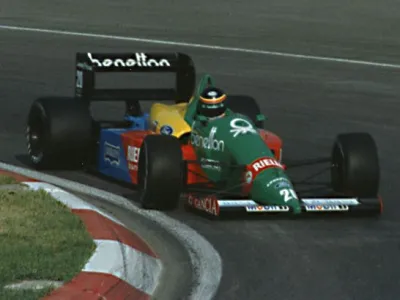
Thierry Boutsens design points towards strategic turning points that were crystallized through external events. His first Saturn return marked the transition into a phase of confirmation and structuring. This was evident in 1983 at age 26 when he made his Formula-1 debut at the Belgian Grand Prix for Arrows. This moment condensed years of groundwork into a solid professional outcome, typical of Saturn energy that demands stability and recognition in one's career.
Later, the Uranus opposition acted as a catalyst for sudden changes or the end of cycles. This mechanism was active in 1999 at age 42: His racing career ended in an accident during the 24 Hours of Le Mans race. Here, Uranus energy did not manifest as gradual development but as a sharp break that concluded his previous life phase and forced a new orientation. Both events underscore how Thierry Boutsens chart translated specific astrological transits into concrete professional milestones – once building structure through Saturn, later dissolving old patterns through Uranus. These configurations describe no coincidences but the temporal sequence of his incarnation task: first proving competence, then accepting the necessity to leave old roles for new developments.
Manifesting Generator · Sacral Authority — Synthesis
Thierry Boutsens design is marked by a dynamic tension between the urge for independent exploration and the need to learn through experience. As an Manifesting Generator with sacral authority (sacral center) and a profile as Researcher/Experimentor (Line 1/3), his life seems to revolve around constant searching, testing, and refining of knowledge and skills. The ability to quickly initiate things (Manifestor aspect) is amplified by the sacral energy while the Researcher drives him deep into topics and draw his own conclusions – a process fueled by defined mental centers (Head-Ajna).
A central paradox lies in the combination of the defined Head Center, which creates constant mental pressure for inspiration and understanding, and the sacral drive to react to external stimuli. While the defined Head Center prompts him to constantly ask questions and seek new insights (Knowledge Circuit), the sacral authority demands an immediate physical response. This tension is evident in the tendency to take quick steps but also the necessity to go back and review when needed – a pattern that showed during pivotal moments of his career (Saturn Return 1, Uranus Opposition).
4 Defined Channels
Incarnation Cross - Right Angle Cross of Maya 2
Solar Return
The Solar Return shows the moment when the sun returns to its exact birth position - your personal solar year.
Life Cycles
Discover the life cycles with a detailed triple view (birth chart, cycle chart, composite).
Human Design Profile
- Strategy
- To respond - wait for something to respond to
- Authority
- Sacral Authority
- Profile
- 1/3 - Investigator / Martyr
- Definition
- Single Definition
- Incarnation Cross
- Right Angle Cross of Maya 2
- Date of Birth
- 13.07.1957 12:50
- Place of Birth
- Brussels, Belgium
Frequently Asked Questions
What is Thierry Boutsen's Human Design type?
What Profiles does Thierry Boutsen have?
Which Authority does Thierry Boutsen have?
What is Thierry Boutsens' incarnation cross?
When was Thierry Boutsen born?
Discover your own Human Design
Are you also a Manifesting Generator? Find out in a personal reading how to unfold your multi-talents and direct your energy wisely.
More Personalities
Back to overviewAldair

Alizée

Angeli

Arletty

Artus

Balthus