
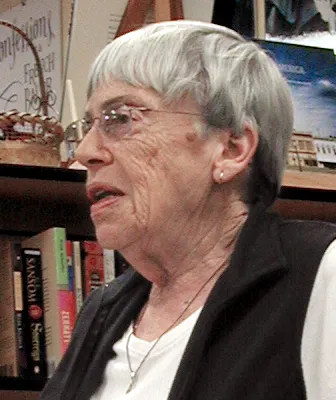
Ursula K. Le Guin
Human Design Chart
Biography
Her dad, Alfred L. Kroeber, was a prominent University of California anthropology professor and her mom, Theodora, was a writer. She grew up with three big brothers in a house filled with books, conversation and stimulating dinner guests. The stories her dad told of his studies among the northern California Indians molded her early ambition to be a writer. When her dad took a job at Harvard she accepted the free tuition at Radcliff. She went on to earn a master's in literature at Columbia and then went to France on a Fulbright scholarship.
Enroute to France aboard the Queen Mary she met her husband-to-be, Charles Le Guin. They were married three months later in Paris on 25 December 1953. She and Charles had three kids: Elisabeth, who became a cellist; Caroline, a college English instructor; and Theo, a social researcher. While Charles taught college Ursula began to write. At first her poetry was accepted for publication while her surrealistic novels got rejection slips until 1964, when she sold "Rocannon's World." Like most of the earlier sci-fi writers, her books centered on male characters. Then, in 1978, she crossed a sexist barrier when she discovered that her male protagonist's female sidekick was really the heart of the story in "The Eye of the Heron." A politically active feminist, she devotes her spare time to the abortion-rights movement and peace advocacy.
Ursula K. Le Guin — Generator with Profile 2/5
Generator 2/5 — Design at a Glance
Ursula K. Le Guin revealed herself as someone with immense, enduring strength that was unleashed not through constant initiation but through quick reactions to external impulses. As a Generator, she possessed a great deal of sacral energy, comparable to that of a workhorse, strong and resilient when burning for its task. This energy became effective when her inner self gave a clear 'yes'. Her strategy was to react to signals from life and then become active, rather than taking the initiative independently.
This mechanism was crucial for her well-being. When she listened to and acted on her inner resonance, it led to a deep sense of fulfillment. Conversely, frustration or energy loss threatened when she acted against this natural flow – whether through the compulsive nature of tasks without inner desire or by interrupting her work on things that moved her heart. The danger lay in wasting energy on things that did not receive inner approval, or being held back from her true creation, even though the strength was still there. Ursula K. Le Guin's design suggested that her greatest strength lay in her ability to react from the gut, thereby deploying her enduring energy purposefully and satisfyingly, rather than exhausting herself in initiatory efforts.
Sacral Authority
Ursula K. Le Guin revealed herself as a Generator whose decision-making was marked by sacral authority. This inner leadership, unique to this type, simplified her process: she did not react through intellectual analysis but through an immediate physical response to external stimuli. Her authority manifested as a 'gut feeling' – a palpable surge of energy or an inner grunting, signaling vitality and inexhaustible energy. When this sacral engine engaged, she acted with great enthusiasm and immersed herself in her tasks, free from excessive purposefulness.
Additionally, the activated Spleen Center acted as a supportive instance. Linked to the Sacral Center, it endowed her with the ability to react particularly quickly and spontaneously. This allowed direct access to her instinctive perception and physical well-being, to which she entrusted herself confidently. The Generator's strategy of reacting rather than initiating thus aligned with this physical intuition. Ursula K. Le Guin lived this mechanism by laughing at the signals of her body – a 'mhm' or a groan – to discern whether an opportunity awakened her energy or exhausted it. Thus, she found her way to satisfaction and joy in everyday life, guided by the clear priority of her sacral impulses over other defined centers.
The 2/5 Profile — Hermit / Heretic
Ursula K. Le Guin revealed herself as someone oscillating between a strong desire for withdrawal and the expectation of external help. Her Profile 2/5, the 'Natural Talent/Hero and Saviour', shaped this dynamic: Line 5 projected a heroic role, prompting others to seek solutions, while Line 2, the Hermit Line, demanded enforced space for isolation and inner clarity. She had to carefully weigh for what she expended energy to avoid losing herself in the service of others.
Her design included Gate 50 (second line), projecting determination and a clear value stance. This intelligence could, however, generate resistance if the foundation was not yet sufficiently refined. In confrontation, she tended to a strategic retreat to protect or reconsider these values. Parallel to this, Gate 56 (fifth line) worked through storytelling and attention-grabbing. Here, the mind examined the nature of life without giving direct action instructions. The world projected expectations on this ability to be stimulating and unusual. Uranus promoted innovation for attention-grabbing but also harbored the danger of deception or 'Born Lying', when stories were used for self-assertion. Ursula K. Le Guin used her alone time to discover when she could solve problems without forgetting herself. She often overcame resistance through exchange with friends who shared her values, rather than isolating herself against the pressure.
Split Definition — Defined & Open Centers
Ursula K. Le Guin appeared as a person with a consistent, trustworthy mental structure. Her defined Ajna Center ensured that she processed concepts and theories in a specific, consistent way, without being easily influenced by others. This mind was always active, providing her with a reliable source of conceptual thinking. She expressed these thoughts through her defined Throat Center, which acted as a pivot to translate mental content into clear communication and action.
Her ability to act stemmed from her defined Sacral Center, a source of immense vital energy. As a generator, she reacted to life rather than initiating; her sacral response determined whether energy was available for a task. This endurance was supported by her defined G Center, which gave her a firm self-identity and a clear sense of direction. She knew who she was and could show others new paths without being dependent on their expectations. Additionally, she had a defined Spleen Center, which gave her spontaneous intuition and a strong body awareness to act in the present and recognize what was essential for survival. The defined Root Pressure provided the constant undercurrent that propelled her forward.
At the same time, she was exposed to certain vulnerabilities through open centers. Her open Head Center lacked its own inspiration, tended to absorb the mental pressure of others, and got entangled in questions that were not her own. Her open Heart Center lacked consistent willpower; it was vulnerable to the attempt to prove its worth through promises, which often ended in frustration. Her open Solar Plexus absorbed the emotions of the environment, leading her to amplify and experience foreign moods as her own, rather than possessing a stable emotional wave. This openness made her a sensitive barometer for the emotional climate, but required the ability to disentangle from non-own feelings.
Channels for change, curiosity, intuition, logic and discovery.
Ursula K. Le Guin showed herself as someone who delved deeply into experience to make discoveries that later expanded collective understanding. This was an expression of the Discovery Channel 29-46, connecting the Sacral and G Centers. Here, the persistent endurance of Gate 29 merged with the determination of Gate 46 to be in the right place at the right time. She learned from practice, not theory, and shared her insights only when the process was complete.
Her way of transforming ideas into stories that prompted others to think came from the Curiosity Channel 11-56. This channel connected the Ajna Center with the Throat Center. Gate 11 sought new perspectives, while Gate 56 passed these on as inspiration. She was a storyteller, less interested in facts than in the instructive power of storytelling. Her words served to fill gaps in human experience and stimulate imagination.
At the same time, the Mutation Channel 60-3 shaped her inner rhythm. It connected the Root and Sacral Centers, bringing a pulsing, often melancholic energy. Gate 60 accepted limitation, while Gate 3 created order from chaos. Ursula K. Le Guin had to learn to endure the silence between impulses to allow evolutionary change without being overwhelmed by internal tension.
Her ability to translate intuitive depth into masterful precision came from the Wavelength Channel 48-16. This channel connected the Spleen and Throat Centers. Gate 48 sought life-critical information that the mind could not grasp, while Gate 16 transformed skill into talent through practice. She perfected her form of expression through repeated practice until her unique wavelength became clearly audible.
The logical framework was provided by the Acceptance Channel 17-62, connecting the Ajna and Throat Centers. Gate 17 visualized patterns, Gate 62 translated them into language. She mentally organized details to integrate them into her worldview and spoke only when invited to ensure clarity.
Additionally, gates like 50 (Protection Reflex, Tradition), 24 (Mental Mutation), and 44 (Transformation through Interaction) influenced her personality, while gates 2 (Receptivity) and 1 (Uniqueness) shaped her design level.
Collective Circuitry — Circuit Signature
Ursula K. Le Guin's design laid a tendency to parallel, not directly connected, energetic streams. Her Split Definition separated her powers into two independent groups: a base of Sacral, Root, and G Centers, and a cognitive level of Ajna, Throat, and Spleen Centers. These areas worked alongside each other without forming a single continuous flow.
The Knowledge Circuit connected her Sacral and Root Centers through the Mutation Channel. This promoted a pulsing energy that supported deviations from the known and new paths of identity discovery. Parallel to this, the Understanding Circuit connected Ajna, Throat, and Spleen Centers. Through the Acceptance and Wavelength Channels, this configuration fostered focused, rational insights directed toward the future, free from emotional conditioning.
A third aspect was the Meaning Circuit. It consisted of two separate parts: Ajna and Throat on one side, Identity and Sacral Centers on the other side. These parts were not connected to each other. The Curiosity and Discovery Channels promoted here cyclical, emotional reflections of the past, awakening the need to share collected experiences with others. Thus, Ursula K. Le Guin was shaped by the interplay of these separate but simultaneously active fields.
Right Angle Cross of Laws 3
Ursula K. Le Guin's Human Design profile bore the imprint of the right cross of Law 3. This configuration indicated an inner tension arising from the interplay of authority and lawfulness. In Human Design, the right cross of Law 3 represents a specific energy connected to the question of 'right' and 'justice', but often in a way that is not immediately visible to the outside world. It is a structure deeply rooted in the subconscious, manifesting less through active enforcement than through a quiet, yet persistent alignment with internal standards.
For Ursula K. Le Guin, this meant that her actions and decisions were guided by a strong, yet often unspoken, inner compass. She did not primarily seek external confirmation of her authority but oriented herself according to principles she considered fundamental. This energy fostered a stance that oscillated between the desire for freedom and the necessity of order. It was less a struggle against external laws than a constant process of internal weighing to determine if an action aligned with her own understanding of justice. This dynamic shaped her way of moving through the world: not through loud protest, but through a consistent, if restrained, loyalty to her deeply rooted values.
Saturn Return · Uranus Opposition · Chiron Return · 2nd Saturn Return — Life Cycles
Ursula K. Le Guin's Human Design profile showed a tendency to transform inner structures and long-term commitments into tangible, concrete results. This orientation became visible during her first Saturn Return, the cycle of consolidation and responsibility, in 1957, when she was 28 years old, and had her first daughter with Charles A. Le Guin. This step marked the transition from potential energy to lived, structural reality, a typical expression of Saturn energy, which creates stability and durability.
Later, during the Uranus Opposition, often a phase of liberation and new creation, she published 'The Left Hand of Darkness' in 1969, at the age of 40. Using this dynamic energy, she broke through established boundaries and introduced new perspectives into her work. The Uranus influence promoted innovation and the desire to question the old.
The Chiron Return, a cycle of fulfillment and bloom, in which the life purpose deepens, occurred in 1978, when she was 49 years old. She published 'The Eye of the Heron'. This was not a moment of healing but of full unfolding of her inner strength and creative purpose. Finally, the second Saturn Return in 1985, when she was 56 years old, brought her recognition through the Janet Heidinger Kafka Prize. This confirmed the long-term impact of her work and the establishment of her reputation as a master in her field, a result of consistent, structured living.
Generator · Sacral Authority — Synthesis
Ursula K. Le Guin lived deeply in the creative energy of her Sacral Center (Generator Type), with a central red thread running through her life: the connection between inner vitality and the drive to materialize it. Her defined mental center enabled a consistent conceptual thinking, which through the Channel of Mutation (3-60) gained an unpredictable, transformative power. This energy, marked by melancholy and the acceptance of limitations, drove her to create new things and break existing patterns. The profile as a Natural Talent and Hero/Rescuer (2/5) reinforced this impulse, as she needed time for herself but also responded to others' expectations to offer solutions.
A central paradox in her design lay in the tension between the need for withdrawal (Line 2) and the call to problem-solving (Line 5). The cycles showed how she experienced both personal relationships (1957) and professional successes (1969, 1978, 1985), with the creative energy always alternating between phases of inner reflection and public recognition. This alternation between isolation and engagement shaped her creative process and revealed a deep ambivalence between the desire for autonomy and the obligation to do something for others.
5 Defined Channels
Incarnation Cross - Right Angle Cross of Laws 3
Solar Return
The Solar Return shows the moment when the sun returns to its exact birth position - your personal solar year.
Life Cycles
Discover the life cycles with a detailed triple view (birth chart, cycle chart, composite).
Human Design Profile
- Type
- Generator
- Strategy
- To respond - wait for something to respond to
- Authority
- Sacral Authority
- Profile
- 2/5 - Hermit / Heretic
- Definition
- Split Definition
- Incarnation Cross
- Right Angle Cross of Laws 3
- Date of Birth
- 21.10.1929 17:31
- Place of Birth
- Berkeley, CA, United States
Frequently Asked Questions
What was Ursula K. Le Guin's Human Design type?
What Profile did Ursula K. Le Guin have?
What Authority did Ursula K. Le Guin have?
What incarnation cross did Ursula K. Le Guin have?
When was Ursula K. Le Guin born?
Discover your own Human Design
Are you also a Generator? Find out in a personal reading how to use your sacral energy correctly and discover deep satisfaction.
More Personalities
Back to overviewAaliyah

Alain-Fournier

Alexia

Angèle

Angeli

Anne-Marie
