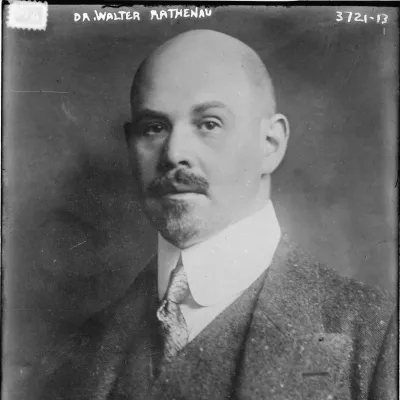
Walther Rathenau
Human Design Chart
Biography
Rathenau held a number of executive positions in German industry and, at the outbreak of World War I, headed the AEG. One of the few German industrialists who realized that governmental direction of the nation’s economic resources would be necessary for victory, Rathenau convinced the government of the need for a War Raw Materials Department in the War Ministry. As its head from August 1914 to the spring of 1915, he ensured the conservation and distribution of raw materials essential to the war effort. He thus played a crucial part in Germany’s efforts to maintain its economic production in the face of the tightening British naval blockade. He then returned to business and writing, but, when the collapse of the Western front became imminent in the autumn of 1918, he proposed a desperate levée en masse (“call to arms”) to turn defeat into victory.
After the war, Rathenau helped found the middle-class German Democratic Party and advocated a policy of cooperation with the Social Democratic Party of Germany. Convinced that the days of unrestricted capitalism were over, he advocated in his Die neue Wirtschaft (1918; “The New Economy”) industrial self-government combined with employee participation and effective state control rather than the wholesale nationalization of industry by the state.
Rathenau combined democratic convictions and a strong belief in international cooperation with economic experience and a knowledge of foreign countries.
The Human Design of Walther Rathenau: Projector 2/5
Projector 2/5 — Design at a Glance
Walther Rathenau's Human Design suggests a tendency towards precise system analysis. As a Projector, he did not have an intrinsic energy source from the undefined Sacral Center. Instead, his aura acted like a focused beam of light that directly targeted weaknesses in his environment. He could immediately identify flaws in other people’s systems. However, this ability was risky: Directly addressing these flaws often felt uncomfortable and met with resistance. His optimal strategy involved waiting for an honest invitation from his surroundings to engage. Rather than pushing himself forward actively, he should radiate his competence through harmony, allowing others to seek out his leadership naturally. If he did not follow this design, burnout was a risk due to the lack of rest zones between phases of high activity. Success and recognition were rewards for living according to this design; deviating from it inevitably led to experiencing bitterness as a non-self theme. His nature was designed to illuminate paths for others, not to overshadow them with mere presence or correct them against their will.
Splenic Authority
Walther Rathenau's Human Design suggests an inclination towards intuitive and immediate decision-making. His inner authority resided in the defined Spleen Center while his Emotional and Sacral Centers remained open – a configuration only Projectors or Manifestors exhibit. The Spleen served as his health and alarm system, equipped with a pronounced survival intelligence. This manifested as spontaneous internal knowledge about whether a situation, environment, or society was right for him. His instincts and physical well-being acted as reliable indicators. Decisions had to be made in the immediate moment; the first impulse was always correct and directly served his protection. This allowed him to rigorously shield against harmful influences and take good care of himself. However, this Spleen voice was a very subtle impulse that only appeared once in the present moment. It could easily be ignored or drowned out by other influences, requiring high vigilance. Since Walther Rathenau knew what was right only at the moment, plans could change quickly. Long-term commitments were difficult; his design preferred much freedom and flexibility over rigid obligations. A retreat to make decisions could be helpful in perceiving this subtle impulse without it being lost amidst external noise.
The 2/5 Profile — Hermit / Heretic
Walther Rathenau's Human Design suggests a tendency towards strategic withdrawal before engaging publicly. His Profile 2/5 combined the need for solitary immersion with the role of Helper, which others sought out during crises. He used his alone time to clarify where he wanted to invest his energy rather than reacting to every demand. This protected him from exhaustion due to constant expectations from his environment.
The Line 2 in Gate 18 promoted acceptance towards unchangeable circumstances. Instead of fighting against irreparable situations, he sought renewal through inner adaptation. At the same time, the Line 5 in Gate 52 allowed him to remain precise and focused during phases of inactivity. In times of crisis, his strength lay in holding back and only acting when necessary. His statements were concise and goal-oriented, giving them effectiveness within the collective. Thus, Walther Rathenau lived not through constant action but through targeted interventions after careful deliberation in solitude.
Single Definition — Defined & Open Centers
Walther Rathenau's Human Design indicated a tendency towards intuitive, momentary action. His defined Spleen Center provided strong body awareness and a reliable instinct for the 'now'. This existential intuition served as an inner authority: he tended to trust spontaneous warning signals or feelings of well-being rather than questioning them rationally. Simultaneously, his defined Root Center presented a constant, adrenalized pressure. This stress did not function as a disturbance but as a driving force that propelled him materially forward and corrected when systems failed. The combination of Spleen intuition and Root pressure created a mechanism for survival-oriented progress: he acted from the gut, sustained by a steady internal push.
At the same time, his design revealed significant vulnerabilities to external conditioning. His open Head Center made him susceptible to mental overload; he tended to get entangled in questions and doubts that did not belong to him and sought inspiration or answers from outside to relieve mental pressure. The open Ajna Center amplified this flexibility: he absorbed concepts and theories like a mirror without identifying them as his own truth, making him receptive to intellectual currents of all kinds but also leading him to pretend to be more certain in his ideas than he was.
His open Throat Center lacked a firm identity or direction; he adapted to the environment and sought the right 'place' where he could feel comfortable. The open Heart Center led to not being consistently willful, often feeling the pressure to prove his worth through promises or performance – a cycle that resulted in self-doubt upon failure. Additionally, his open Solar Plexus absorbed others' emotions, making him appear emotionally volatile, while the open Sacral Center meant he did not have a constant energy source and easily became exhausted when he could not resist the generative energy of his environment.
Channels for logical analysis and finding the best solution.
Walther Rathenau's Human Design indicated a tendency towards analytical sharpness and a drive for structural perfection. He was someone who questioned patterns to correct them and make them functionally viable for the collective. This attitude was primarily shaped by Channel Judgment 58-18. This connection between Root and Spleen Centers linked the living energy of Gate of Vitality (58) with the critical eye of Gate of Correcting (18). Logic had to prove that it offered the best answers; an insatiable impulse arose to check everything that was not in balance. Rathenau's judgment acted like a sentry ensuring patterns remained healthy and executable to restore joy and satisfaction.
Additionally, other gates shaped his orientation: Gate 17 brought logical teaching and concern for succession as well as human rights, with doubt seen as a healthy process. Gate 52 demanded self-imposed pauses for concentration on pattern correction while Gate 32 focused on continuity, material success, and tribal connection. Gate 57 provided intuitive clarity in the here and now, Gate 28 the ability to listen to risks and make decisions in the moment. Finally, Gate 39 through analysis and provocation activated selective processes to induce mutations. This combination created a personality that not only critically judged but sought structural solutions that were both logically sustainable and intuitively clear.
Collective Circuitry — Circuit Signature
Walther Rathenau's Human Design indicated a tendency towards strategic clarity and improving structures. As someone with simple definition, he had a coherent, continuous energetic flow without internal fractures or separate fields. His focus was on the Understanding Circuit, a system using logic, strategy, and rational insight to guide society toward a better future. This circuit operates consciously free from emotional conditioning as the Solar Plexus Center is not involved; it's pure, 'emotionless ratio'.
Within this circuit in Walther Rathenau specifically, Channel Judgment was active. This channel directly connected the Spleen and Root Centers. The Spleen Center brings the ability to recognize patterns and select essentials while the Root Center provides the necessary energy for endurance and implementation. Through this connection, Walther Rathenau could translate intuitive insights into strategic action capability. Energy flowed seamlessly between these two centers as they belonged to the same group. This shaped his way of improving things: through focused analysis and sharing logical insights based on a deep understanding of connections. His simple definition also meant he experienced these forces as an integrated unit, not as conflicting impulses from different sources.
Right Angle Cross of Service 3
Walther Rathenaus Human-Design legged a foundational orientation towards service to others. This alignment corresponded with the configuration 'The Right Service Cross 3'. It did not describe passive submission but rather an active dedication to tasks that transcended personal ego boundaries. The energy of this structure acted as a driving force for engagement aimed at collective benefit. Rathenau was marked by this mechanism: his actions were less oriented towards individual recognition and more towards fulfilling a larger task. This 'service' was not a moral ideal but an energetic necessity of his system. The number 3 in this designation pointed to a specific expression often associated with communication or the construction of structures that benefited others. Rathenau lived this dynamic not as a choice, but as an inner logic of his existence. His motivations flowed where they were needed to stabilize or improve systems. This configuration created a connection between personal energy and external effect, always focusing on the welfare of the whole. It was a design that found its true fulfillment in supporting others without losing its own self, but rather confirming it through service.
Saturn Return · Uranus Opposition · Chiron Return — Life Cycles
Walther Rathenaus Human-Design established a tendency towards strategic build-up and structural consolidation. This foundational stance became evident in 1893 when he founded the subsidiary company 'Elektrochemische Werke Berlin G.m.b.H.' at age 26, and built a factory for washing soda production in Bitterfeld. This first Saturn Return marked a point where years of groundwork condensed into a tangible, material result – a typical moment of anchoring for his system.
Later, a phase of dissolution and reorientation emerged. In 1907 at age 40, Rathenau resigned from the board of ECW. This coincided with the Uranus Opposition cycle, often breaking existing structures to initiate necessary change or crises that release old bonds.
The Chiron Return, an achievement cycle between ages 49 and 51 where one's incarnation cross unfolds and purpose becomes experiential, marked his later years. In 1916 at age 49, he participated in a conference at the Prussian War Ministry advocating for the deportation of Belgian civilians to forced labor. At this age, his design showed a phase where personal life task and inner purpose increasingly manifested in external life – not as healing but as flowering of his own design, independent of moral judgment of the action itself.
Projector · Splenic Authority — Synthesis
Walther Rathenau lived an existence marked by a deep drive to recognize potential within systems and optimize it through precise analysis (Channel Judgment). His defined Spleen Center endowed him with a pronounced instinct for what enabled healthy decisions in the present moment, coupled with the ability to quickly identify errors – a gift that propelled him to improve existing structures. This tendency was repeatedly evident in initiatives aimed at efficiency enhancement and realignment, always seeking ways to perfect the existing (Gate 18).
Simultaneously, his profile as a natural talent/hero and rescuer revealed a paradox: although he possessed the ability to offer solutions and support others, it also required phases of withdrawal and inner collection (Line 2). Recurring cycles that both showed professional success (founding ECW) and crises (resignation from board, participation in deportation conferences) indicated his oscillation between the need for engagement and desire for autonomy. This led to a tension between the drive to actively influence and the necessity of protecting oneself from overextension.
1 Defined Channel
Incarnation Cross - Right Angle Cross of Service 3
Solar Return
The Solar Return shows the moment when the sun returns to its exact birth position - your personal solar year.
Life Cycles
Discover the life cycles with a detailed triple view (birth chart, cycle chart, composite).
Human Design Profile
- Type
- Projector
- Strategy
- Wait for the respectful invitation
- Authority
- Splenic Authority
- Profile
- 2/5 - Hermit / Heretic
- Definition
- Single Definition
- Incarnation Cross
- Right Angle Cross of Service 3
- Date of Birth
- 29.09.1867 08:00
- Place of Birth
- Berlin, GER
Frequently Asked Questions
What was Walther Rathenau's Human Design type?
What profile did Walther Rathenau have?
Which authority was active in Walther Rathenau?
What incarnation cross did Walther Rathenau have?
When was Walther Rathenau born?
Discover your own Human Design
Are you also a Projector? Find out in a personal reading how to unfold your leadership qualities and recognize the right invitations.
More Personalities
Back to overviewSissy Spacek

Alain-Fournier

Anémone

Ann-Margret

Bourvil
Hergé