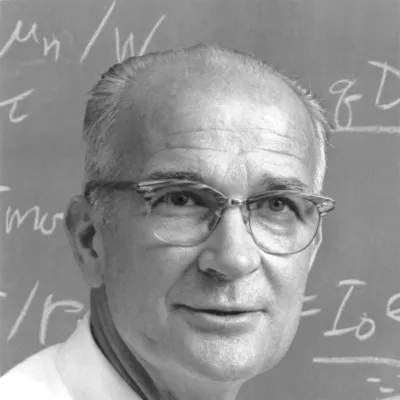
William Shockley
Human Design Chart
Biography
He was awarded many prizes and received many honors culminating in the Nobel Prize for Physics, 1956.
His contributions during World War II were numerous. He worked in Bell Labs but his abrasive management style caused him to run his own company. He became increasingly paranoid and because of that his team broke up.
In his later years, Shockley slipped into eugenics and was attacked in print, on television and in scientific journals. His last years were very sad; he was estranged from all his friends.
He died of prostate cancer on 12 August 1989 at age 79 in Stanford, California.
William Shockley — Manifesting Generator with Profile 6/2
Manifesting Generator 6/2 — Design at a Glance
William Shockley was someone who quickly drew things into his life. As an Manifesting Generator, he had constant sacral energy, which gave him the power to push projects forward with great dynamism. His nature was a hybrid of Generator and Manifestor, allowing him to skip steps when taking action. However, this speed was double-edged: Often, his actions were too quick, causing important stages to be overlooked. In such cases, he had to backtrack and make up for the missing parts, leading quickly to frustration – his specific Non-Self theme. Additionally, he tended to tackle multiple things at once, driven by various impulses. Without strict adherence to his strategy of waiting and responding to inner signals, his creative enthusiasm easily tipped into overextension. The key position for him was to start only when his sacral center gave a clear “yes”. When this condition was met, he could draw deep satisfaction from his work. Then the parallelism of different tasks not only helped but also promoted his necessary play mode. The advice to focus on one thing did not suit his constitution; variety and fun were essential to keep his unique creative power going.
Sacral Authority
William Shockley's design tended towards direct, physical resonance. As a Generator, he had sacral authority, meaning that his strategy and inner decision-making instance were identical: waiting for external stimuli and responding to them. This structure greatly simplified his orientation process as no weighing between different strategies was necessary.
The prerequisite for this clear leadership was an open emotional center. William Shockley showed through a so-called “gut feeling” or noticeable energy surges that arose in response to his environment. His system signaled agreement with loud sounds like grunts or hums, and soft sounds like “Hmm”. When his sacral motor engaged on a topic, he felt vital and alive. He then had seemingly inexhaustible energy and completed tasks with great enthusiasm. This allowed him to immerse himself in his activities without the need for external purpose.
Furthermore, his activated spleen center and its connection to the sacral center acted as supporting authority. This configuration enabled William Shockley particularly fast and spontaneous reactions. He had direct access to his physical well-being and instinctive perception, which he could rely on confidently. His decisions thus did not arise from intellectual planning but from a direct, physiological response to the world around him.
The 6/2 Profile — Role Model / Hermit
William Shockley's design presented itself as a path of profound transformation through personal experience and later wisdom. In the early years of his life, before turning 30, his configuration worked like an experimental phase: trial and error characterized his approach, followed by necessary withdrawals for processing. This period served to gather many personal life experiences without yet possessing final clarity.
After around thirty years, this dynamic fundamentally changed. The sixth line became active and drew him into a metaphorical cave – a state of distance and intense reflection. Here he evaluated his earlier experiments with newly gained emotional clarity. This phase was not a passive pause but a process of healing and deep self-awareness, where he examined which principles of his revolution truly promoted justice and prosperity.
He learned to delegate responsibility and trust experts rather than proving everything himself. This ability to delegate relieved him from frustration and allowed him to focus on the essentials. When he finally emerged from this period of introspection, it was as a wise person. Others sought his advice to partake in his life wisdom and learn the art of deep self-reflection from him. His authority did not rest on coercion but on authentic transformation through personal example and careful, long-term decision-making processes.
Split Definition — Defined & Open Centers
William Shockley's design predisposed him to a tendency of constant mental pressure and conceptual processing. The definition between Head Center and Ajna Center created a perpetual impulse to question and understand connections, without providing the direct energy needed for implementation of these thoughts. This often led to inner concern or frustration when his mind tried to immediately turn ideas into action instead of waiting for the right moment for others.
At the same time, he had a reliable internal structure through defined G-, Heart- and Sacral Centers. The G Center gave him a firm identity and direction, while the Heart Center offered willpower and the ability to keep promises. As a Generator with defined Sacral, he possessed an enormous vital energy source that could only be correctly activated by reacting to external stimuli; initiatives from his mind quickly led to resistance and exhaustion here.
In contrast, his Solar Plexus and Root Centers revealed specific vulnerabilities. His open Solar Plexus Center absorbed the emotions of the environment, making him susceptible to emotional conditioning and prone to personalizing foreign moods or avoiding confrontation out of fear of rejection. Simultaneously, his open Root Center amplified external stress and adrenaline, putting him under pressure to be constantly active to escape this unpleasant feeling – a cycle that without awareness quickly led to overloading. His challenge was not to misinterpret mental inspiration as an instruction for action but instead trust in his sacral response and inner authority to avoid energy depletion through emotional or stress-induced reactions.
Channels for powerful expression, clarity and pioneering spirit.
William Shockley's design predisposed him towards individual, exemplary leadership. The Channel of Inspiration 1-8 connected his G Center with the Throat Center, drawing attention through his mere presence and expression of unique identity. He inspired others not primarily through words but by living out his creative direction and thereby changing their perspective.
This effect was deepened by the Channel of Wavelength 48-16. Here, the intuitive depth of the Spleen Center (Gate 48) connected with dexterity in the Throat Center (Gate 16). William Shockley sought life-critical information and perfected skills through repetition until technical mastery became a talent. This required engagement and recognition of his work to further develop the pattern.
As an Manifestor Generator, the Channel of Charisma 34-20 acted as a motor for these forms of expression. The sacral energy (Gate 34) propelled him to act in the moment and unfold his charismatic power. This raw life force required reaction to external stimuli to avoid slipping into obsession or chaotic action; it served self-reinforcement through activities that truly mattered to him.
Mentally, two additional channels shaped him. The Channel of Awareness 61-24 connected the Head Center with the Ajna Center. Here his mind sought inspiration (Gate 61) and transformed it into rational answers (Gate 24). He could not control when knowledge appeared; it happened mutatively as Satori, when the thought process opened a gap.
Additionally, the Channel of Initiation 51-25 connected the Heart with the G Center. The competitive energy of the ego (Gate 51) sought the shock of initiation to promote individualization. This was a mystical process: William Shockley could only strengthen others if invited; otherwise, imposing leadership led to bitterness. His design demanded dedication to these inner impulses to survive transcendent encounters and immerse in new awareness.
Individual Circuitry — Circuit Signature
William Shockley's design presented a complex structure of split definitions, where four circuits formed specific energetic flows. In the Knowledge Circuit, two isolated segments existed: Inspiration connected Head Center with Ajna Center (Channel 1-8), while Awareness linked Throat Center with Identity Center (Channel 24-61). This separation meant that mental impulses did not directly flow into the expression of his own identity.
The Centering Circuit acted through Initiation (Channel 25-51), which directly connected Identity Center to Heart Center. This created inner stability and strong personal convictions, but lacked direct access to Throat Center for their external expression. Simultaneously, the Understanding Circuit linked Throat Center with Spleen Center via Wavelength (Channel 16-48). Here, a capability was shown to articulate logical insights and strategic knowledge precisely, separate from emotional evaluation.
Finally, the Integration Circuit connected Throat Center with Sacral Center through Charisma (Channel 20-34), enabling intuitive power and life energy to be directly translated into words or actions. Although William Shockley had defined centers in both groups – on one hand Head and Ajna, on the other G-, Throat-, Spleen-, Sacral-, and Heart Centers – these main clusters remained energetically separate from each other. Thus, the mentioned circuits formed distinct, parallel existing functional areas without a continuous flow between the two large center clusters.
Left Angle Cross of Revolution 1
William Shockley's Human Design profile featured the left cross of Revolution. This configuration signaled an inner drive aimed at profound changes. It combined a personal growth need with the impulse to question and reorder existing structures. For William Shockley, this meant not just individual development but also a stance that sought systemic shifts. The left cross of Revolution describes a path where self-definition comes through breaking old patterns. It's about transforming oneself as well as using this transformation as a catalyst for larger upheavals. Thus, William Shockley was someone whose life mission involved destabilizing established orders to make way for the new. This energy wasn't passive observation but an active process of creation through deconstruction. His design suggested that true fulfillment lay only in mastering this revolutionary task – in the constant cycle of destruction and rebuilding. It was a driving force pushing him to transcend boundaries and establish new paradigms, often against the resistance of the status quo.
Saturn Return · Uranus Opposition · Chiron Return · 2nd Saturn Return — Life Cycles
William Shockley's Human Design profile showed a clear orientation towards technical innovation and the realization of complex ideas. This tendency reflected in his professional career, especially during the Uranus Return cycle. At age 37, in 1947, he participated in developing the transistor. This marked a phase of restructuring and new perspectives, typical for the influence of the planet Uranus on personal design. It was a moment when innovative impulses led to concrete implementation.
Later came the Chiron Return cycle period, often associated with the culmination or flowering of one's life purpose. William Shockley received the Nobel Prize in Physics in 1956 at age 46. This wasn't coincidental but aligned with the mechanics of this cycle: when a person follows their strategy and authority, their incarnation cross unfolds increasingly in life. The Nobel Prize thus represented visible confirmation of his inner development. It was not about healing old wounds but experiencing meaning and purpose through recognition for contributions to science. These events underscore how William Shockley's design shaped his role in the history of physics.
Manifesting Generator · Sacral Authority — Synthesis
He lived a life marked by deep sacral energy and an unceasing drive towards innovation. The combination of manifesting generator strategy – not initiating, but reacting to impulses – and defined Head Center (Inspiration) created an unstoppable cycle of inner motivation and creative expression. This process was reinforced by the Profile of Role Model: first intense personal experience, followed by a phase of reflection, and finally sharing profound insights with others. The ability to quickly spark things (Manifestor aspect) correlated with the knowledge circuit, enabling him to generate and transform new insights – a pattern evident in documented events.
A central paradox lay in the tension between the speed at which he could realize ideas and the necessity of not skipping important steps. Sacral impulse propelled him forward while the defined Head Center constantly raised new questions and inspired further thought. This led to an internal rhythm of swift action followed by reflection – a dynamic that both shaped his successes and potential setbacks, enabling him to act as a role model for others.
5 Defined Channels
Incarnation Cross - Left Angle Cross of Revolution 1
Solar Return
The Solar Return shows the moment when the sun returns to its exact birth position - your personal solar year.
Life Cycles
Discover the life cycles with a detailed triple view (birth chart, cycle chart, composite).
Human Design Profile
- Strategy
- To respond - wait for something to respond to
- Authority
- Sacral Authority
- Profile
- 6/2 - Role Model / Hermit
- Definition
- Split Definition
- Incarnation Cross
- Left Angle Cross of Revolution 1
- Date of Birth
- 13.02.1910 09:45
- Place of Birth
- London, UK
Frequently Asked Questions
What was William Shockley's Human Design type?
What profile did William Shockley have in Human Design?
What authority did William Shockley have?
What incarnation cross did William Shockley have?
When was William Shockley born?
Discover your own Human Design
Are you also a Manifesting Generator? Find out in a personal reading how to unfold your multi-talents and direct your energy wisely.
More Personalities
Back to overviewAldair

Alizée

Angeli

Arletty

Artus

Balthus