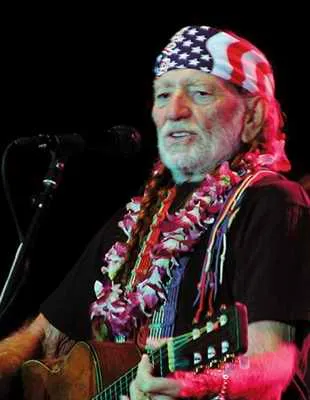
Willie Nelson
Human Design Chart
Biography
The second of two kids, Willie and his older sister Bobbie were raised by their paternal grandparents on a small farm. His parents left when he was three. Raised in the church with gospel music, granddad bought him a Stella guitar when he was six. He won a singing contest at age nine and joined a polka band the year after.
After service in the Air Force, Willie attended Baylor University. He was a disc jockey in 1956 and cut his first record, selling copies to his listeners in Vancouver, WA. After moving to Nashville in 1960, singing dates were few and in order to pay the rent and buy food, Willie started to sell his songs. His first break as a writer was Patsy Cline's recording of "Crazy" in August 1961. His Grand Ole Opry debut was 28 November 1964. Discouraged, he purchased a pig farm, but gave up when a fire destroyed the house on 23 December 1970.
"Red Headed Stranger" was his first gold album, 1975. He had the first platinum country album and multi-platinum albums during three different years and over 20 No.1 hits including "Blue Eyes Crying In The Rain" and "On The Road Again." He received Grammy Awards in 1975, 1978, 1980, 1982 and a Grammy Legend Award in 1990. His film debut was in 1979 in "The Electric Horseman." Willie published his autobiography June 1984.
His heart went out to the plight of small farmers and in 1985 he founded Farm Aid with Neil Young and John Mellencamp to help save struggling farmers from foreclosure. He used his concerts to raise more than $14 million dollars for the organization in the following 12 years and he received a Humanitarian Award.
Willy himself had major problems with the IRS. A former business manager did not file taxes from 1975 to 1982, leaving his finances in a state of ruin.
The Human Design of Willie Nelson: Projector 2/5
Projector 2/5 — Design at a Glance
Willie Nelson's design had a tendency towards precise diagnosis of system faults, coupled with the necessity to introduce these insights only when explicitly invited to do so. As a projector, he possessed a dense, focused aura that acted like a bright flashlight: it illuminated areas in the surroundings that were still in the dark or not functioning optimally. However, this ability to immediately recognize a fault in the system could be counterproductive if it was uninvited and directly addressed. The recipient often perceived the intense 'light' as unpleasant or accusatory, leading to friction.
Willie Nelson's effective strategy was not to actively impose this diagnostic sharpness but to attract others through his own harmonious glow. By living a functional reality himself, other people were automatically drawn to him and actively sought his advice. Only upon a respectful, honest invitation could he introduce his insights without provoking resistance.
Since his Sacral Center was undefined, he did not have a constant, intrinsic source of life energy. Instead, he experienced phases of high productivity, followed by necessary rest phases to avoid burnout. If he followed this rhythm and waited for the invitation, he was rewarded with success. Ignoring this dynamic and acting uninvited led to his Non-Self theme: bitterness. Therefore, his design required patience and restraint to effectively use his profound perception.
Emotional Authority
Willie Nelson's inner authority lies in his defined Emotional Center. This means that his decision-making is always influenced by an emotional wave that runs in a permanent up and down of feelings. The world appears to him colored by his current mood; the same thing can be totally inspiring in one moment and negatively evaluated in the next. His feeling in the moment is just a snapshot, a first impression that does not necessarily represent his truth. Quick, spontaneous decisions based on emotion can therefore have negative consequences.
The mechanics of his authority require patience: the more time he takes to let a decision mature, the deeper and more comprehensive he can perceive the situation. This involves sleeping on a decision multiple times and allowing himself to hesitate and ask multiple times. Over time, the intense feelings subside, emotional distance gains strength, and clarity and calmness set in. Only then is the process complete. This rule applies regardless of what else is defined in his chart; emotional authority always takes precedence. It is particularly important for long-term decisions that have a significant impact on the life course. Thus, Willie Nelson was shown to be someone who finds his deepest truth by waiting for emotional clarity.
The 2/5 Profile — Hermit / Heretic
Willie Nelson's design pointed towards a tension field between a deep need for withdrawal and the expectation of external help. As a person with the Profile 2/5, the 'Natural Talent', he needed time for himself to gain inner clarity, while others sought immediate solutions for their problems from him. The Line 2, the Hermit Line, requires isolation to spontaneously adapt new forms and project new things without internal reflection. This contrasts with Line 5, the Hero and Illusions Line, which prompts others to call for rescue. Willie Nelson had to carefully weigh where to invest his energy to avoid being drained by the constant requests of his environment. His role as a 'rescuer' was not always an active gesture but often a projected expectation that he could only fulfill after gaining the necessary distance and perspective in his 'cave'. Without this phase of self-reflection, there was a risk that he would forget himself or get into conflicts because the projected solutions did not align with his inner reality. His path was to integrate these two poles: to reconcile the solitude of the researcher with the public role of the helper.
Triple Split Definition — Defined & Open Centers
Willie Nelson's Human Design profile suggests a tendency towards persistent mental pressure and a clear, unshakable identity. The definition between the Head Center and Ajna Center created a constant inner drive to question and form concepts, yet without the energy to force these thoughts directly into the world. This required patience: inspiration only formed questions, whose solutions revealed themselves at the right moment. Simultaneously, his character was shaped by the defined G Center and Heart Center. He possessed a firm self-identity and a clear sense of direction, coupled with a strong willpower that allowed him to determine his life and resources. His voice, guided by the defined Throat Center, served as a reliable channel to express these inner truths.
At the same time, his system was vulnerable to external conditioning due to open centers. The open Sacral Center meant he did not have a constant, personal energy flow but instead absorbed and amplified the vitality of his environment. This could lead to overextending himself by mistaking borrowed energy for his own and not knowing when to stop. Additionally, the open Spleen Center carried a fundamental fear of survival and health. It tended to cling to people or situations that gave a false sense of security or well-being, rather than trusting his own healthy intuition. The challenge was to use the clarity of the Head, G, and Heart Centers to filter the impulses of the open Sacral and Spleen Centers and not react impulsively to external energy or fear.
Channels for emotional depth, reflection, clarity, community and abstraction.
Willie Nelson's Human Design profile suggests a tendency towards deep reflection and patient observation. He was someone who collected experiences to transform them into a coherent narrative later on. This attitude was shaped by the Lost Son Channel 13-33. It connected the G Center with the Throat Center, where listening (Gate 13) and withdrawal (Gate 33) worked together. Willie Nelson stored information and secrets, then withdrew to think about what he had heard before passing it on. This created continuity based on patience and waiting for the right revelation.
Parallel to this, the Awareness Channel 61-24, connecting the Head Center with the Ajna Center, was at work. Here, inspiration (Gate 61) and rational thinking (Gate 24) met. Willie Nelson's mind sought sudden insights, a 'Satori', that could not be forced. He had to trust the inner truth that revealed itself in its own time, often supported by silence or music to ease mental pressure.
Emotionally, the Channel of Emotional Release 39-55 shaped his expression. It connected the Root Center with the Solar Plexus Center, generating a pulsating wave between joy and melancholy. Willie Nelson used this moodiness to create authentic emotional depth, often through provocation (Gate 39), which spoke to the minds of others.
Socially, the Channel of Community 37-40, connecting the Solar Plexus Center with the Heart Center, was at work. He sought recognition (Gate 37) and the right place in the whole, but also needed breaks (Gate 40). Willie Nelson built bridges between individuals by waiting for personal invitations and direct connections, rather than impersonal contacts.
The Channel of Abstraction 47-64 connected the Head and Ajna Centers, filtering experiences through a kaleidoscope of mental images. Willie Nelson sought a story that made sense and shared this perspective once clarity emerged.
Additionally, Gate 44 (Awareness, Transformation) and Gate 19 (Resources, Spirituality) contributed to the ability to interact without preconditions and to act in a safe environment. Gate 21 (Control, Material Life) and Gate 41 (Evolutionary Development, Feeling) promoted overcoming obstacles through willpower and going through specific emotional experiences. Gate 51 (Willpower, Adaptation) and Gate 62 (Logic, Details) rounded out the profile by providing adaptability and the ability to recognize patterns and clarify facts.
Individual Circuitry — Circuit Signature
Willie Nelson's Human Design profile suggests a tendency towards pulsating, acoustic creativity, connected with the need to reflect on past experiences and share resources in the collective. These triply separated energy streams worked in parallel, not as a continuous flow.
The Knowledge Circuit in Willie Nelson connected the Head and Ajna Centers as well as the Solar Plexus and Root Centers. This promoted innovative flashes of insight and emotional waves that emphasized the unique path and new identity. The Purpose Circuit also connected the Head and Ajna Centers, as well as the Throat and Identity Centers. Here, it was about sharing felt insights from the past to learn together. Both circuits used the Head-Ajna connection, showing an intense, visually-emotional processing of ideas and memories.
The Ego Circuit connected the Heart and Solar Plexus Centers. This supported cooperation and giving and taking in the tribe, without the constant life force of the Sacral Center. It was necessary to take rest pauses to generate resources for the collective creation. Thus, Willie Nelson's design showed a person who, through intuitive inspiration and emotional reflection, went on new paths, shared them in the collective, and relied on mutual support and traditional values in dealing with resources.
Right Angle Cross of the Four Ways 1
Willie Nelson's design points to a specific configuration often referred to as the 'right cross of the four paths.' This structure is not just a collection of features but describes a deep archetypal imprint that manifests in the way he navigates life paths and deals with challenges.
In Human Design, this cross represents a unique kind of assertiveness and perseverance that arises not from external coercion but from an inner, almost fated constancy. It's not about aggressive pushing through but about a quiet, unshakable presence that doesn't necessarily overcome obstacles but simply endures them through sheer endurance and persistence. Willie Nelson demonstrated the ability to move through situations where others would have given up, not through loud protest but through a near meditative persistence.
This mechanism means that his influence often worked indirectly: he shaped his environment simply by being there, acting consistently, and living his own truth until circumstances adapted to him. It's the energy of 'finding the way' through the act of walking itself, without a rigid plan but with a clear inner direction. This quality defined his way of navigating life – less as a strategic master planner and more as someone who left his mark through sheer presence and endurance, simply continuing where others would have stopped.
Saturn Return · Uranus Opposition · Chiron Return · 2nd Saturn Return — Life Cycles
Willie Nelson's design shows a structure where external validation and inner integrity are strongly intertwined. His first Saturn Return in 1961 marked the transition from preparation to established presence. At this age, 'Hello Walls' reached number one on the Country Charts – a success that translated years of hard work into a sustainable, public achievement.
At 40, during the Uranus Opposition in 1973, a phase of radical realignment began. The production of the album 'Shotgun Willie' reflects the typical urge of this cycle: breaking old structures to make room for a more authentic, often provocative expression. It was not just a career step but a necessary break from established patterns.
The Chiron Return in 1982 brought the bloom phase of his incarnation purpose. At 49, he received the ACM Award for 'Always on My Mind.' This success was no coincidence but the late, clear unfolding of his deepest purpose – the experience that his specific contribution was now fully effective in life.
However, his second Saturn Return in 1990 brought a harsh test. At 57, he faced tax debts of over $16 million and lost all his possessions. This cycle forces confrontation with the foundations of one's existence. The loss was the price for a necessary, though painful, reordering of the material and structural basis of his life.
Projector · Emotional Authority — Synthesis
A central red thread in this design is the dynamic interaction between the need for solitude and the calling to serve others. The profile as a natural talent and hero (2/5) implies a natural ability to recognize problems (Gate 13), but also a deep desire to withdraw to process these observations (Gate 33). Emotional authority strengthens this inner rhythm, as decisions need time to clarify within the emotional wave. The defined Head Center contributes to a steady presence of inspiration and questions, enhancing the ability to recognize patterns and offer solutions, but also leading to inner pressure.
The central paradox lies in the tension between the Projector type, designed to bring light into darkness and reveal errors, and the need to selectively apply this gift. The line 5 in the profile indicates that expectations for help arise, while the line 2 emphasizes the need for solitude. Experienced cycles show that both successes (1961, 1982) and crises (1990) are connected to the expression of this inner dynamic, with the Uranus Opposition (1973) marking a phase of career transformation.
5 Defined Channels
Incarnation Cross - Right Angle Cross of the Four Ways 1
Solar Return
The Solar Return shows the moment when the sun returns to its exact birth position - your personal solar year.
Life Cycles
Discover the life cycles with a detailed triple view (birth chart, cycle chart, composite).
Human Design Profile
- Type
- Projector
- Strategy
- Wait for the respectful invitation
- Authority
- Emotional Authority
- Profile
- 2/5 - Hermit / Heretic
- Definition
- Triple Split
- Incarnation Cross
- Right Angle Cross of the Four Ways 1
- Date of Birth
- 30.04.1933 00:30
- Place of Birth
- Abbott, TX, United States
Frequently Asked Questions
What is Willie Nelson's Human Design type?
What Profile does Willie Nelson have in Human Design?
What Authority does Willie Nelson have?
What incarnation cross does Willie Nelson have?
When was Willie Nelson born?
Discover your own Human Design
Are you also a Projector? Find out in a personal reading how to unfold your leadership qualities and recognize the right invitations.
More Personalities
Back to overviewSissy Spacek

Alain-Fournier

Anémone

Ann-Margret

Arletty

Arno