
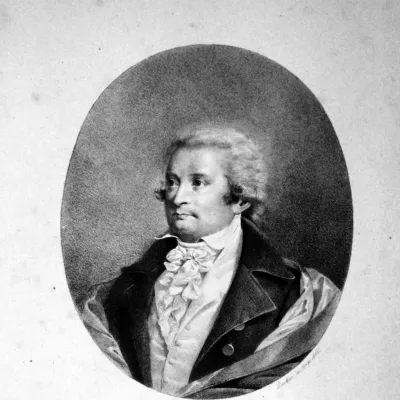
August Wilhelm Iffland
Human Design Chart
Biography
Destined for the church, Iffland, at the age of 18, broke with parental authority and joined the Gotha court theatre to study acting under Konrad Ekhof’s direction. In 1779, after Ekhof’s death, Iffland went with the Gotha company to Mannheim, where he created the part of Franz Moor in Friedrich von Schiller’sDie Räuber (“The Robbers”) and where his own plays achieved great popularity. He virtually controlled the Mannheim theatre and maintained a conservative policy and repertory. In 1796, on J.W. von Goethe’s invitation, Iffland appeared as guest star on the Weimar court stage, charming his audiences with truthful and yet stylized portraits of pathetic and comic middle-class characters. His flights into tragedy (Lear, Wallenstein, Egmont) were less successful. As an author, Iffland achieved comparable fame in the fields of domestic drama and sentimental comedy. In 1798 he was appointed manager of the Berlin National Theatre, and in 1811 he became director-general of all the royal theatres in Prussia.
He died 22 September 1814, Berlin.
What does Generator 3/5 mean for August Wilhelm Iffland?
Generator 3/5 — Design at a Glance
August Wilhelm Iffland had a Generator with enormous, sacral endurance. His design defined him as someone who generated energy not through sheer will but through reaction to external impulses. His system's motto was not 'initiate' but 'react'. His strength became effective when he responded to signals from his environment and gave a clear 'yes' internally.
This mechanism carried two specific risks. First, exhaustion threatened when he engaged in activities that did not resonate with him internally; here, he burned energy meant for his heart matters. Second, he suffered when he was prevented from working on his own projects, even though his inner drive still pushed him forward.
Living in harmony with this strategy – that is, waiting for the impulse and then acting – rewarded him with deep satisfaction and a sense of fulfillment. Initiating on his own, without reacting to a signal, inevitably led to frustration and a noticeable lack of energy. His strength thus lay not in pushing plans forward but in the powerful, enduring response to what life offered him.
Sacral Authority
August Wilhelm Iffland's design inclined him towards intuitive, physically anchored decisions. As a Generator, he possessed sacral authority, which also served as his strategy and simplified the decision-making process. This inner guidance did not come through intellectual analysis but as a direct physical reaction to external stimuli. Iffland had a 'gut feeling', manifesting as bursts of energy or loud, unconscious sounds like grunts or hums. Such signals marked the moment his sacral motor engaged with something. In these states, he felt vital and alive, with an almost inexhaustible energy that allowed him to lose himself in activities. He acted without purposefulness but out of pure enthusiasm and joy. The prerequisite for this clear guidance was his open emotional center, ensuring that emotional fluctuations did not distort the sacral response. Additionally, his activated spleen center acted as a supporting authority. This endowed him with the ability to react particularly quickly and spontaneously. He had immediate access to his physical well-being and instinctive perception, which he could reliably follow. This configuration shaped Iffland as someone who acted through spontaneous, powerful actions and a deep connection to his own life rhythm.
The 3/5 Profile — Martyr / Heretic
August Wilhelm Iffland emerged as someone who learned through personally experimenting with extremes to later guide others. His Profile 3/5, that of the experimenter and hero, defined this attitude: Line 3 prompted him to initially believe nothing blindly but to experience everything himself. He amassed a rich trove of practical experiences, often also through failures, which were essential lessons for him.
This personal appropriation of knowledge served not only himself. Line 5, the hero line, used these insights to solve others' problems and serve as an example. Iffland thus became attractive to his surroundings; people sought his advice because they wanted to learn from his lived experiences. This role of helper flattered his design, but could be painful if he failed in front of others.
The mechanics of his lines underscored this: Line 3 stood for mutation and overcoming limitations, while Line 5 offered leadership through practical solutions in crisis times. Iffland learned to wait for the right moment for changes to avoid confusion. He established limitations that paved the way for new developments, thereby transforming his own survival struggles into an offer for others.
Triple Split Definition — Defined & Open Centers
August Wilhelm Ifflands design points to a tendency towards consequential, self-determined action. His defined Heart Center endowed him with a reliable willpower and the need to control his life and resources independently. He enjoyed working but preferred the role of his own boss, following internal mechanisms that told him when it was time to work or take a break. This energy required him to only make promises he could keep, strengthening his self-esteem and avoiding resistance.
Parallel to this, he had a constant mental structure through his defined Ajna Center. His mind was constantly active, generating concepts and theories. He was not easily mentally influenced by others and used his mind as an external authority to condition the mental field in his aura. This mental clarity flowed into his defined Throat Center, allowing him to express what he thought with ease and honesty. His communication was thus a direct translation of his conceptual processes.
His defined G Center gave him a firm self-identity and a sense of his own direction. He knew where he belonged and could show others new paths without being dependent on them. It was important to him not to direct others who were not invited to follow him, as he could not control their direction.
In contrast, his Head and Solar Plexus Centers were open. The open Head Center made him vulnerable to mental pressure and the questions of others, which he did not necessarily recognize as his own. The open Solar Plexus Center absorbed the emotions of the environment, leading him to personalize foreign feelings or avoid confrontations out of fear of rejection. These open centers required vigilance to not be drawn into emotional waves or mental confusion of others, while his defined centers gave him the strength to be effective in the world.
Channels for pioneering spirit, change, seeking and ambitious transformation.
August Wilhelm Ifflands design points to a tendency towards evolutionary change driven by inner tension and sudden impulses. The Mutation Channel 60-3 connects the Root Center with the Sacral Center. This configuration generates a powerful, pulsating energy, often accompanied by melancholy. Iffland had to learn to accept the limitation and wait patiently for the right reaction from his Sacral Center, rather than rationalizing the moods away. This channel brought innovation and renewal into his life, but also forced him to adapt to unexpected changes.
Parallel to this, there was a pronounced curiosity about new ideas and stories. The Curiosity Channel 11-56 connects the Ajna Center with the Throat Center. This gave him the ability to transform information into captivating narratives that inspired and taught others. He was a storyteller who shared new perspectives through his experiences, engaging the imagination of his listeners, less interested in dry facts than in the magical power of a well-told parable.
Another defining aspect was the Initiation Channel 51-25, which ran through his Heart Center. It connected the competitive energy of the ego with the universal love of the Higher Self. Iffland had the gift of awakening the potential for individuation in himself and others through 'shocks' or challenges. This process was mystical and could not be controlled; it required that the initiation find him rather than him seeking it.
Additionally, the Transformation Channel 54-32, connecting the Root Center with the Spleen Center, was at work. Driven by ambition and the desire for recognition, he sought ways to improve his position and prove his worth. This energy required the support of the tribe to sustainably succeed.
Further Gates like Gate 50 (Values/Tradition) and Gate 52 (Concentration/Silence) added layers of awareness and withdrawal, while Gates like 38 (Resistance) and 2 (Receptivity) shaped his reaction to pressure and evolutionary directions.
Individual Circuitry — Circuit Signature
August Wilhelm Ifflands design points to a tendency towards separate, parallel functioning energetic blocks, characteristic of his Triple Definition. He did not have a continuous connection between these areas but acted with three independent power centers.
The Knowledge Circuit in him connected the Sacral with the Root Center through the Mutation Channel (Gates 3-60). This shaped a pulsating energy focused on deviations from the known and the emergence of a unique identity.
Parallel to this, the Centering Circuit, connecting the Identity with the Heart Center (Initiation Channel, Gates 25-51), fostered solid, courageous personalities with strong inner convictions. However, without a connection to the Throat Center, these firm stances often remained unspoken or hard to verbalize.
A third, isolated block formed the Meaning Circuit, connecting the Ajna with the Throat Center (Curiosity Channel, Gates 11-56). This was about the cyclical processing of emotions and experiences from the past. These felt insights were meant to be shared with the collective to learn together from history.
Finally, the Ego Circuit showed a connection between the Spleen and Root Centers (Transformation Channel, Gates 32-54). Without direct connection to the life force of the Sacral Center, this area required rest pauses to build resources for cooperation and mutual support in the social environment. August Wilhelm Iffland thus lived with these four distinct, non-fused energetic focal points.
Right Angle Cross of Laws 1
August Wilhelm Iffland's Human Design revealed a tendency towards inner stability and the protection of his own integrity. He was someone who was able to resist external pressure and maintain a deep, almost unshakable calm in the process. This stance resulted from the right cross of Laws 1, a structure that creates a strong connection between the emotional center and the solar plexus center. This connection generated an emotional resilience that allowed him to remain steadfast in turbulent times or under stress. Instead of being swept away by the emotional currents of others, he relied on his own slowly maturing emotional truths. This inner strength served as a protective shield, shielding his personal energy and self-worth from harmful influences. It was not an aggressive defense, but a quiet, almost stoic persistence that helped him maintain his own boundaries and not get caught up in the whirlpool of others' expectations. This mechanism shaped his approach to challenges: through inner centering and the avoidance of impulsive actions based on fleeting moods. Thus, a personality emerged that did not always speak loudly or dominate, but through its consistent stance and emotional clarity, it radiated a quiet authority that others respected.
Saturn Return · Uranus Opposition · Chiron Return — Life Cycles
August Wilhelm Iffland's Human Design was characterized by a clear orientation towards structural validation and public recognition. His life path was marked by milestones that aligned with the pursuit of recognition and status. In 1786, at the age of 27, he was invited by Prince Ludwig of Nassau-Saarbrücken. This event marked his first Saturn Return, a phase in which years of hard work often condense into a tangible, visible result. For his system, this moment was a typical proof of the ability to achieve a position validated from the outside through consistent work.
The dynamics of his development accelerated later through unexpected turns. In 1798, at the age of 39, he was appointed director of the Berlin National Theatre. This fell during the time of the Uranus Opposition, a configuration that often brings sudden changes or promotions that were not linearly planned but appeared as external opportunities. His structure responded by accepting and stabilizing this new authority.
The peak of this development occurred in 1808, when he returned to Vienna at the age of 49. This corresponded to his Chiron Return, a fulfillment cycle in which one's potential, if lived according to the inner strategy, fully unfolds. For Iffland, this was not a moment of healing but of bloom: years of work and achieved positions culminated in a phase where his life purpose and competence in public life showed their full, meaningful impact.
Generator · Sacral Authority — Synthesis
August Wilhelm Iffland primarily lived through his sacral energy (Generator Type), which through experimentation and testing (Line 3) constantly opened up new paths. This energy found expression in a pulsating, creative format (Knowledge Circuit), fueled by the acceptance of limitations (Channel 3-60) and the resulting melancholy. He was a person who gained knowledge through practical experience and used this knowledge to inspire and transform others – a process that was reinforced by the defined mental center, which created consistent concepts.
A central tension field lay in the interaction between his need for constant renewal and the resulting confusion (Gate 3) and the ability to create order through defined thought structures (Ajna Center). This led to an inner dynamic in which he acted mutatively and unpredictably on one hand, but also had the need to solidify and pass on his experiences. Career events (Saturn Return, Uranus Opposition, Chiron Return) showed how he navigated this tension throughout his life.
4 Defined Channels
Incarnation Cross - Right Angle Cross of Laws 1
Solar Return
The Solar Return shows the moment when the sun returns to its exact birth position - your personal solar year.
Life Cycles
Discover the life cycles with a detailed triple view (birth chart, cycle chart, composite).
Human Design Profile
- Type
- Generator
- Strategy
- To respond - wait for something to respond to
- Authority
- Sacral Authority
- Profile
- 3/5 - Martyr / Heretic
- Definition
- Triple Split
- Incarnation Cross
- Right Angle Cross of Laws 1
- Date of Birth
- 19.04.1759 00:30
- Place of Birth
- Hannover, Germany
Frequently Asked Questions
What was the Human Design type of August Wilhelm Iffland?
What Profile did August Wilhelm Iffland have?
What Authority did August Wilhelm Iffland have?
What incarnation cross did August Wilhelm Iffland have?
When was August Wilhelm Iffland born?
Discover your own Human Design
Are you also a Generator? Find out in a personal reading how to use your sacral energy correctly and discover deep satisfaction.
More Personalities
Back to overviewSissy Spacek

Aaliyah

Alexia

Anémone

Angèle

Ann-Margret
