
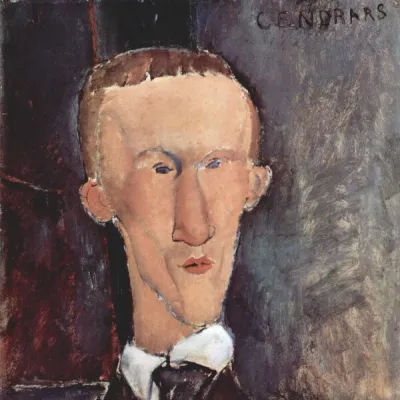
Blaise Cendrars
Human Design Chart
Biography
Sauser left his parental home at the age of 15 and began an apprenticeship with a jewelry-maker. He travelled for a big part of his life and visited China, Mongolia, Iran, the Caucasus and Russia. He had many jobs until he went to study medicines and philosophy in Bern.
He moved to Paris in 1910 where he met the poet Guillaume Apollinaire, under his influence and the experience of his world travel he began to cultivate his own style. In his poem Prose du Transsibérien et de la petite Jeanne de France he describes his world travel. His carreer as a writer got interrupted by World War I. He fought in the French Foreign Legion from December 1914 till February 1915. He lost his right arm in battle and got dismissed from the army. He wrote about his experiences in La main coupée (the cut hand) and J’ai tué (I have killed).
(the portret painting of Blaise Cendrars is from Modigliani)
Blaise Cendrars — Projector with Profile 4/6
Projector 4/6 — Design at a Glance
Blaise Cendrars revealed himself as someone who could identify weaknesses in systems and people with almost relentless clarity. His Projector Design endowed him with a dense, focused aura that shone like a bright beam of light on areas where others were still in the dark or not functioning properly. However, this ability to immediately spot flaws could be counterproductive when he addressed these shortcomings directly; his interlocutors often found it uncomfortable, much like being blinded by a direct light beam.
Instead, Blaise Cendrars was most effective when he lived harmoniously and developed an attractive aura that drew others to him. People sought out his advice actively because his shining example invited them to ask for his insider tips. His strategy involved waiting for respectful invitations from those around him rather than taking the initiative himself.
Since he lacked a defined Sacral Center as a Projector, he did not have a constant source of intrinsic life energy. Instead, he went through phases of high activity and rapid work speed followed by necessary rest periods to regenerate. Ignoring his need for pauses could lead to burnout. However, if he lived in harmony with his nature and waited for others' invitations, he was rewarded with success. If he missed this path, sooner or later he would feel bitterness as an expression of his non-self.
Emotional Authority
Blaise Cendrars lived with emotional authority. His design determined that the defined Solar Plexus Center carried his inner decision-making instance. In Human Design mechanics, this rule is strict: if the Emotional Center is activated, it takes over the authority – regardless of which other centers are also defined. This priority was a central mechanism in his graphic.
His inner landscape showed constant ups and downs of emotions. The world appeared to him always colored by his current mood. In one moment he could be totally enthusiastic about something, in the next he saw the same thing completely negatively. His feeling at any given moment was however only a snapshot, an initial impression that did not necessarily correspond with deeper truth.
Quick, spontaneous decisions based on such emotions often had negative consequences for him. The more time he took to let a decision mature, the deeper and more comprehensive he could see the situation. This process required patience and multiple reconsiderations of important questions. He should take his time and ask himself several times. Over time, intense feelings subsided, emotional distance was gained, clarity and calmness set in. Only then had he gone through the process. This mechanism applied particularly to long-term decisions that could have a significant impact on his life course.
The 4/6 Profile — Opportunist / Role Model
Blaise Cendrars revealed himself as someone whose life was strongly shaped by the tension field between the urge for connection and the need for detached reflection. In his first thirty years, he intensely experimented with relationships and friendships, driven by the dynamics of his Profile Line 4, which in this phase worked similarly to a Line 3 and promoted curiosity and social exploration. However, once Line 6 became active, a character conflict emerged: The desire to be part of a community clashed with the impulse to withdraw to ponder deeper questions about meaning. This inner contradiction between heart and head often led to confusion as he had to learn to integrate these two poles.
Line 4 emphasized the importance of correct timing in the network; he sought the right moment for influence, but also needed to find balance between willpower and necessary rest phases to prevent burnout. Simultaneously, through his Line 6 a growing skepticism towards superficial conviction developed. Initially gullible and susceptible to propaganda, over time he learned to assess others' expressive power and make critical judgments. This pursuit of artistic skill served him as a means to achieve a form of immortality, but the failure to reach his high ideals could trigger depression. In later years, he became an example figure whose wisdom was defined by cooperation with others and careful handling of his large heart.
Split Definition — Defined & Open Centers
Blaise Cendrars revealed himself as someone whose expression stemmed from a deep inner structure. His defined Throat Center connected with the Heart and Solar Plexus Centers, giving him a voice that was both willful and emotionally tinged. He did not just express concepts but acted out of a strong ego ("I want this") and let his feelings flow into his communication. This combination shaped a direct, authentic style that required patience: Since his Solar Plexus Center was defined, he had to wait for the emotional wave to pass before gaining clarity and speaking or acting. Impulsive statements at emotional peaks tended to be regretted later; true precision emerged only after navigating through emotional fluctuations.
At the same time, his Spleen Center was defined, giving him spontaneous, intuitive perception in the moment. This bodily intelligence served as a protective mechanism and source of immediate, trustworthy judgments about health and well-being, independent of rational thought.
In contrast, his open G Center revealed a lack of fixed identity. Cendrars did not actively seek direction or love; instead, he absorbed them from his environment. He tended to question who he was when in false contexts but found his true alignment through initiation by others at the right places. His open Head and Ajna Centers made him receptive to inspirations from the environment, yet he was vulnerable to adopting foreign mental pressures and confusion as his own. Rather than solving endless questions himself, he benefited from acting as a mirror for other people's ideas without identifying with their uncertainties. His open Sacral and Root energy also meant that he absorbed energy from the surroundings – making him susceptible to exhaustion if he did not trust his inner authority to set boundaries and recognize external stress rather than interpreting it as personal drive.
Channels for community, intuitive clarity and precise communication.
Blaise Cendrars revealed a deep, instinctive intelligence that he translated into precise expressive power. His design combined intuitive insight with the ability to perfect skills. The Channel of Wave Length 48-16 linked Gate Depth (48) in the Spleen Center with Gate Dexterity (16) in the Throat Center. This configuration fostered the development of a unique talent through repeated experimentation and refinement, where inner intuition culminated in technical mastery. Parallel to this, the Channel of Flash of Insight 57-20 worked, linking intuitive insight (Gate 57) directly with communication in the present moment (Gate 20). This enabled spontaneous, truth-based expressions that drew from a deep survival intelligence and encouraged others to recognize their own inner wisdom.
Additionally, the Channel of Community 37-40 shaped his social engagement. It connected Gate Friendship (37) in the Solar Plexus Center with Gate Solitude (40) in the Heart Center. This created an emotional foundation for trusting relationships and fair agreements where willpower and affection went hand in hand. Cendrars sought his place within a group, built bridges between individuals, ensuring that everyone could make a respected contribution.
Individual Gates complemented this profile: Gate 9 at the Sacral Center promoted meticulous work and taming of details through focused energy. Gate 55 in the Solar Plexus Center brought emotional instability and mood swings, while Gate 31 enabled the transmission of leadership qualities. Gate 28 steered decisions here and now considering personal risks. Gate 56 supported storytelling through vivid abstraction of mental processes. In his design, Gate 45 with its tribal energy, Gate 62 with logical pattern recognition, and Gate 50 as a conservative reflex for traditional values worked together to shape a person who combined deep knowledge with clear communication and social cohesion.
Tribal Circuitry — Circuit Signature
Blaise Cendrars’ design inclined towards impulsive, creative impulses that were directly translated into language. His Knowledge Circuit linked the Throat Center with the Spleen through Channel 20-57. This connection generated sudden flashes of insight – intuitive realizations that had to be immediately articulated. Parallel to this, his Understanding Circuit also ran between throat and spleen but was defined by Channel 16-48. Here it was about sharing logical strategies and visual concepts for the future. Both circuits used the same energetic path yet differed in quality: once intuitive creativity, once rational structure.
A third, separate stream formed his Ego Circuit. It linked the Heart Center with the Solar Plexus through Channel 37-40. This created a dynamic of giving and taking, guided by emotional waves. Since this group was not connected to the others, Blaise Cendrars had two parallel, non-intersecting systems: on one hand, communicative expressiveness (throat-spleen), on the other, interpersonal resource distribution and emotional support (heart-solar plexus). The Shared Definition meant that these energies were clearly delineated from each other; there was no continuous flow from creative idea to emotional relationship or vice versa. Each of these spheres operated independently without direct energetic influence from the other.
Right Angle Cross of Planning 3
Blaise Cendrars exhibited a fundamental disposition marked by profound inner restlessness. His Human Design profile featured the right cross of Manifestation 3, a configuration not aligned with static security or linear progress but rather characterized by an ongoing drive for change and renewal.
This mechanism meant that Blaise Cendrars often found himself in phases where he left behind the familiar to create something new. It was not random leaps but a necessary process of letting go and reorienting. The energy of this cross promoted a kind of life marked by cycles of dissolution and rebirth. Blaise Cendrars lived this dynamic by repeatedly breaking away from established structures to follow new impulses.
The Manifestation 3 in the right side of his profile underscored a focus on the outer world and action. It was less about abstract theories than concrete experiences gained through direct engagement with the environment. Blaise Cendrars sought ways to translate his inner vision into reality, often through radical breaks with the past. This configuration allowed him to develop new orders from seemingly chaotic situations by abandoning old patterns and being open to unexpected possibilities. His path was thus a constant experimentation with identity and direction.
Saturn Return · Uranus Opposition · Chiron Return · 2nd Saturn Return — Life Cycles
Blaise Cendrars’ Human Design profile indicated a tendency towards deep structural fractures that acted as catalysts for necessary reorientations. His first Saturn Return around age 28 marked the transition into a phase of taking on burdens and solidifying structures. This was evident in 1915: Through the loss of his right arm during an attack on September 28, his physical integrity was shattered, which in his design is read as a forced confrontation with personal limits and the necessity for new support systems.
The Uranus Opposition around age 40 brought impulses to break free from established patterns. In 1927, Blaise Cendrars traveled to Brazil for the third time, an act of letting go and seeking new connections typical of this phase of destabilizing renewal.
His Chiron Return around age 49 served as a fulfillment cycle in which his incarnation task became more sharply defined. This was expressed in 1936 not as a healing reconciliation but as active defense of personal integrity: Blaise Cendrars filed plagiarism claims against Luis Trenker in Germany. This step clarified his own position and protected his work from appropriation.
His second Saturn Return around age 56 demanded final structuring and farewell to old burdens. The death of his first wife, Félicie Poznanska, in 1943 marked the end of a long-term bond and forced him to redefine his personal foundation. These events condensed his life task through painful but structure-forming crises.
Projector · Emotional Authority — Synthesis
Blaise Cendrars’ life was characterized by a deep ability to recognize potential and weaknesses in his environment (Projector with defined Throat Center). This gift, enabled particularly through the Channel of Wave Length, allowed him to gain profound insights and express them communicatively. Simultaneously, he was an emotional authority type whose perception was always colored by an inner wave, forcing him to let decisions mature over time to achieve clarity. This combination of sharp observational skills and the need for emotional maturation shaped his path as someone who recognized others' potential while also seeking personal truth.
A central paradox in his design lay in the tension between a desire for belonging (Line 4 in Profile) and the need for individual reflection (Line 6). This inner struggle, particularly evident in the first decades of life, led to an experimental spirit but also reflected deep melancholy – a hallmark of the Knowing Circuit. The cycles confirm this: crises and losses (Saturn Return, Chiron Return) acted as catalysts for transformation, while relationships and travel (Uranus Opposition) brought moments of inspiration and new insights.
3 Defined Channels
Incarnation Cross - Right Angle Cross of Planning 3
Solar Return
The Solar Return shows the moment when the sun returns to its exact birth position - your personal solar year.
Life Cycles
Discover the life cycles with a detailed triple view (birth chart, cycle chart, composite).
Human Design Profile
- Type
- Projector
- Strategy
- Wait for the respectful invitation
- Authority
- Emotional Authority
- Profile
- 4/6 - Opportunist / Role Model
- Definition
- Split Definition
- Incarnation Cross
- Right Angle Cross of Planning 3
- Date of Birth
- 01.09.1887 19:45
- Place of Birth
- La Chaux-De-Fonds, Switzerland
Frequently Asked Questions
What was Blaise Cendrars' Human Design type?
Which Profile did Blaise Cendrars have?
What Authority did Blaise Cendrars possess?
What incarnation cross did Blaise Cendrars have?
When was Blaise Cendrars born?
Discover your own Human Design
Are you also a Projector? Find out in a personal reading how to unfold your leadership qualities and recognize the right invitations.
More Personalities
Back to overviewSissy Spacek

Alain-Fournier

Anémone

Angeli

Ann-Margret

Bourvil
