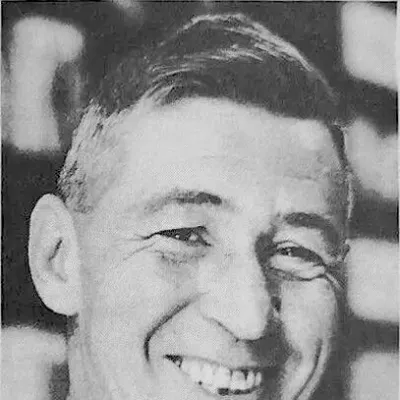
Photo: Wikimedia Commons
Eldridge Cleaver
Human Design Chart
Biography
Raised in the Los Angeles ghetto, he served jail time from age 12. He entered Soledad prison for robbery on 18 June 1954, for a year, after which he began his career as a rapist. While in Folsom prison for rape, 1957-1966, he read extensively of Marxist texts and wrote the series of essays "Soul on Ice."
Freed on parole, he met Huey Newton February 1967, and along with Newton became a leader in the Black Panther movement, a major figure in redirecting blacks away from Martin Luther King's ideal of assimilation toward more radical aims.
"Soul on Ice" was published 12 February 1968 and gained immediate recognition. Involved in a violent shoot-out on 6 April 1968, his parole was revoked and he was returned to jail 27 November 1968. His "Post-Prison Writings" was published 17 February 1969.
Newton fled to Cuba 13 July 1959 and directly on to Algiers, then North Korea and Paris in 1973. He voluntarily returned to the U.S. 18 November 1973 and gave himself up to arrest, Tried, he pleaded guilty to assault 3 December 1979 for a reduced sentence.
During the '80s, Newton became a born-again minister. Now a political conservative, he preached the gospel for wife-beating (God's work) and against homosexuality (Satan's work). He set up a group known as "Guardians of the sperm."
On 1 March 1994 he was arrested and charged with possession of crack cocaine, when found wandering near his Berkeley home. When he was found to have injuries, he was taken to the hospital for brain surgery due to being beaten and robbed while buying coke.
A powerful symbol of the '60s Black rebellion who came full circle to conservative politics and Christianity, Cleaver died at 62, probably of diabetes, on 1 May 1998, Pomona, CA.
Human Design Analysis: Eldridge Cleaver as Projector 2/4
Projector 2/4 — Design at a Glance
Eldridge Cleaver was someone who could quickly identify systems and their flaws. His Projector design gave him a dense, focused aura, like a bright flashlight that pinpointed weaknesses in his surroundings. However, this ability to 'shine a light into the dark' was a double-edged sword. When he addressed these deficiencies directly, it often felt like a blinding light to others, causing rejection and anger.
The mechanics of his design dictated a different approach: Instead of confrontationally correcting, it was more elegant to shine through his own harmonious presence. This way, he would attract others who would then actively seek his insights. The central strategy was to wait for an honest invitation rather than forcing himself upon others. Additionally, as a Projector, he lacked a constant energy source from the Sacral Center. Instead, he experienced phases of high productivity followed by necessary rest periods for regeneration. Ignoring this rhythm need or acting without invitation put him at risk of burning out. If he did not live by this principle, bitterness became his dominant feeling. His success thus depended on whether he patiently used his diagnostic gift and waited for recognition from others, rather than uncontrolled energy expenditure.
Emotional Authority
Eldridge Cleaver was someone whose inner compass was determined by a constant emotional wave. His design carried Emotional Authority, meaning his defined Emotional Center was the sole decision-making authority – independent of other defined areas in his chart. This configuration shaped a perception that was always colored by the current mood. At one moment, he could be totally enthusiastic about something, and in the next, view the same situation completely negatively. However, his immediate feeling was only a snapshot, not a final judgment. Quick, spontaneous decisions that emerged directly from this emotional heat often risked negative consequences, as the first reaction did not yet reflect his deeper truth.
The mechanics of his authority required patience and time. To gain clarity, he had to let decisions mature, ponder them, and sleep on them multiple times. Only when the intense feelings subsided and emotional distance was established did calmness set in. This process was crucial for long-term realignments that significantly influenced his life path. Eldridge Cleaver lived in this rhythm of ups and downs, with the necessity of not immediately following the first emotional wave being a central aspect of his inner guidance. His truth did not lie in the first impulse but in the calm that followed the emotional turbulence.
The 2/4 Profile — Hermit / Opportunist
Eldridge Cleaver was someone who oscillated between a deep need for withdrawal and the urge to connect. His Profile 2/4, the 'Natural Talent/Networker', established an inner tension: On one hand, he sought solitude to gather strength, on the other, he was drawn to the community to share his ideas. This dynamic required clear communication about when he needed company and when he wanted to be left alone.
In his 'Me-Time', marked by Line 2, he immersed himself in internal processes. This phase of calm was crucial for regaining willpower and gaining clarity. Without this preparation, he risked being perceived as a 'paper tiger' – resolute but lacking the necessary substance. Once this inner balance was restored, Line 4 came into play. It propelled him to act as a leadership figure and channel transpersonal energies.
This line sought the right opportunity to discover talent and support others. Eldridge Cleaver used his network time to reflect on what he had developed in solitude and formulate brilliant ideas. His path involved integrating these two poles: Solitude served as preparation, community as implementation. Only through this constant alternation between cave and network could he fully realize his potential and effectively apply his insights.
Triple Split Definition — Defined & Open Centers
Eldridge Cleaver appeared as a person constantly under internal mental pressure to question and understand connections. His defined Head and Ajna Centers created a permanent source of inspiration and conceptual thinking, but lacked direct energy for implementation. This pressure could lead to mental anxiety if it was not accepted as pure thought process and instead transformed into hasty actions externally. At the same time, his defined G Center provided him with a clear sense of direction without being dependent on others, giving him a reliable self-identity. His defined Throat Center allowed him to consistently express these mental concepts and his identity.
In contrast, his open Sacral Center was vulnerable to absorbing energy from the environment. Cleaver tended to question whether he should continue working, even though he did not have a consistent vital energy supply. This often led to overexertion and the use of borrowed energy, leading to exhaustion, as he did not naturally know when to stop. His open Spleen Center made him sensitive to fears and the well-being of his environment. He tended to cling to people or situations that gave a false sense of security rather than trusting his own, often fearful impulses. Additionally, his open Root Center absorbed stress and adrenaline-driven pressure from the environment. Cleaver was confronted with amplifying this external pressure rather than generating it himself, making him vulnerable to overload and burnout when trying to escape this non-self-generated pressure through constant action.
Channels for inspiration, community and abstract images.
Eldridge Cleaver drew attention through his mere presence and individual expression, stemming from the Inspiration Channel 1-8, connecting the G Center with the Throat Center. Through Gate 1, the individual entrance for mutative perspectives, and Gate 8, the Gate of Contribution, he lived his unique identity. His impact did not primarily come from explanations but from demonstrating his individual direction and inspiring others to express their own uniqueness.
In addition to this public projection, he sought a place where he truly belonged within a community. The Community Channel 37-40 connected his Solar Plexus Center with the Heart Center. Here, Gate 37 of Friendship and Gate 40 of Solitude played a role. He waited for the right invitation to become part of an organization and sought agreements based on mutual benefit and willpower rather than spontaneous impulses.
Mentally, he constantly went through a process of finding meaning. The Abstraction Channel 64-47 connected his Head Center with the Ajna Center. Gate 64 of Confusion and Gate 47 of Understanding drove him to filter every experience through a kaleidoscope of mental images. His mind continuously played with possibilities until a clear, inspiring story or new perspective emerged, which he then shared.
Additionally, other gates were at work: Gate 16 promoted experimentation to improve the new, while Gate 9 offered the ability for detailed work and perfection through repetition. Gate 46 stood for dedication and presence in the here and now. Gate 6 regulated emotional waves and friction as a motor for growth. Gate 43 enabled breakthroughs of individual insights, which he communicated, though this was connected with the fear of rejection. Gate 56 abstracted mental processes into pictorial narratives. Gate 15 represented collective behavior and adaptation to natural rhythms. Gate 61 sought inner truth and stillness, while Gate 62 emphasized logical pattern recognition and fact-finding.
Individual Circuitry — Circuit Signature
Eldridge Cleaver's design presented as separate, parallel energy fields that did not flow into each other. The Triple Definition created three isolated energy islands that worked independently.
In the Knowledge Circuit, the Inspiration Channel connected the Throat Center with the Identity Center. This gave him the ability to express new, individual impulses directly and impulsively. His identity showed through this connection as pulsating and creative, driven by the need to go his own way and inaugurate change through acoustic presence.
Parallel to this, the Meaning Circuit, which connected the Head Center with the Ajna, dominated the energy of abstraction. This connection directed his mind to the past to uncover hidden connections. It was about reflecting on past events to gain emotional insights to share with others. This process proceeded in a wave-like and cyclical manner, driven by the search for meaning behind events.
The third field formed the Ego Circuit, which connected the Heart Center with the Solar Plexus. The Community Channel established a clear principle of give and take here. It was about mutual support and cooperation within a group. Since this energy source did not have a direct connection to the Sacral power, it required necessary rest periods to maintain resources for the tribe. These three areas – individual expression, abstract meaning finding, and cooperative support – existed alongside each other in Eldridge Cleaver without forming a continuous, unified life energy.
Right Angle Cross of Planning 3
Eldridge Cleaver's Design inclined towards strategic, long-term thinking based on careful preparation. He was someone who initiated actions not impulsively, but after thorough deliberation and planning. This approach stemmed from the configuration of the "right cross of planning 3." In Human Design mechanics, this structure represents the ability to penetrate complex relationships and derive a clear, well-thought-out path from them. It was an energy that required patience and precision to effectively achieve goals. Eldridge Cleaver utilized this inner architecture to set his steps consciously, rather than being driven by external environments. The mechanics fostered a kind of intelligence that not only considered the here and now but also assessed the consequences of future decisions. This allowed him to maintain a calm, calculating stance in dynamic situations. His approach was characterized by the necessity to gather, process information, and then act only when a solid plan was in place. This trait shaped his way of dealing with challenges, as he always sought the optimal solution rather than settling for quick, superficial answers. Thus, the structure supported a deep, analytical approach to life.
Saturn Return · Uranus Opposition · Chiron Return · 2nd Saturn Return — Life Cycles
Eldridge Cleaver's Design set a tendency for profound, often confrontational turning points that radically changed his external identity and affiliation. His Uranus Opposition acted as a catalyst for abrupt breaks with established structures. This was concretely evident in 1975, at the age of 40, when he returned to the USA and turned his back on the Black Panthers. This Uranus phase marked the moment when old ties were no longer sustainable and a new, more isolated position was forced upon him.
Later, his second Saturn Return presented itself as a phase of harsh confrontation with his own limits and responsibility. Saturn demands structure and discipline; if this pressure is not integrated, it can shift into rigid patterns or crises. In 1992, at the age of 57, he was again arrested for cocaine possession. This event underscores the Saturnine dynamics: the attempt to gain control through external substances met the unyielding reality of consequences. His chart thus describes a life path marked by sudden liberating blows and later by the heavy burden of structuring and its failures.
Projector · Emotional Authority — Synthesis
Eldridge Cleaver lived an inner continuity between the urge to recognize and reveal patterns (defined Head Center) and the need to withdraw from the resulting mental pressure (Profile 2/4). He was destined to bring "light into the darkness" for others, identifying errors in the system (Projector Type, Channel Inspiration), yet he also needed phases of isolation to process the inspiration and gain clarity. This interaction between the need to observe and analyze and the desire for inner peace shaped his decisions and behavior. The cyclical crises (Saturn Return) and turning points (Uranus Opposition) appeared as moments when this inner rhythm became particularly evident – phases of public activity followed periods of withdrawal.
A central paradox in Eldridge Cleaver's design lay in the tension between his emotional drive (Emotional Authority) and the knowledge circuit. He was able to gain deep insights and develop transformative ideas, yet these insights were always tied to an emotional wave. The necessity to let decisions mature stood in contrast to the impulsive expression of his inspiration (Channel 1-8), leading to inner conflicts and unpredictable turns. This shift between emotional depth and the desire for creative expression created a dynamic, often contradictory energy.
3 Defined Channels
Incarnation Cross - Right Angle Cross of Planning 3
Solar Return
The Solar Return shows the moment when the sun returns to its exact birth position - your personal solar year.
Life Cycles
Discover the life cycles with a detailed triple view (birth chart, cycle chart, composite).
Human Design Profile
- Type
- Projector
- Strategy
- Wait for the respectful invitation
- Authority
- Emotional Authority
- Profile
- 2/4 - Hermit / Opportunist
- Definition
- Triple Split
- Incarnation Cross
- Right Angle Cross of Planning 3
- Date of Birth
- 31.08.1935 02:15
- Place of Birth
- Little Rock, AR, United States
Frequently Asked Questions
What was Eldridge Cleaver's Human Design type?
What Profiles did Eldridge Cleaver have?
What Authority did Eldridge Cleaver have?
What incarnation cross did Eldridge Cleaver have?
When was Eldridge Cleaver born?
Discover your own Human Design
Are you also a Projector? Find out in a personal reading how to unfold your leadership qualities and recognize the right invitations.
More Personalities
Back to overviewSissy Spacek
Alain-Fournier
Anémone

Ann-Margret

Bourvil
Hergé