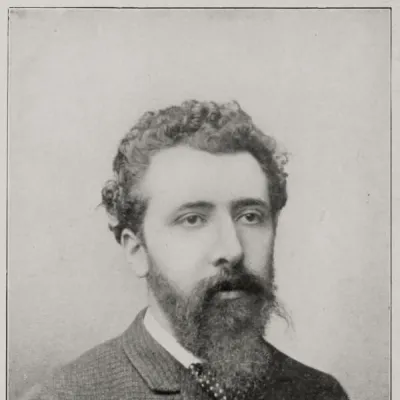
Georges Seurat
Human Design Chart
Biography
Seurat's artistic personality combined qualities that are usually thought of as opposed and incompatible: on the one hand, his extreme and delicate sensibility, on the other, a passion for logical abstraction and an almost mathematical precision of mind. His large-scale work A Sunday Afternoon on the Island of La Grande Jatte (1884–1886) altered the direction of modern art by initiating Neo-Impressionism, and is one of the icons of late 19th-century painting.
Georges Seurat — Projector with Profile 4/6
Projector 4/6 — Design at a Glance
Georges Seurat had a focusing aura that acted like a bright flashlight: It shone directly on areas in other people's systems that were still in the dark. His design allowed him to immediately recognize systemic errors and inefficient processes. Yet this sharp vision carried a risk. When he addressed these flaws head-on, his perception often felt like blinding light to others, causing friction and resistance.
The more effective way for him to express himself was simply to glow pleasantly. By embodying harmony himself, Georges Seurat became naturally attractive to those around him. People came to him of their own accord to seek advice or insights without needing to be lectured. This underscores the central strategy of his Projector type: waiting for a genuine and respectful invitation before bringing in his leadership skills.
Additionally, he lacked a constant source of intrinsic life energy due to his undefined Sacral Center. Instead, he experienced phases of high intensity and rapid productivity that were inevitably followed by periods of rest. These pauses served for regeneration and prevented burnout. Living in harmony with this rhythm and strategy rewarded him with success. Ignoring these needs and intervening uninvited led sooner or later to his Non-Self theme: bitterness.
Emotional Authority
Georges Seurat demonstrated a decision-making process that required time and distance. His design carried Emotional Authority, meaning the defined Solar Plexus Center determined his inner guidance. This configuration was subject to constant emotional waves, an ongoing up-and-down of feelings. The world appeared colored by his current mood: one moment could inspire enthusiasm, while another would make the same thing seem negative.
This initial emotional impression was not truth but merely a snapshot. Quick, spontaneous decisions stemming directly from this fleeting emotion were risky and often had negative consequences. Instead, his mechanism required patience. The more time Georges Seurat took to let a decision mature, the deeper and broader his understanding became. This often meant sleeping on decisions multiple times until intense feelings subsided.
Through this delay, he gained emotional distance. Only then did true clarity and calm set in. This process was especially crucial for long-term life decisions as they significantly influenced future directions. Emotional Authority always took precedence over other defined centers in his chart; regardless of other definitions, the Solar Plexus Center was where final confirmation occurred. Georges Seurat had to endure delays and ride out emotional waves to reach inner truth.
The 4/6 Profile — Opportunist / Role Model
Georges Seurat's design established a lifelong internal conflict: while his Heart sought deep community, his Head craved distance and objective wisdom. In the first three decades of his life, Line 4's experimental energy dominated. He intensely tested relationships and friendships driven by the urge for externalization and influence among peers. This phase was marked by a focus on details and attempts to find a place in groups, with the Heart always cautious to avoid being hurt by false people.
After turning thirty, Line 6 fully activated. The impulse now turned toward intellectual distance; he withdrew to observe life from an eagle's perspective. This duality often created confusion: his emotional need for belonging clashed with his rational pursuit of authority and truth. He was expected to be a wise role model who stood out through cooperation. Simultaneously, he identified inferior forces in the community and used his willpower against unfair demands. His life continually moved between wanting to be rooted and the urge to float above things on a mountain – an ongoing struggle between Heart and Head that shaped his interactions with the world.
Split Definition — Defined & Open Centers
Georges Seurat revealed himself through a design with four defined centers: Throat, G Center, Heart, and Solar Plexus. This configuration gave him a consistent voice for manifesting messages as well as a firm sense of self-identity with clear direction. His defined Heart provided permanent willpower to control his resources, while the defined Solar Plexus acted as an inner authority; he was designed to wait out emotional waves to gain clarity rather than impulsively reacting to feelings.
In contrast, five centers were open: Head, Ajna, Sacral, Spleen, and Root. These open areas functioned as mirrors of the environment. The open Head Center made him vulnerable to mental pressure and doubt that did not originate from himself; he tended to get entangled in other people's questions. The open Ajna Center allowed for flexible concepts but was susceptible to conditioning by foreign opinions. Particularly defining was the open Sacral Center: Georges Seurat did not have a consistent generative energy source. He absorbed the vitality of his environment and amplified it, putting him at risk of overextending himself through "borrowed" energy and falling into exhaustion if he didn't pause. The open Spleen Center led to seeking security externally rather than relying on stable inner well-being, making him vulnerable to unhealthy attachments. Finally, the open Root Center absorbed external stress and adrenaline from the environment; this pressure was not his own but could drive him to hyperactivity if he succumbed to it instead of recognizing it as foreign energy and letting go.
Channels for awakening, principles and true community.
Georges Seurat revealed himself through a conscious dedication to his essence: His design suggested that his survival and confirmation depended on acting as himself in every moment, radiating this clarity. This trait stemmed from the Awakening Channel 10-20 in his personality. This connection between G Center (Gate of Appearance) and Throat Center (Gate of Now) transformed individual knowledge into right action, guided by an internal code for successful interaction. It was about the statement "I am," carried by self-love and trust. By living his nature, he unconsciously inspired others to be themselves, which brought him genuine invitations and protected him from resistance.
At the same time, in the background of his design, the Community Channel 37-40 between Solar Plexus Center (Gate of Solitude) and Heart Center (Gate of Friendship) was at work. This unconscious emotional flow brought waves of belonging and a desire for fair agreements. Gate 40 sought recognition as a whole, while Gate 37 secured connection through willpower. As this energy was emotional, it needed time to gain clarity; spontaneous deals were impossible. Seurat waited for personal touch rather than impersonal contacts to find his place in the community and build bridges between individuals.
Additionally, other Gates shaped his Profile: Gate 9 promoted detail work and perfection through repeated experiments in the Sacral Center, while Gate 16 offered mutative potential for skill mastery through continuous experimentation. On the personality side, Gate 13 supported meaning-making by reflecting collective memory and continuity. Gate 7 projected leadership patterns and hierarchies tested through experiments. In his design, Gate 62 worked with its logic and pattern recognition to establish facts. Gate 55 at the Solar Plexus brought emotional instability and genetic mutation, while Gate 49 demanded principled loyalty in family and clan. Finally, Gate 36 enabled handling crises as cyclical movement for new experiences.
Individual Circuitry — Circuit Signature
Georges Seurat exhibited a duality between clan-oriented cooperation and individual self-assertion. His design connected the Heart and Solar Plexus Centers through Channel 37-40 in the Ego Circuit. This promoted a balance of giving and taking, as well as mutual support within the community. Since this circuit did not connect to the Sacral Center, there was no constant life force; therefore, rest periods were essential to regenerate resources for the clan. Parallel to this, the Integration Circuit sub-circuit secured his individual survival. Here Channel 20-10 connected Throat and Identity Centers. This connection allowed him to draw strength from reacting to life (Gate 34) through proper behavior (Gate 10) and to actualize in the present moment (Gate 20). Although Gate 57 belongs to intuitive knowledge, it was not directly linked to the other gates in this specific channel connection but formed part of his individual strategy for synthesizing reaction and action. The shared definition separated these two systems: on one hand, cooperative resource creation with necessary pauses, and on the other hand, the individual ability to survive through intuitive action in the moment. This mechanism shaped his existence as someone who balanced between the need for communal support and the necessity of immediate personal adaptation.
Right Angle Cross of Planning 4
Georges Seurats Human-Design profile featured the right cross of Planning 4, a configuration that structured how energy and intention were transmitted into the world. This mechanical alignment did not serve as mere background noise but fundamentally shaped the transfer from inner intent to outer expression. The right cross of Planning 4 functioned as a structuring element for this process, determining how impulses were ordered and formed before they could take effect. For Georges Seurat, this meant a specific dynamic in handling his own forces: Energy transmission was not arbitrary or chaotic but channeled through the architectural framework of his design.
The mechanics of this cross suggested that the connection between inner reality and outer manifestation ran through a particular planning mode. It was about structuring intention. In this regard, Georges Seurat's energetic expression filtered through this level of planning. Energy did not simply find its way out but was shaped by the right cross of Planning 4. This created a certain quality in his work: An intention that underwent an internal ordering before being realized. For his overall profile, this was a central aspect as it defined how his specific energy entered the world and found resonance or resistance there. The Planning 4 provided the framework within which this transmission occurred, significantly influencing Georges Seurat's interaction with his environment.
Saturn Return — Life Cycles
During this phase of life, Georges Seurat showed a clear shift towards structure and defined responsibility. His design inclined him to trade experimental freedoms for a stable life order. This aligned with the first Saturn Return, occurring around ages 29 to 32. This cycle marks the transition from playful experimentation to integrating lasting commitments and clearer boundaries.
Specifically, this mechanical development became visible in 1890 when Georges Seurat, now 31 years old, became father to his son Pierre Georges through Madeleine Knobloch. The birth represented the practical implementation of a new life phase: Focus shifted from mere individuality towards nurturing a relationship and assuming parental care. For his Human Design, this meant translating the abstract demand for structure into the concrete reality of a family setting. The Saturn Return acted as a catalyst, prompting him to no longer freely distribute his energy but instead invest it purposefully in building and securing a personal foundation. This development underscores how the pressure of the Saturn Return created a necessity for Georges Seurat to establish a reliable order to meet new demands.
Projector · Emotional Authority — Synthesis
Georges Seurat was a Projector whose design endowed him with a profound ability to recognize patterns and potentials in his environment (Communication & Manifestation). Yet, this gift came hand-in-hand with an emotional authority that compelled him to let decisions mature over extended periods. Thus, he lived a process of constant observation and internal deliberation to understand underlying dynamics before expressing or acting on them. This shaped his approach based on grasping the essence and representing it in a new form (Awakening Channel).
A central paradox lay within his profile as a Networker/Role Model (4/6). On one hand, he sought connection with community (Line 4), while on the other, he felt compelled to withdraw and contemplate higher principles (Line 6). This internal conflict between social interaction and contemplative distance ran through his life, where the desire to act as a wise role model clashed with the need for inner freedom. His focus was thus on uncovering connections and patterns – both in the world around him and within his own contradictory nature.
2 Defined Channels
Incarnation Cross - Right Angle Cross of Planning 4
Solar Return
The Solar Return shows the moment when the sun returns to its exact birth position - your personal solar year.
Life Cycles
Discover the life cycles with a detailed triple view (birth chart, cycle chart, composite).
Human Design Profile
- Type
- Projector
- Strategy
- Wait for the respectful invitation
- Authority
- Emotional Authority
- Profile
- 4/6 - Opportunist / Role Model
- Definition
- Split Definition
- Incarnation Cross
- Right Angle Cross of Planning 4
- Date of Birth
- 02.12.1859 01:00
- Place of Birth
- Paris, France
Frequently Asked Questions
What was Georges Seurat's Human Design type?
Which Profile did Georges Seurat have?
What Authority did Georges Seurat possess?
What incarnation cross did Georges Seurat have?
When was Georges Seurat born?
Discover your own Human Design
Are you also a Projector? Find out in a personal reading how to unfold your leadership qualities and recognize the right invitations.
More Personalities
Back to overviewSissy Spacek
Alain-Fournier

Anémone
Ann-Margret

Baekhyun

Balthus