
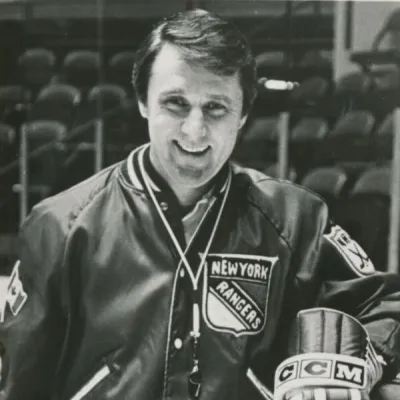
Herb Brooks
Human Design Chart
Biography
From 1960 to 1970, Brooks set a record by playing for the U.S. national team eight times, including the 1964 and 1968 Olympic teams. While playing for the Rochester Mustangs in the United States Hockey League in the 1961–1962 season, he formed part of the highest-scoring forward line in USHL history at the time, along with Bill Reichart and Ken Johannson.
Brooks also coached multiple National Hockey League (NHL) teams, as well as the French team at the 1998 Winter Olympics. He ultimately returned to coach the U.S. men's team to a silver medal at the 2002 Winter Olympics in Salt Lake City. At the time of his death in 2003, he was the director of player personnel for the Pittsburgh Penguins.
Brooks was inducted into the United States Hockey Hall of Fame in 1990 and the IIHF Hall of Fame in 1999. He was honoured posthumously with the Wayne Gretzky International Award in 2004 and inducted into the Hockey Hall of Fame in 2006.
Brooks married Patricia Lane, known as Patti, in 1965. They had two children, Dan and Kelly. Brooks died six days after his 66th birthday in a car accident on 11 August 2003 near Forest Lake, Minnesota.
Human Design Analysis: Herb Brooks as Generator 6/2
Generator 6/2 — Design at a Glance
Herb Brooks possessed immense, enduring strength that made him seem like a workhorse as long as he had energy for his tasks. As a Generator, he had a lot of sacral energy, which enabled him to materialize things in life. However, his design dictated that this energy was primarily released when he responded to impulses. The motto was not to initiate but to react.
His most successful strategy was to wait for signals from life and then, when his sacral center gave a clear 'yes', to respond with action. Living in harmony with this principle rewarded him with a sense of deep fulfillment. Deviations from it quickly led to two typical pitfalls. If he constantly did things he had no interest in, he wasted his energy and was prone to burnout. Conversely, it was frustrating when he was prevented from working on his heart project, even though he still had plenty of power to continue.
If he constantly initiated independently instead of reacting, he encountered a feeling of persistent frustration and a lack of energy. His design required him to act from the gut and respond to life rather than anticipate it. Only in this way could he fully tap into his intrinsic creative power without falling into exhaustion or dissatisfaction. This dynamic shaped his way of using energy and advancing projects.
Emotional Authority
Herb Brooks' design established a tendency towards emotional wave motion, which significantly influenced his perception and decision-making. He experienced the world through the coloring of his current mood. In one moment, he could be totally enthusiastic about something, and in the next, he could view the same matter completely negatively. These fluctuations were not a sign of unreliability but an expression of his inner authority: emotional authority.
Since his emotional center was defined, it always functioned as his inner guiding authority, regardless of which other centers were also defined in his chart. This priority rule meant that his emotional truth took precedence over other impulses. However, his momentary feeling was merely a snapshot, a first impression that did not necessarily reflect his deeper truth. Quick, spontaneous decisions made directly from such an emotional peak could therefore have negative consequences.
The mechanics of his design required patience. The more time he took to let a decision mature, the deeper and more comprehensive he could perceive the situation. This meant that he had to sleep on decisions and ask himself multiple times. Over time, the intense feelings subsided, he gained emotional distance, and clarity and calmness set in. Only then had he gone through the process and made decisions that aligned with his true nature. This path of delay was particularly crucial for long-term, life-changing steps.
The 6/2 Profile — Role Model / Hermit
Herb Brooks emerged as someone who intensively experimented in the first three decades of his life, gathering his life experience through trial and error. His design as a 6/2-line shaped this phase with a constant alternation between active tests and necessary withdrawals after failures. Only after about thirty years, with the return of Saturn, did the sixth line activate. Then he mentally retreated into a metaphorical cave to look back at his earlier experiments with great distance. This period of intense reflection served for healing and deep self-awareness. From this isolation, he later emerged as a wise person, ready to attract others who wanted to learn from his life wisdom and the ability for deep introspection. Simultaneously, the second line worked, giving him a natural talent for the right direction without his conscious control. It was crucial that he was called correctly and did not intervene himself so that this natural talent could fully develop. A defined ego supported the realization of his abilities better than an open attitude. His development thus followed a clear pattern: from early, often chaotic experimentation through a long phase of withdrawal and renewal to the role of a role model, guiding through silent wisdom and inner direction.
Split Definition — Defined & Open Centers
Herb Brooks was a Generator with a rare combination of relentless mental activity and profound emotional depth. His defined Head and Ajna Centers generated a constant inner pressure to question and develop concepts. This mental engine ran continuously; he did not just think when necessary but was perpetually caught in the process of understanding and grasping. This configuration marked him as someone who generated inspiration but had to learn that these thoughts did not possess direct energy for implementation. The attempt to immediately convert this mental load into action would have driven him into frustration. Instead, his mind served to inspire others to think while he waited for the right moment.
His defined G Center gave him a firm identity and a clear sense of direction. He knew who he was and radiated this self-assurance without relying on others. Simultaneously, his defined Heart Center provided willpower and the ability to keep promises. He could control resources and express his ego, which helped him establish a foothold in the material world and take responsibility. However, his energy source lay in his defined Sacral Center. As a Generator, he had to wait until he was asked to deploy his vital energy. Only through reacting to external impulses could he unleash his full satisfaction and endurance without exhausting himself.
Despite this inner stability, he was vulnerable to external influences through open centers. His open Root Center absorbed stress from the environment, putting him under pressure to constantly achieve something, even though this pressure did not originate from him. His open Spleen Center made him intuitively react to the well-being of others, sometimes with the fear of not being sure or by clinging to unhealthy situations just to maintain a sense of security. Additionally, due to his open Throat Center, he tended to feel the pressure to attract attention by speaking rather than waiting to be invited. His defined emotional authority in the Solar Plexus Center challenged him to make decisions only after riding the emotional wave to gain clarity, rather than acting impulsively.
Channels for rhythm, pioneering spirit, community and abstraction.
Herb Brooks was distinguished by a profound ability to initiate new directions while respecting the natural flow of life. His design combined the power of mutation with the logic of rhythm, allowing him to translate innovative impulses into material results without working against biological givens.
The Beat channel 14-2 connected the Sacral Center with the G Center. Through Gate 14, which cleverly handled power and resources to drive mutation, and Gate 2, which directed higher knowledge and movement through space and time, he possessed the resources to bring innovative, reinforcing new directions. This was not a random invention but a powerful resource for creative life force that reinforced a change of direction by relying on the reaction from his Sacral.
Parallel to this, the Rhythm channel 5-15 also connected the Sacral Center with the G Center. Gate 5 held fast to established habits and rituals, while Gate 15, with its love for extremes, integrated the diversity of society into the life flow. This channel was the cornerstone of all biological life processes and bound him closely to the flow of the natural world. He had his own sense of timing, determined by his inner rhythm. When aligned with this flow, everything felt effortless and benefited those around him by bringing them into their own rhythm.
Additionally, the Initiation channel 51-25 shaped his approach. It connected the Heart Center through Gate 51, which represented shock and the will to be first, with Gate 25, the spirit of self and universal love. This gave him a natural competitive edge that served to awaken others to expand and test their limits. Each breakthrough brought a new consciousness and served as a bold example for others.
The Community channel 37-40 connected the Solar Plexus Center with the Heart Center. Gate 37 sought recognition and his place in the whole, while Gate 40 was ready to work to provide for loved ones but needed breaks. This secured tribal business through emotional clarity and willpower. He understood the need to make good deals and seal them to build bridges between individuals in a community.
The Abstraction channel 64-47 connected the Head Center with the Ajna Center. Gate 64 brought confusion and sifting experiences through mental images, while Gate 47 sought understanding. His mind constantly played with possibilities until a picture emerged and an inspiring story could be shared.
Additionally, Gate 33 with reflection and withdrawal, Gate 19 with resources and spirituality, Gate 1 with uniqueness and creative timing, Gate 17 with logical teaching and succession, Gate 34 with individual power and integration, and Gate 24 with mental mutation and renewal influenced him. These configurations shaped how he designed and understood life.
Individual Circuitry — Circuit Signature
Herb Brooks’ design showed a split structure where two independent energetic poles existed without directly flowing into each other. The first pole united identity, sacral center, heart, and solar plexus. Here, the Knowledge Circuit worked through the channel “The Beat” (2-14), connecting identity and sacral center. This created a pulsating, acoustic energy emphasizing the unique path and new identity aspects. Parallel to this, the Centering Circuit worked through the channel “Initiation” (25-51), connecting the identity with the heart center. This fostered solid convictions and self-worth without necessarily communicating them outwardly, as the throat center was not involved here. The Understanding Circuit used the channel “Rhythm” (15-5) to connect identity and sacral center, supporting the sharing of logical insights. The Ego Circuit connected through the channel “Community” (40-37) the heart with the solar plexus center. This allowed emotional giving and taking as well as cooperation, but required pauses as the sacral center did not directly lie in this circuit. The second, isolated pole consisted of head and Ajna centers. Here, the Meaning Circuit worked through the channel “Abstraction” (64-47). This connected the inspiration of the head with the mental processing of Ajna to reflect on past experiences and find meaning. These two poles – the emotional, identity-forming lower region and the cognitive, reflective upper region – existed side by side without direct energetic exchange, shaping Herb Brooks’ experiential world.
Left Angle Cross of Refinement 1
Herb Brooks' design featured the left Refinement Cross 1. This configuration established a fundamental tendency towards precise differentiation and the ability to reduce complex situations to their essential elements. It was not a crude simplification but a fine-tuning process where nuances were recognized and clearly articulated.
In Human Design, this cross describes a specific energy aimed at refining and clarifying things. The number 1 represents the beginning, initiative, and the creation of new structures. Combined with the quality of refinement, this means that Herb Brooks tended to initiate new approaches or ideas and continuously sharpen and optimize them. His focus was on transforming the raw material of an idea or plan into something more functional and elegant.
This mechanism acted as an inner drive to eliminate fuzziness and create clarity. It was an energy that linked detail accuracy with a broader overview to ensure that the result was not only correct but also optimal. Thus, Herb Brooks emerged as someone who achieved results through precise analysis and targeted improvement, which were both effective and well-thought-out. His problem-solving approach was characterized by this persistent pursuit of the best possible form.
Saturn Return · Uranus Opposition · Chiron Return · 2nd Saturn Return — Life Cycles
Herb Brooks' design inclined towards strategic patience and structured implementation. His first Saturn return, the period when long-term preparations often solidify into sustainable results, occurred in 1964. At 27 years old, he led the US ice hockey team to the Winter Olympics. This was no coincidence but a typical expression of this phase: the inner work found its external validation through a responsible position.
Later, at the age of 39, the Uranus opposition came into effect. This cycle often marks a turning point where established patterns are broken and new horizons are conquered. In 1976, Herb Brooks won the National Championships. This success underscores the dynamics of his design: after consolidating the first phase of life, a period of renewal and proven capability followed. His path was marked by these rhythmic spurts – first anchoring through discipline, then breaking through with change. The mechanics of his chart are reflected in this sequence: structure creates the foundation, innovation delivers the decisive advantage. Herb Brooks lived this sequence by using his role not just to train teams but to transform them.
Generator · Emotional Authority — Synthesis
Herb Brooks was a Generator whose life was marked by deep, sacral energy (Generator type). This energy, coupled with emotional authority, guided him through waves of feelings that ripened decisions and gave him a unique perspective (emotional authority). His profile as a role model and natural talent was evident in an early life full of experiments followed by a phase of intense reflection, from which he emerged with wisdom (Profile 6/2). The defined Mental Center provided a constant pressure to question and understand, driving him towards innovations and new thought paradigms (defined Head Center). The Beat Channel, anchored in Sacral and G Center, points to a capacity to direct energy into new directions and initiate changes (Channel 14-2).
A central paradox in Herb Brooks' design lay in the tension between his need for deep emotional maturation and the pressure to continuously provide inspiration (emotional center & defined Head Center). He lived the creative melancholy of the Knowledge Circuit, which drove him to create and transform while simultaneously feeling the need to withdraw and reflect (Knowledge Circuit). Witnessed events showed that he directed his energy purposefully during moments of success and recognition (Uranus opposition) as well as during phases of development (Saturn return).
5 Defined Channels
Incarnation Cross - Left Angle Cross of Refinement 1
Solar Return
The Solar Return shows the moment when the sun returns to its exact birth position - your personal solar year.
Life Cycles
Discover the life cycles with a detailed triple view (birth chart, cycle chart, composite).
Human Design Profile
- Type
- Generator
- Strategy
- To respond - wait for something to respond to
- Authority
- Emotional Authority
- Profile
- 6/2 - Role Model / Hermit
- Definition
- Split Definition
- Incarnation Cross
- Left Angle Cross of Refinement 1
- Date of Birth
- 05.08.1937 15:18
- Place of Birth
- Saint Paul, MN, United States
Frequently Asked Questions
What was Herb Brooks' Human Design type?
What profile did Herb Brooks have?
What authority did Herb Brooks have?
What incarnation cross did Herb Brooks have?
When was Herb Brooks born?
Discover your own Human Design
Are you also a Generator? Find out in a personal reading how to use your sacral energy correctly and discover deep satisfaction.
More Personalities
Back to overviewAaliyah

Alain-Fournier

Alexia

Angèle

Angeli

Anne-Marie
