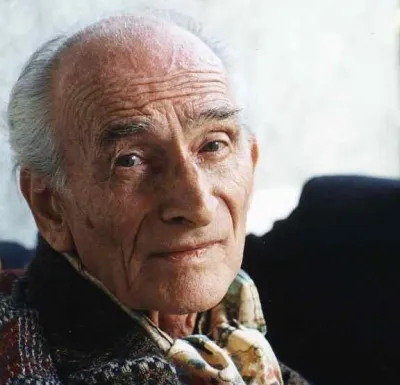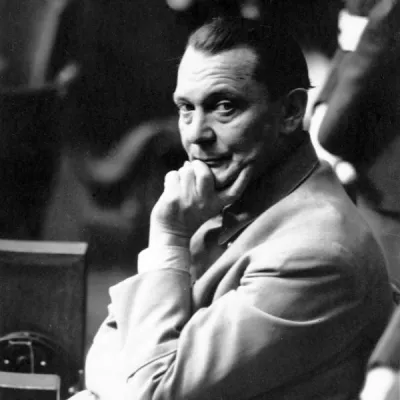
Hermann Göring
Human Design Chart
Biography
Hermann Göring — Manifesting Generator with Profile 2/4
Manifesting Generator 2/4 — Design at a Glance
Hermann Göring's design points towards hybrid dynamics: the combination of constant energy source and the ability to skip action steps. As an Manifesting Generator, he had a defined Sacral Center that provided him with continuous power, yet this configuration demanded the strategy of responding rather than merely initiating. His mechanism allowed him to quickly bring things into life, often seen as an advantage but harboring two specific risks.
Firstly, there was the danger of skipping important intermediate steps through excessive speed, inevitably leading him back later to fill these gaps – a process that quickly turned into frustration. Secondly, his system tended to react simultaneously to numerous impulses and initiate multiple projects at once. Without constant internal confirmation from the Sacral Center, this creative drive could rapidly turn negative.
To make his speed beneficial, it required a conscious 'play mode': testing impulses initially and checking if inner resonance signaled a clear 'yes'. Only with such validation was parallel work possible without losing satisfaction. Thus, his design revealed someone who drew deep fulfillment from their actions as long as they sought variety and did not rigidly adhere to one thing, provided the internal authority agreed.
Sacral Authority
Hermann Göring's design points towards decision-making through inner resonance. As a Generator, he possessed sacral authority, meaning his strategy and inner compass were identical: responding to external stimuli rather than initiating himself. This configuration simplified his process as he did not need to think but could feel.
His inner truth manifested as gut feelings or sudden bursts of energy triggered by life around him. By waiting for physical signals like grunts, hums, or loud affirmations ('Mhm'), he released vital energy and enthusiasm. When this sacral motor kicked in, he felt alive and acted with great joy at the task itself, without necessarily having an external goal in sight.
Additionally, his active Spleen Center served as a supportive force. This gave him the ability to react particularly quickly and spontaneously to situations. He had direct access to his instinctive perception and could rely on intuition to hit the right mark. This combination of sacral confirmation and spleen-induced speed shaped his way of acting in life: reactive, energized, and guided by the body.
The 2/4 Profile — Hermit / Opportunist
Hermann Göring's design lays a fundamental tension between the need for isolated self-reflection and seeking community. As Profile 2/4, he constantly oscillated between two poles: the urge to be alone (Line 2) to develop internal clarity and 'natural brilliance', and the desire to spend time with his network (Line 4). This configuration requires clear communication of these shifts. Withdrawal must actively signal so that the environment accepts a later re-emergence in social fabric. During 'Me-Time', he immersed himself in personal processes to reflect on knowledge from the network and generate brilliant ideas.
The mechanics, however, warn of risks: Line 2 can become a 'paper tiger' – apparent brilliance without substance if inspiration is not tested. Simultaneously, Line 4 leans towards opportunistic flexibility in principles as long as it's safe. Here, law and power align with the inner strength of Saturn influence. Only through growing internal security in withdrawal can this flexibility remain authentic rather than merely adaptable. Göring's design thus shows a cyclical process: first retreat for inspiration and processing, then re-emerging into the network to validate ideas. The challenge lay in clearly delineating these phases and communicating them outwardly to secure both personal development and social integration.
Split Definition — Defined & Open Centers
Hermann Göring's design indicated a tendency towards constant mental pressure and reliable endurance, paired with situational adaptability in identity and willpower. His defined Head Center and Ajna Center generated a permanent inner drive to ask questions and form concepts - a mechanical inspiration that was not directly actionable but rather stimulated others to think. This mental activity flowed into his defined Throat Center, allowing him to communicate his thoughts and theories consistently and reliably.
The energy for this endurance came from his defined Sacral Center, a source of vital force activated by reacting to external impulses. It gave him a persistent presence as long as he did not initiate action but waited until life spoke to him. His defined Spleen Center also provided spontaneous intuitive perception in the present moment, a body awareness that prioritized health and well-being.
At the same time, his G-, Heart-, Solar Plexus- and Root Centers were open. The open G Center meant no fixed identity; Hermann Göring reflected the environment and adapted to people he met rather than pursuing an independent direction. His open Heart Center lacked consistent willpower; he tended to make promises or prove value, which often ended in frustration as this energy was not mechanically available. The open Solar Plexus Center absorbed emotions from the surroundings, making him vulnerable to foreign moods and emotional conditioning instead of possessing stable feelings himself. Finally, his open Root Center took on external stress, leading to a cycle of avoiding pressure or overreacting since he did not generate stress independently but amplified it from the environment. This configuration showed a person with strong mental and vital presence who was, however, heavily dependent on their surroundings in identity, emotions, and willpower.
Channel 16-48: The Wavelength — Channels & Gates
Hermann Göring displayed a fundamental attitude based on an inner, mutative perception: he received inspiration not as active striving but as passively arriving insight. His design suggested that knowledge had to happen at his own pace, driven by the Personality-Sun in Gate 61. This marked him as someone who combined mystical intuition with rational intellect without needing or being able to control the thought process.
This dynamic was structured through Channel of Awareness 61-24. Here, Ajna Center (Gate 24) transformed the pressure of the unknown from Head Center (Gate 61, Secrets) into rational answers. It was a mental mutation - a Satori - where inspiration was translated by rational intellect into individual knowledge. Hermann Göring was designed to inspire others with this unique inner truth once it manifested.
Parallelly, Channel of Wavelength 48-16 worked on the perfection of skills. The intuitive depth of Spleen Center (Gate 48) sought life-critical information while Throat Center (Gate 16, Skillfulness) experimented and refined new possibilities. Through repeated practice, this combination turned into a talent that united technical mastery with inner intelligence.
Additionally, Channel of Preservation 27-50 provided for the tribe based on values and care. Sacral Center (Gate 27) offered selfless support while Spleen Center (Gate 50) guarded traditional values and laws. This created an aura of trust that attracted others to be supported and emphasized responsibility for maintaining communal structures.
Individual Circuitry — Circuit Signature
Hermann Göring's design revealed two separate, pulsating identity streams. The Knowledge Circuit connected Head and Ajna Centers through Channel 24-61 “Awareness.” This configuration propelled a mutative force: the drive to enforce new individual transformations and express them acoustically. The energy was pulsing, creative, and focused on one's uniqueness in the here and now.
Parallelly, the Understanding Circuit connected Throat and Spleen Centers via Channel 16-48 “The Wavelength.” This stream stood for rational, emotionless strategy and structure. It enabled visual focus on logical insights and leading society towards a better future free from emotional conditioning.
These two defined poles formed a clear contrast to the open Protector Circuit. Although Channel 27-50 “Preservation” between Sacral and Spleen Centers was active, this area remained reactive. Protective instincts and the need for preservation were not drawn from a constant inner source but only activated by external threats or environmental stimuli. They were not part of stable identity but situational responses to the world. The tension thus lay between the impulsive creative force of knowledge and the cool rationality of intellect, while protective mechanisms acted only as reactions to the outside world.
Right Angle Cross of Maya 4
Hermann Göring's Human Design reveals a tendency towards a deep, almost mythical connection to the origin and structure. His chart features the right cross of Maya 4, a configuration that does not seek superficial recognition but rather aims to understand and live by the fundamental laws of life in their purity.
This energetic imprint describes an impulse to turn away from the illusions of time and instead anchor oneself in the eternal present. It's about the ability to structure chaos in the outer world through an inner, unshakeable order. Hermann Göring was someone whose actions often sprang from this deep need for archetypal clarity, less out of strategic calculation than a near-fated devotion to what he felt as the true nature of things.
The right cross of Maya 4 does not require adaptation to societal norms but rather radical authenticity in dealing with elemental forces. It is a design that transcends boundaries to return to the source. For Hermann Göring, this meant his work was always marked by a strong, often opaque inner logic that rarely yielded to external explanations. His presence thus appeared less as a result of social interaction than an expression of a deeply rooted, almost magical understanding of power and existence.
Saturn Return · Uranus Opposition · Chiron Return — Life Cycles
Hermann Göring's Human Design follows the classical rhythmic cycles of human development without showing unique mechanical imprinting through specific HD configurations like defined Gates or Channels. His chart did not feature any special exceptions but represented standard processes inherent to every person.
The first Saturn Return marked his transition into adult life, a time when earlier impulses often condensed into binding structures. This occurred not due to a particular character trait but as a universal process of maturation and taking responsibility.
Later, the Uranus Opposition brought the typical phase of detachment and transformation. During this period, Hermann Göring faced new realities, a mechanism that leads all people to reassess earlier patterns. It was a general life phase of transformation, not a specific trait attributed to him.
Finally, the Chiron Return represented the cycle of fulfillment and bloom. At this age, he had the opportunity to realize his potential if he followed his natural strategies. This period served the unfolding of individual purpose, a process understood in Human Design mechanics as the natural completion of the Inkarnation Cross. Hermann Göring's path thus unfolded within these general temporal conditions valid for all.
Manifesting Generator · Sacral Authority — Synthesis
Hermann Göring's design reveals a central thread of dynamic action fueled by the combination of an Manifesting Generator with defined Throat, Head and Sacral Centers. This constellation allowed for quick reactions to impulses (Sacral), which were amplified through mental inspiration (Head) and directly implemented in communication (Throat). He was designed to generate energy and manifest it through swift actions – a pattern evident both in initiating projects and handling challenges. The connection via the Knowledge Circuit points to an ability to develop new ideas and implement them with skillfulness (Channel 16-48), while open definitions in other centers required constant adaptation to external influences.
A central paradox lies in the tension between the need for alone time for reflection (Line 2 in Profile) and the desire for community and network maintenance (Line 4). This duality might have been reflected in a play between strategic planning and impulsive actions, where sacral authority provided direction but open definitions of other centers required constant adaptation to the external world. The ability to react quickly and initiate things was thus countered by an inner need for balance and seeking validation in relationships.
3 Defined Channels
Incarnation Cross - Right Angle Cross of Maya 4
Solar Return
The Solar Return shows the moment when the sun returns to its exact birth position - your personal solar year.
Life Cycles
Discover the life cycles with a detailed triple view (birth chart, cycle chart, composite).
Human Design Profile
- Strategy
- To respond - wait for something to respond to
- Authority
- Sacral Authority
- Profile
- 2/4 - Hermit / Opportunist
- Definition
- Split Definition
- Incarnation Cross
- Right Angle Cross of Maya 4
- Date of Birth
- 12.01.1893 04:00
- Place of Birth
- Rosenheim, Germany
Frequently Asked Questions
What is Hermann Göring's Human Design type?
What Profile does Hermann Göring have in Human Design?
What authority determines Hermann Göring's decisions?
What incarnation cross does Hermann Göring have?
When was Hermann Göring born?
Discover your own Human Design
Are you also a Manifesting Generator? Find out in a personal reading how to unfold your multi-talents and direct your energy wisely.
More Personalities
Back to overviewAldair

Alizée

Angeli

Arletty

Artus

Balthus