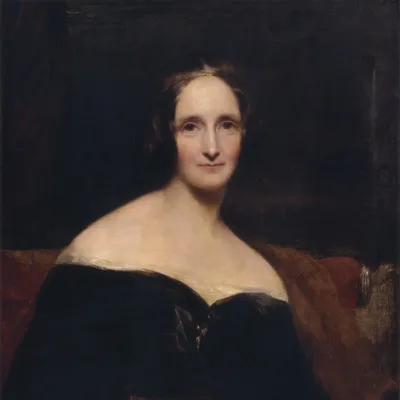
Mary Shelley
Human Design Chart
Biography
Mary was the daughter of two social reformers ahead of their time. Her feminist mother died at her birth and her father remarried, to Jane Clairmont who had a daughter, Claire. William Godwin was a part of an English liberal movement with his book, "Political Justice." The young poet, Percy Bysshe Shelley was one of the young men who agreed with his forward views and who began to frequent his salon in 1813.
Mary and Percy fell in love and eloped on 28 July 1814, fleeing to Switzerland by coach. The were accompanied by Mary's stepsister Claire and Percy's friend, Lord Byron and wandered across Europe before setting in Italy.
Mary had a female infant on 22 February 1815 which died on 6 March. She had another child in 1816 which did not survive. By 1816, she was involved in writing "Frankenstein," and during the pleasant days in their villa, she and Percy and Lord Byron read their work for each other's review. Claire and Lord Byron became lovers and had a child, Allegra, on 12 January 1817. The child later died of typhus at age five, 19 April 1822.
When Percy's wife died, a suicide, Mary and Percy were married, 30 December 1816. They had another child, Clara, on 2 September 1817 who died at one year, 24 September 1818. Only one child, Percy Florence, born 12 November 1819, survived into adulthood. Mary had a severe miscarriage on 16 June 1822.
Shelley's income stopped in 1821 as he owed money for the care of his children whom he'd had with Harriet, and his small trust went to that demand. On 8 July 1822, Percy drowned in a violent lake storm. Mary moved back to London, where she spent her grief in the editing of Percy's letters and poems, editing his works.
She wrote, "For eight years I communicated, with unlimited freedom, with one whose genius far transcending mine awakened and guided my thoughts....
Human Design Analysis: Mary Shelley as Manifestor 3/5
Manifestor 3/5 — Design at a Glance
Mary Shelley's design predisposes her to forward-thinking leadership and visionary action. As a Manifestor, she was destined to guide the world into new directions, similar to an emperor in ancient Rome who had the vision of a great empire but did not fight battles himself; instead, he delegated tasks to others. This configuration meant that her plans and ideas often failed to resonate with everyone; she polarized people. Some loved and followed her due to her far-reaching dreams, while others misunderstood or even rejected her because of this grandeur. This formed a central pain point in her design: the feeling of not being understood. To find the right followership and minimize resistance, her mechanics required a clear strategy: she had to inform others precisely about her intentions at the right time. If Mary Shelley followed this strategy and adhered to her inner authority, her system rewarded her with profound peace. Acting against this design without informing or waiting resulted in persistent, deep anger. Therefore, her path involved balancing her pioneering role through clear communication to achieve the state of peace promised by her correctly aligned design.
Emotional Authority
Mary Shelley lived with emotional authority, meaning that her defined Emotional Center carried her inner decision-making process. This mechanism is independent of all other definitions in her design: once the Emotional Center is activated, it takes charge. She was subject to natural waves of emotional ups and downs, coloring her perception of the world through her current mood. What she found inspiring at one moment could appear negative in the next. However, her immediate feeling only represented a temporary snapshot, not necessarily the deeper truth. Quick, spontaneous decisions from such an emotional state often had adverse effects. Instead, her configuration required patience and conscious maturation of choices. By sleeping on them multiple times, her intense feelings gained distance until clarity and calmness prevailed. This process was essential for long-term life decisions that shaped her path significantly. Thus, Mary Shelley emerged as someone who found true insight only after the initial emotional waves subsided. Her inner voice spoke not in the first impulse but in the peace following the processing of emotions. This was not a lack of resolve but a specific strategy of her internal architecture to avoid misjudgments due to transient moods and recognize deeper patterns.
The 3/5 Profile — Martyr / Heretic
Mary Shelley's design inclined her towards a heroic adventurer who learned through personal experimentation. As Profile 3/5 – Explorer and Heroine – she initially believed nothing given, but had to experience everything herself. She gathered a rich trove of practical life experiences that she presented to others. This Line 3 marked a lifelong maturation process of humility through trial and error. Solitude was central to protect against negative influences; there were phases of withdrawal and collaboration, determined by her will process. Arrogance could lead her to not enjoy these calm periods and remain trapped in negative patterns.
Simultaneously, she carried the energy of Line 5, often referred to as the 'spoilsport.' She long considered herself untalented and rejected external recognition. Only through transformation did she acknowledge her abilities and prepare to use them for the collective good. Projectors had to encourage her to utilize her talents. This critical stance towards herself shaped her inner world; she needed support to value her own gifts. The combination of an experimental spirit and the role of helper created a magnetic presence that attracted others to learn from her – even if public failures in this heroic role could be painful.
Single Definition — Defined & Open Centers
Mary Shelley's design inclined towards powerful self-assertion and emotional depth. Her defined Heart Center endowed her with consistent willpower; she determined her life herself, kept promises, and sought recognition for her contribution. This energy was filtered through her defined Solar Plexus Center, which formed her inner authority. She was designed to wait for the emotional wave before acting to gain clarity. This interplay generated a seductive aura that required patience as impulsive action on emotional highs or lows could cause chaos.
Her defined Throat Center served as a focal point for these energies. It transmuted information from her system into communication and action. With her throat connected to motor centers, she had the potential to express her truth directly but needed to learn not to act on every impulse to avoid energy waste. Her defined Spleen Center provided spontaneous intuition in the present moment; her instinct was trustworthy and protected her health as long as she did not give precedence to reason. The also defined Root Center supplied the necessary pressure for survival and material ascent, nourishing existential awareness.
At the same time, Mary Shelley showed herself vulnerable through her open centers. Her open Head Center tended to exert mental pressure and engage with foreign questions or doubts, which could distract from the correct decision-making process. Her open Ajna Center made her mind flexible but also vulnerable to accepting opinions as personal truth. Her open G Center meant she did not have a fixed identity; she adapted to her environment and often sought borrowed direction or love, leading to uncertainty if she was not in the right place. Finally, her open Sacral Center made her susceptible to absorbing foreign energy. She tended to run on 'borrowed' vitality, overexert herself, and neglect boundaries as she did not have a consistent personal energy level to rely on.
Channels for ambitious devotion, community spirit and emotional dynamics.
Mary Shelley's design inclined towards strategic entrepreneurship and emotional intensity. She was someone who combined material control with instinctive market intelligence. The Money Line Channel 21-45 drove her to take responsibility for resources; the Hunter Gate (21) demanded leadership while the Gatherer Gate (45) decided access. This created a dynamic between service and authority. Complementing this was the Devotion Channel 26-44, which linked instinctive insight (Gate 44) with willpower (Gate 26) – a mechanism to recognize and offer needs of the 'tribe'. In interpersonal relationships, the Community Channel 37-40 came into play: Here she sought recognition (Gate 37) and carefully negotiated agreements before engaging, as emotional clarity required time. Emotionally, the Release of Feelings Channel 39-55 shaped her experiential world. Through provocation (Gate 39) and spirit (Gate 55), she experienced a wave of passion and melancholy, which could nourish creativity or lead to uncertainty. Individual Gates like Gate 16 promoted experimental mastery, while Gate 9 required detail-oriented perfectionism. Gate 51 in the Ego offered strong adaptability during shocks, and Gate 30 steered inner fire through longing. Gate 12 in the Throat Center linked emotional mood with creative expression, often poetically or reservedly. Overall, a profile emerged that united material strategy, instinctive perception, and deep emotional waves, where success depended on balance between control, instinct, and emotional authenticity.
Tribal Circuitry — Circuit Signature
Mary Shelley revealed through her design as someone living in waves of emotional intensity while closely connected to an instinct for the essential. This configuration arose from the Knowledge Circuit, where only Channel 55-39 was active. It linked the Solar Plexus Center with the Root Center. This meant that emotional waves – often melancholic or creatively pulsing – were directly translated into urgent, acoustic energy. The process involved releasing these feelings in the here and now, strengthening her unique identity through deviation from the known.
Parallel to this, her Ego Circuit was fully developed. It connected Throat Center, Heart, Solar Plexus, and Spleen into a cohesive flow. This shaped an attitude of cooperation and joint creation of resources. Through Channels 45-21 (resource accumulation), 26-44 (mediation), and 40-37 (giving and taking) she sought mutual support within a community. As this circuit does not bind the Sacral Center, intense social and material interaction required necessary pauses to replenish energy for the tribe. Her experience thus consisted of two distinct poles: the impulsive, emotional transformation in the Knowledge Circuit and the structured, resource-oriented cooperation in the Ego Circuit.
Right Angle Cross of Planning 3
Mary Shelley exhibited a fundamental disposition shaped by the 'right cross of planning'. This configuration in Human Design indicates a deep inner impulse not just to act but also to carefully consider and create structures beforehand. She was less inclined towards spontaneous impulses than towards clearing a clear path before taking action.
This design element fostered a nature that sought order and meaning. Mary Shelley tended to analyze her environment and ideas to figure out how things could work best. She wasn't simply active; she planned. Her approach included the need to transform chaos into understandable patterns, often manifesting as strategic thinking or organizational intelligence.
The mechanics of this cross mean energy flows through patient waiting for the right opportunity and developing plans. For Mary Shelley, this was not a hindrance but a strength: She could penetrate complex situations and develop solutions based on insight. This characterized her way of dealing with challenges – not by blindly forging ahead but through reflective preparation. Her design suggested she was most successful when allowing space for this planning depth rather than being forced into quick reactions by external pressures. Thus, from her inner logic often emerged a stable foundation for her creative work and interactions with the world around her.
Saturn Return · Uranus Opposition · Chiron Return — Life Cycles
Mary Shelley's design indicated phases of productive creativity triggered by external validation or structural changes. This was evident in 1825 at age 28: The first Saturn return often marked where years of internal labor crystallized into concrete results. That year, Sir Timothy Shelley increased her annual income from £100 to £250 – a material stabilization typical for this phase when personal achievements often also solidify economically and become sustainable.
Later in 1837 at age forty, the Uranus opposition became active. This aspect frequently demands a re-evaluation of oneself within societal expectations. Mary Shelley published *Falkner*, considered one of her best works. Here, her creative expression combined with the drive for individual recognition and independence – a pattern often leading to outstanding artistic achievements that question or expand the status quo.
The Chiron return around 1844 at age forty-seven is in Human Design mechanics not a healing process in medical terms but a phase of fulfillment and finding meaning. In this year, Timothy Shelley, a family member, died at ninety years old. This loss fell during the time when one's incarnation cross – assuming one lives according to strategy and authority – increasingly unfolds. The death of a close relative can here act as a catalyst for clearer recognition of one’s life purpose and confirmation of one’s role in the larger context without falling into narrative victim or healing metaphors.
Manifestor · Emotional Authority — Synthesis
Mary Shelley acted as an initiating force, driven by her visions and experimental spirit (Profile 3/5) to forge new paths. Her design points towards a pioneer who did not shy away from questioning conventions and accumulating personal experiences to gain insights for others. This tendency towards self-discovery and experimentation was reinforced by emotional authority requiring thorough engagement with topics before they could be communicated outwardly (defined Throat Center). The connection between Heart and Throat Centers (Channel 21-45) indicated a strong will to take responsibility and express her vision – a tribal leadership that always came with the necessity of considering others' needs.
A central paradox in Mary Shelley's design lay in the interplay of initiation and emotional maturity. As a Manifestor, she possessed the impulse to set things in motion and bring about change while her emotional authority required a phase of reflection and waiting. This led to tension between the desire for immediate implementation and the necessity of letting decisions mature (Knowledge Circuit). Observed events – from financial support at age 28 to success with a novel at forty and a family death at forty-seven – seem to reflect this dynamic, where initiatives were shaped and influenced by emotional processes.
4 Defined Channels
Incarnation Cross - Right Angle Cross of Planning 3
Solar Return
The Solar Return shows the moment when the sun returns to its exact birth position - your personal solar year.
Life Cycles
Discover the life cycles with a detailed triple view (birth chart, cycle chart, composite).
Human Design Profile
- Type
- Manifestor
- Strategy
- To inform others before acting
- Authority
- Emotional Authority
- Profile
- 3/5 - Martyr / Heretic
- Definition
- Single Definition
- Incarnation Cross
- Right Angle Cross of Planning 3
- Date of Birth
- 30.08.1797 23:20
- Place of Birth
- London, UK
Frequently Asked Questions
What was Mary Shelley's Human Design type?
What Profile did Mary Shelley have in Human Design?
What Authority did Mary Shelley possess?
What incarnation cross did Mary Shelley have?
When was Mary Shelley born?
Discover your own Human Design
Are you also a Manifestor? Find out in a personal reading how to use your initiation power peacefully and dissolve resistance.
More Personalities
Back to overviewChristian-Jaque

Kesha

Lucebert
Masaccio

Nadar
Papus