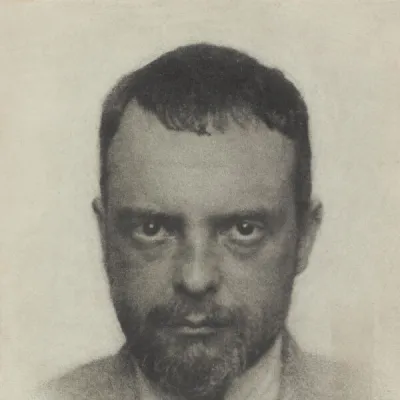
Paul Klee
Human Design Chart
Biography
Klee was a natural draftsman who experimented with and eventually deeply explored color theory, writing about it extensively. His lectures Writings on Form and Design Theory (Schriften zur Form und Gestaltungslehre), published in English as the Paul Klee Notebooks, are held to be as important for modern art as Leonardo da Vinci's A Treatise on Painting was for the Renaissance.
He and his colleague, Russian painter Wassily Kandinsky, both taught at the Bauhaus school of art, design and architecture in Germany. His works reflect his dry humor and his sometimes childlike perspective, his personal moods and beliefs, and his musicality.
Human Design Analysis: Paul Klee as Projector 4/6
Projector 4/6 — Design at a Glance
Paul Klee revealed himself as someone who focused his energy on the environment and often immediately recognized weaknesses in other people's systems. His Projector design gave him a dense aura that acted like a bright light beam: it illuminated areas in others that were still in darkness or not functioning properly. However, this ability to see flaws directly could be problematic when he addressed them head-on. Such direct 'illuminating' was often perceived as unpleasant by his surroundings and led to quick irritation from others, similar to shining a flashlight directly into someone's face.
The most effective strategy for Paul Klee therefore did not lie in active correction but rather in developing a harmonious radiance himself. By simply being pleasant and 'shining', he was automatically drawn to others; people came to him and asked about his insights. His success depended crucially on waiting for appreciative and sincere invitations, rather than taking the initiative himself. Additionally, his undefined Sacral Center lacked constant life energy. He experienced phases of high activity followed by necessary rest periods for regeneration to prevent burnout. If he lived according to this rhythm and invitation strategy, he was rewarded with success; ignoring these mechanisms led sooner or later to bitterness as an expression of not living his true self.
Emotional Authority
Paul Klee lived with an inner authority that was shaped by the defined Solar Plexus Center. This meant that his emotional wave always took precedence over all other defined centers in his design, regardless of further configurations. He was subject to a permanent up and down of emotions; the world appeared colored by his current mood at any moment. In one instance he could be totally enthusiastic, in the next view the same thing negatively.
However, this first emotional impression was only a snapshot, not necessarily his truth. Spontaneous decisions based on such an emotion often had negative consequences. Instead, Paul Klee showed the necessity of allowing time to pass. The longer he let a decision mature, the deeper and more comprehensive could he see. This required patience and multiple reconsiderations of questions. He took proper pride in asking himself repeatedly and waiting until intense feelings subsided.
Only then did he gain emotional distance. Clarity and calm set in, signaling that he had gone through the process. This mechanism was particularly important for long-term decisions that could have a significant impact on his life course. By waiting out the emotional wave movement, Paul Klee arrived at his true answer instead of being led by passing moods.
The 4/6 Profile — Opportunist / Role Model
Paul Klee revealed himself as someone who throughout his life oscillated between a deep desire for belonging and the need for detached wisdom. His design carried Profile 4/6, which created a specific inner tension: The heart yearned for connection while the head sought an overarching perspective. In the first three decades of his life, this configuration still appeared experimental and open, influenced by Line 3 energy within the profile. This led to intense, often trial-and-error relationships and friendships as the later maturity of Line 6 had not yet fully activated.
Over time, the conflict between wanting to be part of a community and the urge to withdraw to ponder the meaning of existence deepened. This dynamic made him vulnerable; the big heart of a 4/6er must always remain vigilant to avoid being hurt by false people. In later life, he was expected to take on the role of a wise role model through cooperation with others. His way of imparting knowledge was selective: valuable insights were deliberately made accessible only to a few while simultaneously radiating strong inspiration that encouraged others to believe in certain ideas. He sought justice and tried to control his emotional nature through clear conditions to ensure that connections were lasting and future generations could live in a sustainable world.
Split Definition — Defined & Open Centers
Paul Klees Design sets a tendency for constant mental pressure to question and develop concepts. His defined Head and Ajna Centers created a perpetual inner drive to understand things; this process, however, operated independently of direct action power.
The connection to his defined Throat Center allowed him to bring these mental processes into the world as communication, while his defined Heart Center provided willpower and control over his resources. Simultaneously, his defined Solar Plexus acted as an emotional authority that required decisions only after experiencing the full emotional wave.
This complex interplay contrasted with his open centers. His open G Center meant Paul Klee did not have a fixed identity or direction; he tended to find his place in his environment and wait for initiation by others rather than prescribe his own path. His open Sacral Center made him vulnerable to exhaustion, as he could absorb foreign energy but lacked his own generative power to set boundaries. Additionally, his open Root Center absorbed external stress, putting him at risk of combating pressure through overactivity.
His open Spleen Center led to feelings of insecurity and seeking safety from others rather than trusting spontaneous intuition. This configuration characterized a life that swung between intense mental creation and the necessity of waiting for emotional clarity as well as filtering external influences.
Channels for mental clarity, inspiration and genuine connection.
Paul Klees Design inclined towards analytical precision and inner stillness. His mind was constantly engaged in translating visual patterns into language and logically organizing them. The Acceptance Channel 17-62 connected the Ajna Center with the Throat Center through Gate 17 (Opinions) and Gate 62 (Details). This allowed him to mentally structure information based on substantial details. Everything he could fit into his internal image, he understood; what did not fit remained incomprehensible. This channel created a foundation for educational communication, where he formulated detailed visual impressions as theories or hypotheses to test their feasibility.
Simultaneously, there was a deep intuitive awareness. The Awareness Channel 61-24 connected the Head Center with the Ajna Center through Gate 61 (Secrets) and Gate 24 (Rationalizing). This was not about discovery in the traditional sense but rather processing inspiration. His mind would repeatedly think through thoughts until a moment of mutation or sudden knowledge—a Satori—occurred. This transformative knowledge broke old abstract cycles and inspired with new insights that emerged at their own pace. He sought stillness as his mind was continually occupied by the "white noise" of inspiration.
Emotionally, he was marked by a drive for connection and community. The Community Channel 37-40 connected the Solar Plexus Center and Heart Center through Gate 37 (Friendship) and Gate 40 (Solitude). This ensured tribal business through emotional clarity and willpower. He waited for the right invitation to become part of an organization and built bridges between individuals so that everyone found a place of honor in the group. Investments were not based on material values but on the needs of the community and mutual support.
Additionally, Gates like 11 (visual memory), 6 (friction/fertility), and 36 (crisis/development) shaped his perception through collective ideas, emotional waves, and cyclical developments.
Individual Circuitry — Circuit Signature
Paul Klees Design points towards inner clarity and structured communication. With split definition, there exist two independent energetic streams that are not directly connected but work as parallel forces. The first stream connects the Head Center to the Ajna Center through the Knowledge Circuit. Here, the Awareness Channel (Gates 24 and 61) promotes innovative flashes of insight. This area is about seeking new knowledge and transforming ideas, driven by a pulsing, creative energy.
The second stream links the Ajna Center to the Throat Center in the Understanding Circuit. Through the Acceptance Channel (Gates 17 and 62), logical thinking is put into words. This allows for sharing rational insights free from conditioning and guiding society towards a better future through focus and strategy. This connection emphasizes the sharing of knowledge as a visual, focused process.
Parallel to this, a third, separate stream operates in the Ego Circuit between the Heart Center and Solar Plexus Center. The Community Channel (Gates 37 and 40) regulates the balance between giving and taking. Since there is no connection to the Sacral Center, pauses are necessary to generate resources for cooperation and joint creation. This area promotes traditional support and material well-being through mutual aid, independent of the cognitive processes of other groups.
Right Angle Cross of Eden 4
Paul Klees Design legt eine Neigung zu einer tiefen, oft schmerzhaften Auseinandersetzung mit der eigenen Existenz und den Grenzen des menschlichen Schicksals fest. Diese Konfiguration, bekannt als das rechte Kreuz von Eden 4, beschreibt einen inneren Zustand, in dem die Suche nach Sinn und Wahrheit nicht als abstrakte Intellektualisierung stattfindet, sondern als unmittelbare, leibliche Erfahrung. Es handelt sich um eine Dynamik, bei der das Bewusstsein über den eigenen Platz im Kosmos eng mit dem Bewusstsein von Verletzlichkeit und Endlichkeit verbunden ist.
Diese Mechanik wirkt nicht als bloße philosophische Haltung, sondern prägt die Art und Weise, wie Paul Klee seine innere Welt strukturiert. Das rechte Kreuz von Eden 4 impliziert eine Konstellation, in der die Kraft des Geistes auf die Schwäche des Körpers trifft. Für ihn bedeutete dies, dass wahre Klarheit oft nur durch die Akzeptanz dieser Spannung erreicht werden kann. Es war keine Suche nach triumphaler Überwindung, sondern ein Prozess der Integration von Licht und Schatten, von Schöpfung und Zerfall.
Die Energie dieses Designs fordert eine ständige Balance zwischen dem Wunsch nach Ausdruck und der Angst vor der eigenen Zerbrechlichkeit. Paul Klee zeigte sich als jemand, dessen innerer Kompass auf diese dialektische Spannung ausgerichtet war. Die Mechanik des rechten Kreuzes von Eden 4 beschreibt einen Weg, bei dem die tiefsten Wahrheiten nicht durch Distanzierung, sondern durch das volle Erleben der menschlichen Bedingtheit zugänglich werden. Dies prägt seine Grundhaltung: eine ernste, fast sakrale Hingabe an die Aufgabe, das Unsichtbare sichtbar zu machen, ohne dabei die Schwere des Seins zu leugnen. Es war ein Design der tieferen Resonanz, nicht der oberflächlichen Anpassung.
Saturn Return · Uranus Opposition · Chiron Return · 2nd Saturn Return — Life Cycles
Paul Klees Design legt eine Tendenz zu zyklischen Verdichtungen fest, in denen innere Strukturen sich durch äußere Ereignisse konkretisieren. Dies zeigte sich bereits 1907, im Alter von 28 Jahren: Bei seinem ersten Saturn-Return wurde sein Sohn Felix geboren. Dieser Zeitpunkt markierte oft den Moment, an dem jahrelange Vorarbeit zu einem tragfähigen Ergebnis verdichtet – hier in Form einer neuen familiären Bindung.
Später, 1919, traf er im Alter von 40 Jahren auf die Galeristin Galka Scheyer. Dies fiel mit der Uranus-Opposition zusammen, einem Aspekt, der häufig plötzliche Begegnungen oder Veränderungen im sozialen Umfeld auslöst, wenn alte Muster brechen und neue Verbindungen entstehen. Die Begegnung war ein Wendepunkt in seiner beruflichen Vernetzung.
1928, mit 49 Jahren, trat Gropius als Direktor des Bauhauses zurück. Dies markierte Klees Chiron-Return, einen Erfüllungszyklus („Blüte“), in dem sich das eigene Inkarnationskreuz entfaltet und Sinn erfahrbar wird – vorausgesetzt, die Person lebt gemäß ihrer Strategie und Autorität. Es war kein Moment der Heilung alter Wunden, sondern eine Phase zunehmender Klarheit über seinen Lebenszweck.
Der zweite Saturn-Return 1936 (Alter 57) fiel auf die niedrigste Produktivität nach Ausbruch seiner Krankheit. Während dieser Zyklus oft zu weiterer Strukturierung führt, zeigte sich bei Klee hier die Belastungsgrenze seines Designs unter physischem Druck. Die Mechanik seines Charts bestimmt somit nicht nur kreative Phasen, sondern auch die Art und Weise, wie er Krisen und Übergänge durchlebte – stets eingebettet in diese astrologisch-human-design-spezifischen Zeitfenster.
Projector · Emotional Authority — Synthesis
Paul Klee war ein Projektor, dessen Leben von einer tiefen inneren Spannung zwischen dem Drang zu verstehen und der Notwendigkeit, die Welt durch eine emotionale Welle zu filtern geprägt war. Das definierte Head Center (mit Channel des Akzeptierens) schuf einen beständigen mentalen Druck, Muster zu erkennen und Details zu ordnen, während die emotionale Autorität bedeutete, dass Entscheidungen Zeit brauchten, um sich in der Tiefe zu entwickeln – ein Prozess, der von anfänglichen Begeisterungsstürmen bis hin zu kritischer Betrachtung reichte. Diese Kombination führte dazu, dass er stets auf der Suche nach dem zugrunde liegenden Sinn war und versuchte, ihn durch logische Analyse (Gate 62) und visuelle Wahrnehmung (Gate 17) zu erfassen.
Das Profil als Netzwerker/Rollenvorbild offenbart ein zentrales Paradox: die Sehnsucht nach Zugehörigkeit (Linie 4) kollidiert mit dem Bedürfnis, aus der Distanz zu beobachten und über größere Zusammenhänge nachzudenken (Linie 6). Diese innere Zerrissenheit zwischen Heart Center und Head Center prägte sein Schaffen. Die wiederkehrenden Belegungen in den Zyklen – Beziehungen, Karriere, Krisen – zeigten, dass er sich immer wieder mit dem Abwägen von Verbindungen und der eigenen Individualität auseinandersetzte, wobei die emotionale Welle seine Wahrnehmung und Entscheidungsfindung beeinflusste.
3 Defined Channels
Incarnation Cross - Right Angle Cross of Eden 4
Solar Return
The Solar Return shows the moment when the sun returns to its exact birth position - your personal solar year.
Life Cycles
Discover the life cycles with a detailed triple view (birth chart, cycle chart, composite).
Human Design Profile
- Type
- Projector
- Strategy
- Wait for the respectful invitation
- Authority
- Emotional Authority
- Profile
- 4/6 - Opportunist / Role Model
- Definition
- Split Definition
- Incarnation Cross
- Right Angle Cross of Eden 4
- Date of Birth
- 18.12.1879 04:00
- Place of Birth
- Münchenbuchsee, Switzerland
Frequently Asked Questions
What was Paul Klee's Human Design type?
What Profile did Paul Klee have in Human Design?
What Authority did Paul Klee have?
What incarnation cross did Paul Klee have?
When was Paul Klee born?
Discover your own Human Design
Are you also a Projector? Find out in a personal reading how to unfold your leadership qualities and recognize the right invitations.
More Personalities
Back to overviewSissy Spacek
Alain-Fournier

Anémone

Ann-Margret

Baekhyun

Balthus