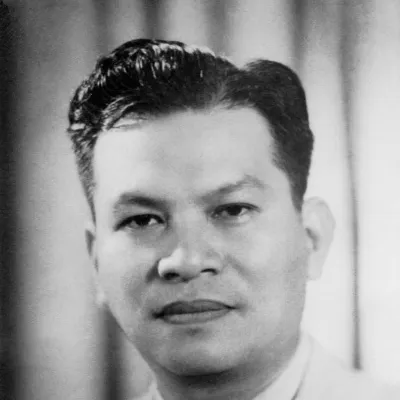
Ramon Magsaysay
Human Design Chart
Biography
He was the son of a farmer who became largely a self-made man. Magsaysay died in a plane crash on 17 May 1957.
Ramon Magsaysay as a Manifestor 1/3 in Human Design
Manifestor 1/3 — Design at a Glance
Ramon Magsaysay presented himself as a pioneer and visionary whose task was to lead the world into a new future. His design resembled that of an emperor in ancient Rome: He had the grand vision of an empire but did not wage wars himself; instead, he sent others to conquer foreign lands. This position often led to misunderstandings and polarization. While his far-reaching dreams captivated some who followed him, others rejected or even hated him because of these visions. To find his true followers, it was crucial for Ramon Magsaysay to inform others timely and precisely about his plans. This strategy of informing formed the core of his design. If he adhered to this path and trusted in his inner authority, his system rewarded him with a sense of inner peace. However, if he lived against this design, he felt instead a persistent, deep-seated anger within himself. Thus, his character was marked by the tension between visionary leadership and the necessity for clear communication, where the reaction of his environment strongly depended on its ability to accept or reject his pioneering role.
Emotional Authority
Ramon Magsaysay lived with emotional authority, meaning that his defined Emotional Center always served as an inner compass – independent of other defined areas in his design. He was subject to a natural wave of emotions that fluctuated constantly between highs and lows. The world appeared colored by his current mood: At one moment full of enthusiastic devotion, the next deeply skeptical.
This configuration required patience as a central tool. Since an immediate feeling was only a momentary reaction and not necessarily the deeper truth, spontaneous decisions based on emotion often had negative consequences. For Ramon Magsaysay, it was therefore crucial to take his time. He used the space between stimulus and response to let decisions mature. Often he would sleep over important choices until the initial emotional heat subsided.
Only when these waves calmed down and an emotional distance was gained did clarity and calmness set in for him. This process of delaying served not to hesitate but to achieve precision. Through waiting, he filtered out the transient mood from the enduring inner truth. This ability to arrive at final insight through patience shaped his way of making long-term life decisions and ensuring they were based on a stable foundation.
The 1/3 Profile — Investigator / Martyr
Ramon Magsaysay appeared as someone who not only collected knowledge theoretically but actively tested it in practical life. His design as an Investigator and Experimenter (Profile 1/3) established a fundamental attitude: Life was a continuous process of learning through trial and error. He combined the curiosity of a scientist with the hands-on mentality of an adventurer, where self-earned insights grounded his authority. When he chose a path, it had to pass both intellectual and practical scrutiny; thus, his judgment was based on tested experience.
This approach was shaped by specific energetic dynamics. The energy of Line 1 emphasized the need for pauses to strengthen willpower – similar to moon phases or digestion processes where recovery precedes new performance. At the same time, Line 3 demanded independence through self-generated talent. Here timing was crucial: Magsaysay had to wait until inner energy and enthusiasm were present to effectively bring in skills. A constant oscillation between planning-oriented Line 1, which could fear insufficient knowledge, and action-oriented Line 3, which wanted to learn from mistakes, characterized his path. His life demonstrated that true competence arises when theory and practice merge in a continuous cycle of testing and correcting.
Split Definition — Defined & Open Centers
Ramon Magsaysay was characterized by a persistent mental pressure to ask questions and conceptualize answers. His defined Head and Ajna Centers created a trustworthy, specific way of thinking; he was constantly engaged in a mental process that kept him under internal tension. This pressure did not serve to immediately implement ideas – as there was no direct energy connection to the motors – but rather to inspire others to reflect. His defined Throat Center allowed him to clearly communicate these concepts and thoughts into the world, making him an external authority on the mental field of his environment.
Parallel to this, Magsaysay had a defined Heart Center, which gave him willpower and the ability to fulfill promises. He controlled his resources himself and sought recognition for his contribution. However, this determination was embedded in a complex emotional landscape: His defined Solar Plexus acted as an inner authority. Magsaysay had to learn to trust the emotional wave and practice patience until clarity set in at the end of the cycle. Impulsive decisions on the highs or lows of this wave would have created chaos; instead, he used the seductive depth of his emotions to enter carefully considered agreements.
In contrast, his G Center, Sacral, Spleen, and Root Centers were open. The open G Center meant that Magsaysay did not possess a fixed identity or direction. He tended to blend with his environment and was dependent on initiation by others to find the right place and true love. Constantly asking “Who am I?” or feeling lost were typical pitfalls of this open center, which he faced rather than accepting as his own truth. His open Sacral Center made him vulnerable to conditioned energy uptake; he could easily become exhausted if running on borrowed vitality from others without learning to set boundaries or rest in time. Additionally, his open Root Center absorbed external stress, leading to a feeling of being overwhelmed when trying to release pressure that did not belong to him. His open Spleen Center made him sensitive to well-being and fears in his environment, making spontaneous decisions risky as they often relied on conditioned insecurity rather than inner wisdom.
Channels for community, clear insight and emotional change.
Ramon Magsaysay was characterized by a mental architecture that favored spontaneous insight over linear logic. The Channel of Awareness 61-24 connected his Head Center with the Ajna Center. This connection generated an individual thinking style: Inspiration from Gate 61 met rationalization in Gate 24, leading to sudden moments of knowledge – a Satori. His mind did not seek discovery through analysis but processed auditory impulses until mutation. He could not control his thoughts; knowledge entered when it fit. This gave him a mystical quality as he surrendered to the inner truth that emerged at its own pace.
Parallel to this, Channel 35-36 of Transience drove him. This emotional manifestor connected the Solar Plexus Center with the Throat Center. Gate 36, the Crisis Gate, felt inexperience as inadequacy and sought movement while Gate 35, the Change Gate, manifested a drive for newness. Magsaysay resisted restrictive patterns; he often created crises to set things in motion and gather new experiences. His advice to others was based on this restless search: to seize the moment when feelings are transient.
Social dynamics were shaped by Channel 37-40 of Community between Solar Plexus and Heart Center. This channel focused on proper agreements and bridging functions within a group. Gate 37 sought recognition in the whole, while Gate 40 did work but needed reward and rest breaks. Magsaysay understood that good deals took time to become emotionally clear and built connections based on mutual benefit and loyalty, not hierarchy.
Additionally, specific gates were at play: Gate 9 in the Sacral Center promoted detailed work and perfection through repetition; without energy fulfillment, depression threatened. Gate 16 enabled mastery through experimenting with new skills. Gate 31 transferred leadership as pure energetic transmission of power to others. Gate 62 established facts through logical pattern recognition and patience, while Gate 12 in the Throat Center produced creative mutation and poetic expression from emotional mood.
Tribal Circuitry — Circuit Signature
Ramon Magsaysay was someone who generated new insights through conscious intuition. His design connected his Head with Ajna Centers via Channel 24-61 (Awareness). This created a pulsating energy for creative flashes of insight and the ability to create entirely new knowledge by utilizing deviations from the known. This connection formed a clear stream of mental innovation.
Parallel to this, there existed a separate flow between Throat and Solar Plexus Centers via Channel 35-36 (Transience). Here it was about sharing emotional waves from the past. Ramon Magsaysay reflected on past experiences to find their meaning and passed these felt insights onto the collective so that lessons could be learned together. This cyclical energy did not directly exchange with his creative intuition but formed an independent sphere of emotional processing and communication.
A third, also separate area connected Heart and Solar Plexus Centers through Channel 37-40 (Community). This promoted a fair balance between giving and taking as well as mutual support within a group. As there was no connection to the Sacral Center, this resource creation required regular rest pauses for regeneration. These three circuits worked in Ramon Magsaysay as parallel, not directly connected forces: mental innovation, emotional sense-making, and cooperative support.
Right Angle Cross of Planning 3
Ramon Magsaysay displayed a fundamental attitude characterized by deep inner confidence. His Human Design indicated the impulse of the right cross of Planning Three, suggesting a natural orientation to understand life as a meaningful and well-thought-out process. This configuration promoted an approach where one does not swim against the current but adapts to the flow of things while always seeing the possibility that everything leads to good. It was an inner security that allowed him to pursue plans with calmness without being easily thrown off course by external obstacles. Ramon Magsaysay lived this quality by making decisions based on trust in his own direction rather than constant fear of mistakes. This kind of planning is not rigid control but a flexible orientation towards the larger whole, enabling him to maintain clarity even during uncertain times and find paths that were both practical and spiritually satisfying. The energy of this cross acted like a compass showing not only the destination but also making the path there seem enriching. Thus, a way of life emerged that combined efficiency with a fundamental acceptance of being.
Saturn Return · Uranus Opposition · Chiron Return — Life Cycles
Ramon Magsaysay's life was marked by clear structural turning points indicating internal maturation processes. His design suggested he took on new responsibilities at certain age stages, often with external events marking the completion of inner developments.
In 1933, at the age of 26, Magsaysay completed his studies in business administration. This coincided with his first Saturn Return, a cycle where years of groundwork and discipline consolidate into a solid result. For his design, this moment was proof of how he laid foundations that later supported his ability to act; the completion was not just academic but signaled the transition from preparation to active shaping of his role in the world.
Another crucial point occurred in 1946 when Magsaysay, at age 39, was elected as an independent member of the Philippine Congress. This coincided with the Uranus Opposition, a phase often requiring unexpected changes or breaking old patterns. His election highlighted how his design led him to break away from established structures and chart his own path rather than fitting into existing hierarchies.
The Chiron Return around age 50 marked the phase of fulfilling his incarnation purpose. In 1957, Magsaysay died in a plane crash. This time point concluded the cycle where his life theme fully unfolded; his death fell precisely during this period of highest expression and meaning of his design.
Manifestor · Emotional Authority — Synthesis
He was a Generator type whose life was marked by an inner necessity to initiate things and set them in motion – a visionary role (Manifestor) reinforced by defined Head and Ajna Centers. This constant mental pressure (Head-Ajna Channel) led to unceasing questioning, desire for understanding, and the development of insights that he then validated through experimentation (Profile 1/3). The ability to transform inspiration into rational answers (Awareness Channel) points to a deep inner wisdom always seeking expression and inspiring others. The right cross of Planning Three underscored this tendency to structure his knowledge and make it accessible for others.
Simultaneously, a tension field was revealed between the drive for innovation (Knowledge Circuit) and emotional authority. Decisions did not mature spontaneously but required time to filter through an emotional wave. This may have led to internal conflict as the quick inspiration of the mind encountered the necessity to feel things out calmly and weigh them. The experienced cycles – completing a study, entering Congress, passing away – showed how these two forces shaped his life: an unstoppable drive for progress always connected with deep emotional processing.
3 Defined Channels
Incarnation Cross - Right Angle Cross of Planning 3
Solar Return
The Solar Return shows the moment when the sun returns to its exact birth position - your personal solar year.
Life Cycles
Discover the life cycles with a detailed triple view (birth chart, cycle chart, composite).
Human Design Profile
- Type
- Manifestor
- Strategy
- To inform others before acting
- Authority
- Emotional Authority
- Profile
- 1/3 - Investigator / Martyr
- Definition
- Split Definition
- Incarnation Cross
- Right Angle Cross of Planning 3
- Date of Birth
- 31.08.1907 02:54
- Place of Birth
- Iba, Philippines
Frequently Asked Questions
What was Ramon Magsaysay's Human Design type?
What profile did Ramon Magsaysay have?
What authority did Ramon Magsaysay have?
What incarnation cross did Ramon Magsaysay have?
When was Ramon Magsaysay born?
Discover your own Human Design
Are you also a Manifestor? Find out in a personal reading how to use your initiation power peacefully and dissolve resistance.
More Personalities
Back to overviewChristian-Jaque
Kesha

Laurent-Eynac
Lucebert
Masaccio
Papus