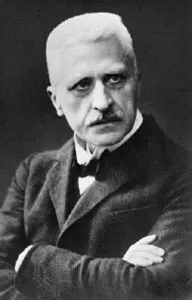
Rudolf Otto
Human Design Chart
Biography
Born in the town of Peine, Otto’s father owned a malt factory; however, in 1882, the family moved to Hildesheim where his father died. When he was 12 years old, he entered the Gymnasium Andreanum, and in May 1888, he enrolled at the University of Erlangen, ready to embark upon a study of theology. While he spent one semester at the University of Göttingen, a more liberal institution, he returned to Erlangen, and in 1892, he passed his first theological examination. Three years later, he passed his second exam and was awarded the degree of Licentiate of Theology, the equivalent of a Ph.D.
For the next eight years, Otto worked as an instructor and lecturer. In 1906, he was promoted to associate professor at Göttingen. He held the title of professor of systematic theology at Breslau in 1915 and Marburg in 1917. From 1913-18, he was a member of the Prussian Parliament, and in 1918, he was a member of the Constituent Chamber where he was a liberal and progressive influence. He founded and led the organization, "The Religious League of Humanity," which strived to bring justice between nations through moral and religious means. He took an extended journey to North Africa and Asia between 1911-12, and in 1927-27, he toured Asia and the Middle East.
As an adult, Otto was often sick. In March 1929, he took an early retirement, stating he was in poor health. In 1936, he fell from a tower at Stauffenberg near Marburg, in what may have been a suicide attempt. He contracted pneumonia during his recovery and died in Hamburg on 6 March 1937.
What does Generator 5/1 mean for Rudolf Otto?
Generator 5/1 — Design at a Glance
Rudolf Otto possessed enormous inner endurance and the capacity to consistently translate his visions into reality with great persistence. His Generator design laid the foundation for this strength: He had a lot of sacral energy that drove him like a robust workhorse – strong and tireless, as long as he was engaged in tasks that truly mattered to him. This energy, however, did not get released through self-initiative but responded to signals from the outside world. The motto was clear: Do not start things on his own initiative, but wait until life sent an invitation and his inner self answered with a clear "yes."
If Rudolf Otto lived in harmony with this strategy of reacting, his system rewarded him with a deep sense of fulfillment. If he, however, went against this natural flow – for example by compulsively initiating things or getting involved in activities that did not resonate with him – it inevitably led to frustration and energy loss. Especially dangerous were two pitfalls: On the one hand, constantly doing without inner consent, which eventually led to exhaustion; on the other hand, interrupting his heart projects when he was still full of energy. His true strength thus always showed itself when he acted from his gut feeling and used his endurance only where his inner self drove him to do so.
Sacral Authority
Rudolf Otto demonstrated decision-making based on direct physical feedback. As a Generator, he possessed sacral authority, meaning his strategy and inner guidance were identical: He waited for an impulse from outside before reacting. This mechanism greatly simplified his process since no abstract analysis was necessary but rather an immediate physical response.
His inner voice manifested not as mental judgment but as a physical reaction – a surge of energy or a sound like a grunt or hum from the abdominal area. These signals originated from the defined Sacral Center and served as a reliable compass. When this motor kicked in, he felt vital and energized, enabling him to pursue tasks with great enthusiasm and without compulsion.
A crucial factor for this clarity was his open Emotional Center. Since it was undefined, no temporary mood could override or cloud the clear message of the Sacral Center. This protected his decision quality from emotional instability. Additionally, an activated Spleen Center acted as a supportive instance. It gave him quick, instinctive access to his physical well-being and enabled spontaneous reactions. Rudolf Otto could thus rely on this combination of sacral drive and spleen-based intuition, helping him move through life with joy and satisfaction and fully immerse himself in his tasks.
The 5/1 Profile — Heretic / Investigator
Rudolf Otto's Design as a 5/1 Profile set a specific dynamic: He was someone who went through deep, inwardly closed research processes (Line 1) to develop solutions that were magnetic for others and sought after by them (Line 5). This configuration described a person whose internal work rhythm was geared towards thorough contemplation and the observance of pauses before acting. Gate 52 in Line 1 emphasized the necessity of this silence and concentration; an early release of his energy would have led to wasted time. At the same time, his external appearance, marked by the projecting qualities of Line 5 (Gate 46), often created expectations among his environment for crisis solutions or expert knowledge. Others instinctively sought answers from him, which put him in the position of having to set clear boundaries so as not to be exhausted by inquiries. His success depended on finding the right timing rhythm: long phases of isolated research for himself followed by targeted sharing of what he had learned. When he learned to also say no at times, he could maintain the balance between his private knowledge accumulation and public problem-solving. The pressure to commit always stood in tension with the necessity of allowing the consequences of his actions to unfold rather than reacting impulsively.
Single Definition — Defined & Open Centers
Rudolf Otto's design points to a tendency towards firm self-determination and inner direction. His defined G Center gave him a reliable identity and the sense of his own mission, allowing him naturally to guide others into new directions without being dependent on them. Enhanced by the defined Heart Center, he had clear willpower; he determined his life himself, kept promises, and sought recognition for his contribution. As a Generator with a defined Sacral Center, he was guardian of an enormous energy source. His strategy consisted of not initiating but waiting until life asked him to respond with full sacral power – which brought him deep satisfaction and endurance in his tasks.
This stable inner core contrasted with his open centers, making him vulnerable to external conditioning. His open Head Center lacked a constant source for inspiration; he tended to engage with the questions and doubts of others or to unwind mental pressure rather than trusting his inner authority. Similarly, his open Ajna Center: He could easily take on concepts and opinions but risked holding these as his own truth or pretending to be more certain than he actually was.
Emotionally and communicatively, he was also open. His open Solar Plexus Center absorbed the emotions of the environment; he could amplify others' moods and personalize them, which led him to avoid confrontations to maintain stability. His open Throat Center drew attention when he waited, but in non-self mode, he often tried actively to be heard, leading to unpredictable speaking. Furthermore, his open Spleen Center was prone to survival fears; he tended to hold onto things that did not serve him just to feel the false sense of security from defined spleens in his environment. Finally, his open Root Center absorbed others' stress, which put him into a cycle of adrenalized pressure waves and attempts to release them through overactivity.
Channels for rituals, extremes, competition and universal love.
Rudolf Otto revealed himself as someone deeply rooted in the natural flow of life, embodying a paradoxical tension between unchanging habit and extreme swings. This fundamental stance stemmed from the Rhythm Channel 5-15. He combined the firm, almost ritualistic routines of Gate 5 with the universal attraction of Gate 15, integrating extremes into the stream of life. For Rudolf Otto, timing was not a matter of whim but a magnetic logic that propelled him and his surroundings forward as long as he did not interrupt his inner rhythm.
Simultaneously, a powerful dynamic of individuation through the Initiation Channel 51-25 came into play. Here, the competition-fostering shock of Gate 51 merged with the universal love of the Higher Self from Gate 25. Rudolf Otto was not only predisposed to grow through transformative "shocks," but also to enable this initiation for others—always at their invitation. This channel drove him to test the limits of his endurance, developing a mystical uniqueness that strengthened the collective.
Additionally, Gate 46 shaped his attitude through full dedication and nurturing the body as a temple; success came from engagement in the here and now. Gate 52 required silent concentration for pattern correction, while Gate 58 in the Root Center provided pressure to perfect processes and experimentally optimize them. Gates 1 and 2 rounded out his Profile: Gate 1 emphasized his creative mutation and individual creativity at the right moment, while Gate 2 ensured receptivity to new evolutionary directions. Together, these energies formed a being that operated through rhythmic stability, initiatory depth, and precise pattern recognition.
Individual Circuitry — Circuit Signature
Rudolf Otto's design established a tendency towards more stable and courageous individuality. He was someone with strong inner convictions and deeply rooted self-esteem, clearly perceiving his own identity. This attitude stemmed from his Simple Definition: the Sacral, Identity, and Heart Centers formed one continuous energetic group.
The Projector Circuit was active here through Channel "Initiation," connecting the Identity Center to the Heart Center. This promoted a pulsating, creative sense of self in the present moment. However, since there was no connection to the Throat Center, these firm convictions often remained difficult to express in words; the inner clarity did not necessarily find external expression.
Parallel to this, the Reflector Circuit operated through Channel "Rhythm," which linked the Identity Center with the Sacral Center and brought focused, rational energy aimed at improving things through logic and structure. Since both circuits utilized the Identity Center, the intuitive, self-esteem strengthening power of the Heart merged with strategic, future-oriented reasoning. Rudolf Otto lived in a unity of deep self-confidence and clear-mindedness, where energies were always directed towards his own individuality and its affirmation rather than external communication or emotional expression forms.
Left Angle Cross of Healing 2
Rudolf Ottos Human-Design profile featured the left Healing Cross 2, implying a specific internal tension and a clear focus on what is essential. This configuration did not describe a general life philosophy but rather a mechanical tendency: the ability to organize or 'heal' complex or confusing situations through deep, often intuitive insight, returning them to their original functional state. It was less about medical intervention than restoring clarity and meaning where chaos or confusion reigned.
For Rudolf Otto, this meant that his internal compass was aligned with separating what is essential from the inessential. The mechanics of this cross are often seen in moments when a person creates order through mere presence or specific understanding of a situation. It's a pattern of precision and penetrating illusion. Rudolf Otto lived with this inner architecture, which inclined him to seek the deeper truth behind surface phenomena and then articulate or live out that realization so clearly it became comprehensible to others. This was a path of clarification, not just information. The energy of this design influenced how he perceived and reacted to his environment: with a drive for authenticity and an aversion to superficial or false representations. It shaped the way he saw the world and found his place in it.
Saturn Return · Uranus Opposition · Chiron Return · 2nd Saturn Return — Life Cycles
Rudolf Ottos Human-Design profile indicated a tendency towards structured, constructive work that crystallized into clear career milestones. This development was evident as early as his first Saturn Return in 1898: At age 29, he earned his Licentiate of Theology (Lic. theol.), a step that built on years of groundwork and laid the foundation for his further career.
His life task configuration called for continuous development and taking on new positions of responsibility. This became evident in 1906 during his Uranus Opposition at age 37, when he was appointed extraordinary professor at Göttingen – a moment of transformation that institutionalized his professional recognition.
The Chiron Return marked the phase of blooming and fulfillment of his incarnation purpose. Rudolf Otto moved to Marburg University in 1917 at age 48. This step was more than just a physical relocation; it expressed an increasing unfolding of his inner potential into external life, with his work finding a new, meaningful framework.
The consolidation of this phase occurred during his second Saturn Return in 1926. At age 57, Rudolf Otto delivered the Olaus Petri Lectures at Uppsala University. Here was the result of a long journey: earlier work had condensed into established authority that was now internationally recognized and taught. His design thus marked clear phases of building up, affirmation, and mature communication of his knowledge.
Generator · Sacral Authority — Synthesis
Rudolf Otto was a Generator whose life was characterized by a deep, sacral drive. The constant energy source (Sacral Authority) seemed to destine him for activities that brought joy and connected him with the flow of life – so long as he wasn't hindered by external expectations or internal doubts. His profile as Hero/Researcher (5/1) suggests that he accumulated knowledge and made it available to others, where the process of learning itself was a central part of his vitality. The defined G Center confirmed a firm self-identity and a natural urge to support others in their direction, which showed in professional stations (career events).
A central paradox lay in the tension between his need for deep immersion into work – fueled by the Rhythm Channel – and the accompanying pressure to be available as a source of knowledge for others. The connection of Sacral Center and Identity Center in the Focusing Circuit pointed to strong inner conviction, yet the profile challenged him simultaneously to set boundaries and protect himself from potential burnout. This oscillation between giving from abundance and the risk of energy loss shaped his path.
2 Defined Channels
Incarnation Cross - Left Angle Cross of Healing 2
Solar Return
The Solar Return shows the moment when the sun returns to its exact birth position - your personal solar year.
Life Cycles
Discover the life cycles with a detailed triple view (birth chart, cycle chart, composite).
Human Design Profile
- Type
- Generator
- Strategy
- To respond - wait for something to respond to
- Authority
- Sacral Authority
- Profile
- 5/1 - Heretic / Investigator
- Definition
- Single Definition
- Incarnation Cross
- Left Angle Cross of Healing 2
- Date of Birth
- 25.09.1869 11:00
- Place of Birth
- Peine, GER
Frequently Asked Questions
What was Rudolf Otto's Human Design type?
Which Profile did Rudolf Otto have?
What Authority guided Rudolf Otto?
What incarnation cross did Rudolf Otto have?
When was Rudolf Otto born?
Discover your own Human Design
Are you also a Generator? Find out in a personal reading how to use your sacral energy correctly and discover deep satisfaction.
More Personalities
Back to overviewAaliyah

Alexia

Angèle

Anne-Marie

Arcángel
Arno