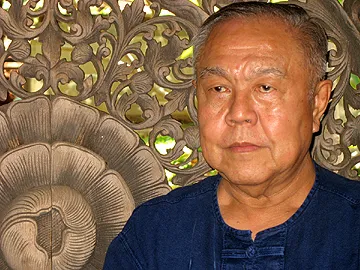
Photo: Wikimedia Commons
Sulak Sivaraksa
Human Design Chart
Biography
Sulak Sivaraksa studied in Wales as well as in England and graduated as a lawyer in London. The military coup of 1976 forced him into exile for two years. During this time, he gave numerous lectures in Europe, Canada, and the United States. He also used the time for further studies at the Social Science Research Council in New York City. The contacts of that time proved important when international protest came to his aid in 1984 and shortened his stay in Thai detention, imposed on him for allegedly insulting the king. Exiled again in 1991, Sulak finally managed to be a free man in his own country again in 1995 after a lengthy journey through the courts.
Shortly before "Coronation Day" on 5 May 2007, another case was dropped for imputed lese majeste, which dated back to the reign of Thaksin Shinawatra, whom he attacked very directly in public. On the evening of 6 November 2008, Sulak was arrested anew for lèse majèsté.
Sulak Sivaraksa is a moral authority among his country's intellectuals and among international bodies, but also an enfant terrible of Thai politics because of his gripping logic and sometimes uncompromising conclusions. He has been instrumental in the establishment of several Thai and international NGOs, associations, foundations and initiatives, and is a welcome advisor and speaker at congresses and universities in several Asian countries as well as in Europe and the United States, where he has also held temporary visiting professorships (including Berkeley and Harvard).
Sulak Sivaraksa — Generator with Profile 3/5
Generator 3/5 — Design at a Glance
Sulak Sivaraksa revealed himself as someone whose work was based on a deep, inner resonance. His design inclined him not to plan or initiate from the head but to wait for what would reach out to him from the outside. As a Generator, he had a lot of sacral energy, making him extremely strong and enduring – comparable to a workhorse that has power as long as it burns for the task. This energy was only released when he responded to impulses. The motto was clear: not to initiate but to react.
His most successful strategy was to listen to signals from life and act as soon as his inner self gave a clear 'yes'. Acting this way, from the gut, led to deep satisfaction and a sense of fulfillment. If he tried to go against this rhythm – by doing things that didn't interest him or being prevented from working on his heart project while he was still full of power – frustration and a lack of energy threatened. The danger lay in wasting energy or holding himself back when the inner drive was still present. Sulak Sivaraksa's strength, therefore, showed itself where he allowed life to set him in motion and then responded to it with all his endurance.
Emotional Authority
Sulak Sivaraksa revealed himself as someone who never made decisions immediately but consciously let them rest until the emotional wave had subsided. His design carried Emotional Authority, meaning that the defined Solar Plexus Center always took precedence over all other defined centers – a firm rule, regardless of further configurations in the chart.
This authority is subject to a constant up and down of emotions. The world is always filtered through the current mood: one moment can be marked by enthusiasm, the next by deep skepticism. Sulak Sivaraksa recognized that a feeling in the moment is only a snapshot, not yet the truth. Quick, spontaneous decisions made in this emotional heat could have negative consequences, as the first impression is often misleading.
Instead, he used time as a tool. By hesitating and reconsidering decisions multiple times, the intense feelings gained distance. Only when the emotional wave subsided did clarity and calm set in. This process was particularly crucial for long-term, life-defining decisions. Only through this patience and waiting for emotional distance could he gain deeper, more comprehensive insights that were not distorted by passing moods.
The 3/5 Profile — Martyr / Heretic
Sulak Sivaraksa revealed himself as someone who did not accept knowledge from afar but gained it through his own, often painful, experimentation. His design as a 3/5 Profile, the Explorer and Hero, inclined him to this attitude: he believed nothing until he had experienced it himself. This Line 3 of the Explorer required trial and error to develop real understanding. Shortcuts were worthless to him, as they neglected important details. Instead, he learned from failures and detailed work until he had a solid foundation.
This self-acquired knowledge then became the basis of his role as a Hero (Line 5). He presented his practical experiences to others who wanted to learn from his insights. This attractiveness of his life experience flattered him, but also carried the risk of public failure. At the same time, he had to carefully weigh his energy. The mechanics of his 58.5 Line challenged him not to be distracted by temptations and to maintain his protective instinct. He only offered his strength for practical solutions, defended what he considered right, and remained responsible towards the collective without losing himself in the role of the attacker. His path was marked by the necessity of finding truth through his own experience and then passing it on as salvaging knowledge.
Split Definition — Defined & Open Centers
Sulak Sivaraksa revealed himself as someone driven by a deep, constant inner source of energy that manifested in a clear self-identity and a firm sense of direction. His defined G Center provided a reliable inner orientation, while the defined Heart Center gave him the willpower to determine his own resources and keep promises he could fulfill. This combination created a person who not only knew who they were but also had the strength to assert this identity in the material world and take responsibility for their environment.
At the same time, his design was marked by a complex mental dynamics. The definition between Head and Ajna Centers created a constant pressure to question and understand connections. This mental process was not impulsive but followed its own logic, which did not have direct energy for implementation. Instead, this mind served to inspire or pressure others to think for themselves. The connection from Ajna to Throat allowed him to clearly articulate these conceptual thoughts and theories, making him an external authority in the mental field of his environment.
Especially notable was the integration of emotion and existence. The defined Solar Plexus Center challenged him to make decisions not in the moment but to wait for the emotional wave to clarify. This aligned with the defined Spleen Center, which gave him a spontaneous, intuitive sense of health and well-being in the "now." While the mind conceptualized and emotions matured, the Spleen provided immediate, intuitive truth. The defined Root Center finally provided the necessary stress to push this entire process—from inspiration through emotional maturation to intuitive action—forward and anchor it in the world. Sulak Sivaraksa was thus a system that united mental inspiration, emotional depth, and existential intuition in a constant, willful structure.
Channels for intimacy, focus, logic, pioneering spirit, community and abstraction.
Sulak Sivaraksa showed a fundamental disposition of deep, patient connection, paired with a sharp, corrective look at existing structures. His design tended to build relationships and communities not spontaneously, but through careful, temporal maturation, while simultaneously questioning patterns to perfect them.
This dynamic rooted in Channel 59-6, linking sacral sexuality with the emotional wave of Gate 6. Here intimacy emerged as a powerful but time-intensive resource that required waiting to gain clarity. This was complemented by Channel 52-9, creating a calm, focused energy between the Root and Sacral Centers. This formative energy allowed for precise evaluation of details and filtering out distractions to logically penetrate patterns.
His intellectual approach was shaped by Channel 17-62, translating visual patterns (Gate 17) into detailed language (Gate 62). This allowed for continuous organization of information in the mind to create a coherent worldview. Simultaneously, Channel 58-18 acted as a driving force for correction. The vitality of Gate 58 was guided by the corrective sense of Gate 18, generating an insatiable urge to identify errors and improve systems – always, however, only upon invitation to avoid resistance.
The motivation for this came from Channel 51-25, linking competitive ego energy (Gate 51) with the universal love of the Higher Self (Gate 25). This promoted individualization and courage to transcend boundaries. In interpersonal space, Channel 37-40, connecting friendship (Gate 37) with the need for solitude (Gate 40), worked to create stable agreements and find one's place in the whole based on mutual benefit and emotional depth.
Mentally, Channel 64-47 linked confusion (Gate 64) with comprehension (Gate 47). This generated an active, experience-based mind constantly seeking stories and meaning, yet unable to serve as an inner authority for personal decisions. Additional nuances were provided by Gate 42 (sacral power, completion), Gate 26 (innovation in the tribe), Gate 41 (evolutionary feeling), and Gate 13 (collective memory), underlining his ability to reflect and carry continuity.
Collective Circuitry — Circuit Signature
Sulak Sivaraksa showed a foundational stance rooted in inner strength and clear identity. The Projected Self-mirror circuit connected his Identity with the Heart Center, linking self-worth and personal convictions directly. This fostered a bold, individualistic presence, even though the missing connection to the Throat Center often made it difficult to outwardly express these firm stances.
Parallel to this, two separate, unconnected energy blocks were at work. On one side, the Understanding circuit linked the Ajna with the Throat Center, as well as the Sacral with the Root and Spleen Centers. This enabled the sharing of logical, rational insights for the betterment of the future, free from emotional coloring. On the other side, the Meaning circuit linked the Head with the Ajna Center. Here, it was about reflecting on past experiences and finding meaning in history to learn collectively from it.
Additionally, the Ego circuit, through the connection of Heart and Solar Plexus Centers, fostered an awareness of mutual support and the balance of giving and taking within a community. The Protector circuit finally linked the Sacral and Solar Plexus Centers, emphasizing instinctive care and the protection of one's genetics or family. These configurations created a profile oscillating between rational future orientation, emotional past reflection, and the protection of the near, with the shared definition making these areas appear as parallel existing but not directly flowing forces.
Right Angle Cross of Service 1
Sulak Sivaraksa demonstrated a fundamental orientation based on service to others and larger contexts. His design indicated a tendency not to define himself primarily through personal assertions of significance, but rather through what he contributed to his environment and community. This alignment corresponds to the mechanics of the 'Right Cross of Service,' a configuration that focuses on selflessness and support.
People with this structure often feel a deep connection to the well-being of others. Their motivation comes less from a desire for individual power or control, but rather from the desire to bring order, help, or clarity into the lives of their fellow beings. It is an energy that works in the background, stabilizing structures and providing resources, without necessarily being in the spotlight.
For Sulak Sivaraksa, this meant that his actions were likely always guided by the question of how best to support and serve. This inner logic shaped his way of interacting with the world: not as a dominant individual, but as an integral part of a whole held together by mutual aid and responsibility. The energy of this cross fosters a stance of humility and engagement, where the value of a person is measured by their contribution to the common good.
Saturn Return · Uranus Opposition · Chiron Return · 2nd Saturn Return — Life Cycles
Sulak Sivaraksa's life path was marked by recurring, profound crises that fundamentally changed his position in the world. This instability was not random but reflected the dynamics of his design, which responds to external upheavals.
In 1976, at the age of 43, during the Uranus opposition, he was forced into exile for two years. Uranus represents sudden, unexpected breaks and liberating shocks; this opposition marked a point where old structures could no longer hold and a radical reorientation was forced.
Ten years later, in 1984, the Chiron return occurred. At 51 years old, international protests helped shorten his imprisonment in Thailand. In Human Design, this cycle signals the bloom phase, where the inner purpose unfolds if one follows their strategy. Here, it showed how external support and inner clarity worked together to overcome a difficult life phase and clear the path for the realization of his mission.
In 1991, at the age of 58, during the second Saturn return, he was again forced into exile. Saturn represents structure, limits, and the burden of responsibility. This cycle often brings a renewed testing of one's foundations. The return to exile underscores that Sulak Sivaraksa's design required a constant confrontation with authority and freedom, where each crisis offered a chance to deepen his own truth.
Generator · Emotional Authority — Synthesis
A central red thread in this Human Design chart is the deep connection between creative energy and service to others. The sacral energy of the Generator (Design View) is channeled through the Pairing Channel (Channels/Tor) into intimate relationships and potentially fruitful connections. This energy finds expression in the Centering Circuit (Circuit), which fosters strong convictions and a strong self-worth – an inner stability that is then used to pass on knowledge and experiences through the Line 5 of the Profile (Profile Role). The repeated crises triggered by Uranus oppositions, Chiron returns, and Saturn returns (Cycles) do not suppress this energy but refine it through exile and imprisonment, intensifying the necessity to place one's knowledge and strength in the service of others.
The design reveals a central paradox between the need for emotional clarity and the pressure to constantly inspire. Emotional authority (Authority) requires time and maturity in decision-making, while the defined Head Center (Centers) generates a constant mental pressure to answer questions and provide inspiration. This contradiction is amplified by the Profile of the Explorer/Hero (Profile Role): the constant testing of new paths (Line 3) contrasts with the expectation to offer solutions as a hero (Line 5). A tension arises between the inner need for emotional authenticity and the outer role of an inspiring mediator.
7 Defined Channels
Incarnation Cross - Right Angle Cross of Service 1
Solar Return
The Solar Return shows the moment when the sun returns to its exact birth position - your personal solar year.
Life Cycles
Discover the life cycles with a detailed triple view (birth chart, cycle chart, composite).
Human Design Profile
- Type
- Generator
- Strategy
- To respond - wait for something to respond to
- Authority
- Emotional Authority
- Profile
- 3/5 - Martyr / Heretic
- Definition
- Split Definition
- Incarnation Cross
- Right Angle Cross of Service 1
- Date of Birth
- 27.03.1933 14:27
- Place of Birth
- Bangkok, THAI
Frequently Asked Questions
What is Sulak Sivaraksa's Human Design type?
What Profiles does Sulak Sivaraksa have in Human Design?
What Authority guides Sulak Sivaraksa?
What incarnation cross does Sulak Sivaraksa have?
When was Sulak Sivaraksa born?
Discover your own Human Design
Are you also a Generator? Find out in a personal reading how to use your sacral energy correctly and discover deep satisfaction.
More Personalities
Back to overviewAaliyah

Alexia

Angèle

Anne-Marie

Arcángel

Arno